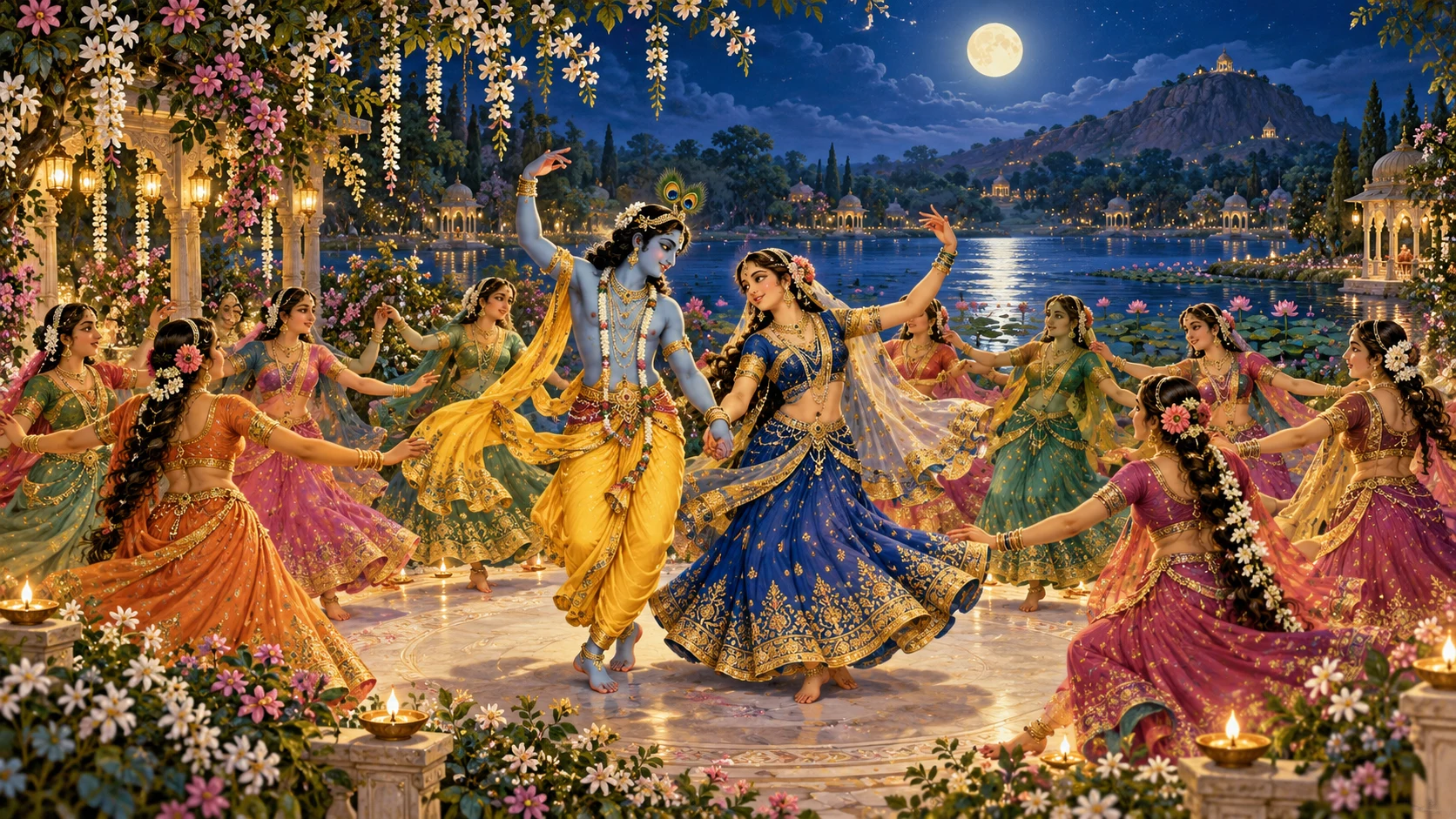
When the dance on the wheel was over, Krishna led the gopis to the bank called Anangollasa-ranga. The Yamuna had washed the sand with lily-scented waves. Moonlight fell on it. The gopis joined hands around Radha and Krishna like stars gathered around the moon and the constellation Vishakha.
Krishna put His arms on the gopis’ shoulders and danced with them. Kaviraja pictures Him in many forms, like a dark cloud amid streaks of lightning. At other moments He danced alone and moved so swiftly that each gopi saw Him at her side. His flute and their voices mingled with bangles and ankle bells to the beat of their feet.
The sakhis sounded the seven notes sa, ri, ga, ma, pa, dha and ni separately. Kaviraja distinguishes songs in fixed forms from songs that unfold freely. He names the three tonal systems shadja, madhyama and gandhara, twenty-two shrutis, forty-nine melodic runs and twenty-one murchhanas. Among the forms they sang were full modes of seven notes and modes with six or five.
The poet goes on to name the tunes, among them Mallara, Karnataka, Kedara, Bhairava, Gandhara, Shri, Gauri, Todi and Lalita. Vrinda handed the dancers instruments of several kinds. There were mridangas and damarus, the murali and vamshi flutes, cymbals and stringed instruments such as the vina, vipanchi and kachchhapi.
The dancers’ hands made the shapes of a banner, a goose’s or parrot’s head, a half-moon, a lotus bud and a snake’s fang. They clapped out patterns, changing from quick to medium and slow tempos and keeping time even where the beat made no sound. Among the patterns Kaviraja lists are Dhruva, Mantha, Eka-tala, Triputa and Tribhangi. Out of this abundance, Krishna and the gopis made one continued dance and song.