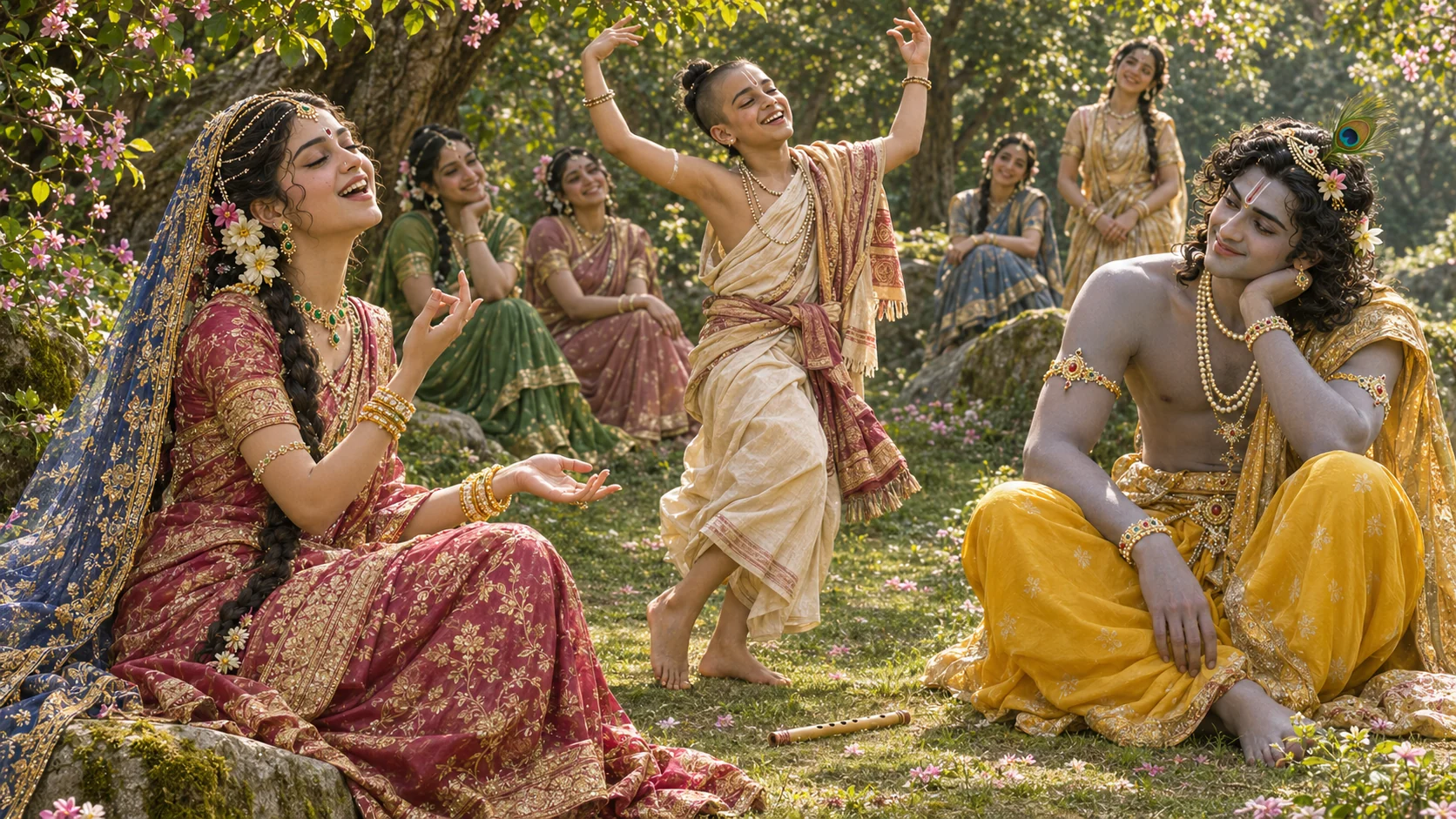
At the spring festival, the gopis quietly agreed to take Krishna’s flute. The flute’s sound overshadowed even their most accomplished singing. Krishna kept it in His hand, and they could find no opening to take it. They whispered among themselves and turned to Radha for help. They asked Her to pretend to resist Him briefly, hoping to distract Him from playing. Kusumasava did not know their whole plan, but he told Krishna that they wanted the flute.
He offered to keep it for Krishna while Krishna sang. As a brahmana, he was confident that the gopis would not dare approach him. Krishna playfully recalled his feats at the spring festival, then asked what he would do if they took it anyway. Kusumasava took the flute, tucked it under his arm, and invited Krishna to sing. Krishna began singing in the charchari rhythm, with a voice the poet sets above the vina. The Yamuna grew still, and drops like tears appeared on the trees and creepers. The deer licked the drops running by one another’s ears as though tasting the sweetness of the song.
Kusumasava boasted that the gopis could not sing like his friend. Sangitavidya pointed to Lalita in her silk garment and proposed the flute as the stake if she sang better. Kusumasava was sure he could judge, and Sangitavidya teased him by saying this kind of singing was different from Vedic recitation. Krishna kept singing with a smile and signaled to him with a glance. Kusumasava proposed seeing whether their singing would also move the river, trees, birds, and animals. He asked the gopis to put up Radha on their side. Lalita replied that this would be like weighing glass against gold. If he wanted equal stakes, she added, he should offer his own friend. Kusumasava agreed.
Lalita began raga Kedara, and her eyebrows moved expressively as she sang. She moved through three vocal registers with varied gamakas, or melodic ornaments. With her command of gandhara-grama, the poet says, she humbled the celestial musicians. After the free opening, known as the alapa, she sang in measured time in the Shauraseni Prakrit language. In the song, dark Krishna was a moon who opened the lotuses and stirred the ocean of love. He wore mango buds on His head and delighted in spring play with His beloved companions in Vrindavan.
As soon as Lalita finished, Kusumasava raised his arms and danced, shouting that she had lost. The flute fell from under his arm. Sangitavidya saw it, hid it quickly, and kept the news even from her companions. She told him to let his friend decide who had won. Kusumasava still argued that the wager concerned charchari, while Lalita had sung a passage in the dvipadika rhythm. The two friends laughed. Sangitavidya drew attention to the notes, their arrangement, and the movement of the voice. She then pointed to the trees. The song had melted their stone basins, and the water had hardened into seats around the trunks.