The play opens by glorifying Radha and Krishna. The first verse calls down the blessing of Radha’s glance at the moment Madhava bars her way. Tears glisten on her lashes, the corners of her eyes are tinged with red, and a hidden smile shows through her glance. Radha draws her gaze back for a moment, then looks sideways at Krishna. Pride, longing, fear, anger, jealousy, tears, and a smile gather in that glance like flowers in a bouquet. The next verse celebrates Radha’s love for Krishna, the conqueror of Mura. However vast it already is, that love goes on growing. Her love plays with indirect words and gestures and remains pure. Every moment lends a fresh sweetness to the beauty Radha already knows.
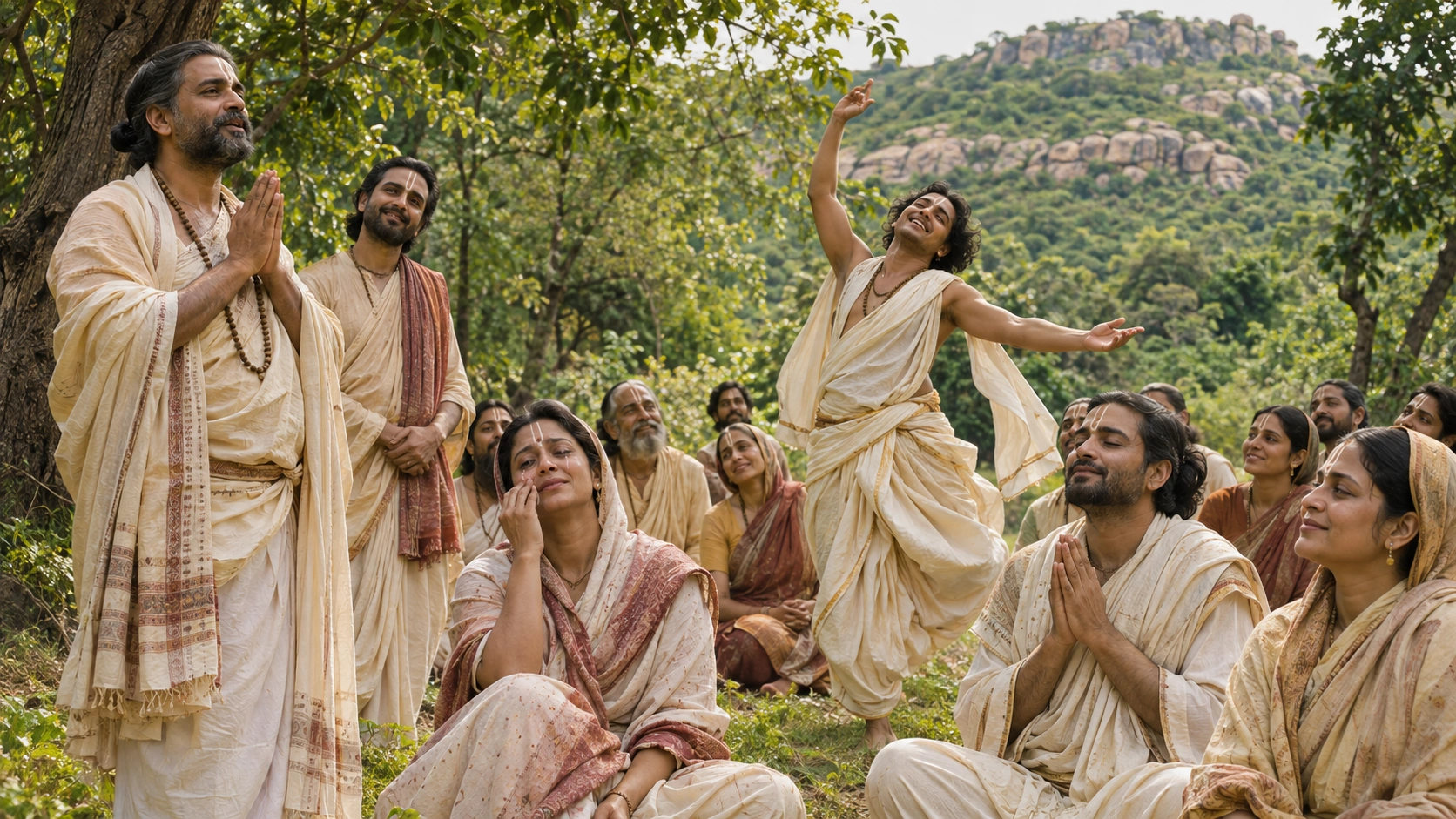
After the blessing, the director looked around. Devotees had gathered at the foot of Nandishvara, deeply moved by his opening words. One danced, his hair standing on end with joy. Another, overcome with longing, grew pale, as though his heart were breaking. A third cried out and ran. Someone fell and remained motionless. The director marveled that the thought of Achyuta’s pastimes could carry away even the most composed among them.
After reflecting, the director said he understood the reason for their excitement. Intense love for Krishna had awakened in the gathering. He likened the depth of the devotees, their steadiness, and their devotion to Hari to the deep ocean with its firm shores. Yet just as the ocean stirs at moonrise, they cannot hold back their excitement when love awakens in full force. The director looked again, shook his head, and composed himself. He said the playful dispute between Radha and the cowherd chief’s son had a sweetness of its own. When their loving dispute reaches the ears even of sages who find joy within themselves, it becomes sweeter to them than nectar.
The actor then entered joyfully. The art they were about to see, he said, shone like a well-ordered kingdom. The play rested on seven strong elements, just as a kingdom has a ruler, minister, ally, treasury, territory, fortress, and army. In the short form the opening and closing came to the fore. Its speech and the grace of its performance added to its beauty. The director praised the actor’s knowledge of dance and drama. He confirmed that, at the request of friends, he would present Dāna-keli-kaumudī, a short play of the bhāṇikā form. Before the action began, he said, he would remember his beloved Lord and ask for a blessing.
With palms joined he glorified the Lord, whose name draws those who taste spiritual sweetness. Through His deeds, he said, the Lord delights Nanda and kindles lasting joy in the devotees. The sight of His beauty becomes a celebration, and His form is eternal. The words for form and eternity also echo the names Rupa and Sanatana. The actor asked the director to see how his music in the Gandhara mode had entranced the connoisseurs. They listened like deer that had forgotten everything around them.
The director likened the play to a powerful sacred art whose song was adorned with grace. Its auspicious opening would delight the one who knew that sweetness, he said. His words also anticipated the sakhis. “Nandimukhi” could point to the opening blessing or to the friend herself, and Gandharvika was Radha, accompanied by Lalita. A voice from behind the stage praised the director. That day Nandimukhi would announce Radha to Krishna and bring Him lasting joy. The director saw the forest goddess Vrinda approaching with Subala. He withdrew with the actor and left the scene to Vrinda and Subala.