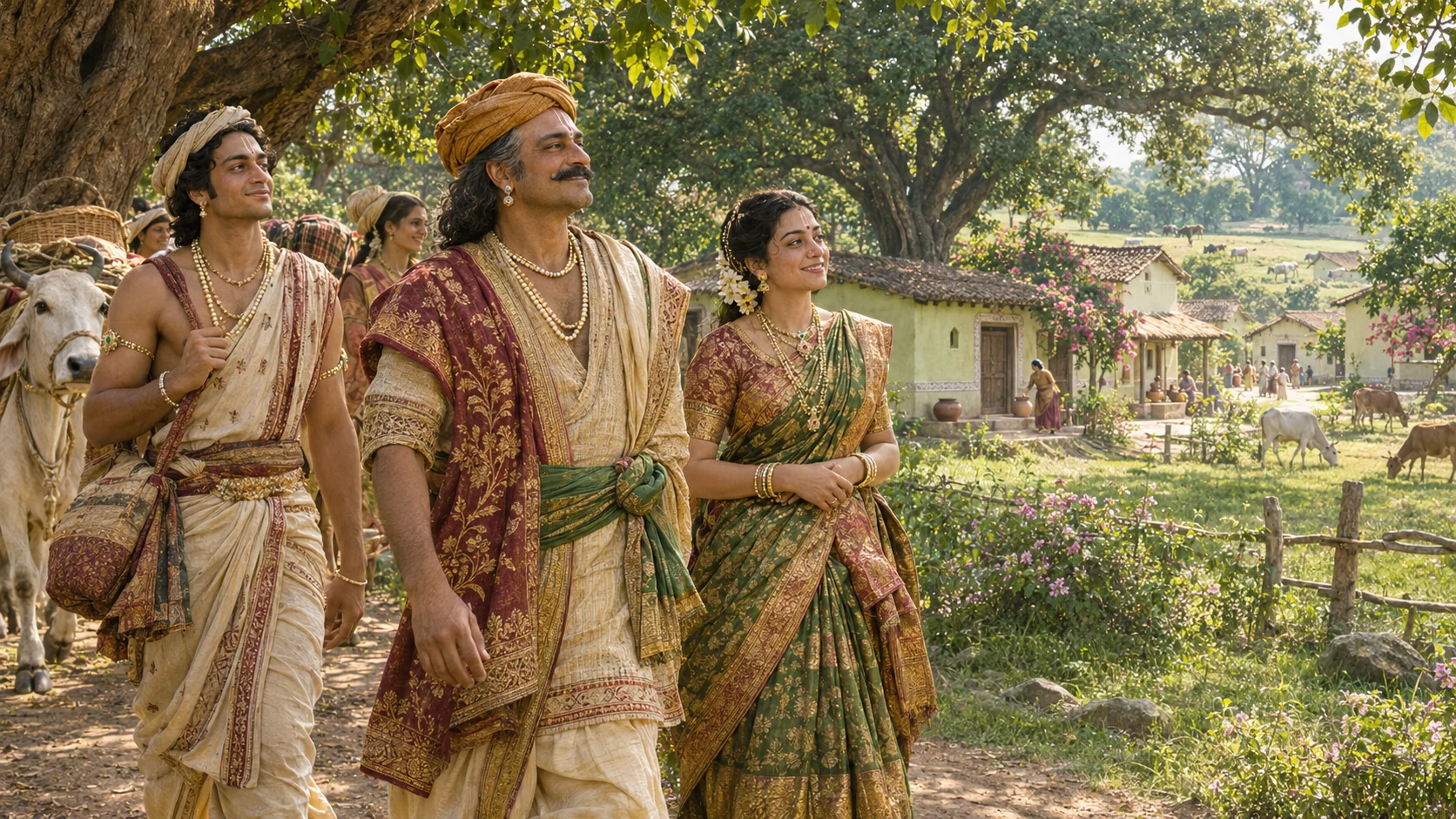
Narada told the king about the gopis of Jalandhara, beginning in the old city of Rangapattana. The city stood beside seven rivers and was renowned for its abundance. The cowherd chief Rangoji ruled there among sons and grandsons, with stores of wealth and grain. Every year he sent a payment in gold to Dhritarashtra, the ruler of Hastinapura.
One year Rangoji decided to withhold the payment. When he did not appear before the ruler, Dhritarashtra sent soldiers after him. They bound him and took him to Hastinapura, where he spent several years in prison. Even after imprisonment and the blows he suffered, Rangoji gave the ruler none of his wealth. One night he escaped from prison and returned to his city.
Dhritarashtra sent three great armies to bring him back. Rangoji met them with his bow as arrows flashed in the fighting. The enemy broke his armor and bow, and some of his own men fell. Rangoji returned to the city and fought on for several more days. Anxious about the outcome, he sent a messenger to Kamsa in Mathura.
At court the messenger bowed to Kamsa with his palms joined. He described Rangoji’s city surrounded by his opponents and asked for protection. He said that Rangoji thought of Kamsa in danger the way a thirsty man thinks of water. Kamsa decided to go to him with his forces. He mounted the great elephant Kuvalayapida, which roared like a cloud. Chanura, Mushtika, and several of his company set out toward Rangapattana with him.
When the forces of the Yadus and Kurus met, arrows darkened the sky. Narada compared Kamsa entering the opposing ranks to fire entering a forest. He said that Kamsa’s mace brought down armored warriors like a thunderbolt. Vyomasura, Vrishasura, and Keshi joined the fighting, scattering elephants, chariots, and horsemen. The surviving Kuru soldiers fled.
Kamsa took Rangoji and his family to Mathura to the sound of drums. The Kauravas grew angry when they heard of the defeat. Seeing the strength of their opponents, they fell silent. Kamsa gave Rangoji the beautiful town of Barhishada on the edge of Vraja. The cowherd chief settled there.
By Hari’s blessing, the gopis of Jalandhara were born into Rangoji’s family. They married into cowherd households, and their hearts turned to Krishna with deep love. Narada ended in the month of Chaitra, when Hari welcomed these gopis to the great rasa dance in Vrindavan.