The eighth night of the dark half of Bhadra arrived. The night brightened with the coming of the child whom Jiva compares to a full moon for the delight of Nanda’s wife. The gods approached with gifts. The blessings of all the ages seemed to gather in Vraja, and flowers opened and fruits ripened without waiting for their seasons.
In the starry sky and distant clouds the poet sees signs of the rainy and autumn seasons together. Night-blooming water lilies and daytime lotuses opened at once. The child’s face recalls a dark lotus, his lips a red flower, and his chest a cloud that has retained a flash of lightning. In this telling Yogamaya was born after the boy and attended his pastime from the beginning.
Snigdhakantha asked how Krishna is also spoken of as the son of Vasudeva and Devaki. Madhukantha remembered Narada’s counsel to explain it in Vraja through Garga’s words, so that the tenderness would not be lost in the majesty. He said that when Krishna appears as someone’s child, parental love is the seed of that appearance. The people of Vraja experience that nearness according to their relationship with him.
Madhukantha spoke of the four-armed form revealed to Vasudeva and Devaki and the two-armed form revealed to Yashoda. Fearing Kamsa, Devaki wished the first form hidden. In the account Yogamaya bore the two-armed child unseen like the wind carrying a blue lotus petal, and the two forms came together. The listeners wondered and asked what happened next.
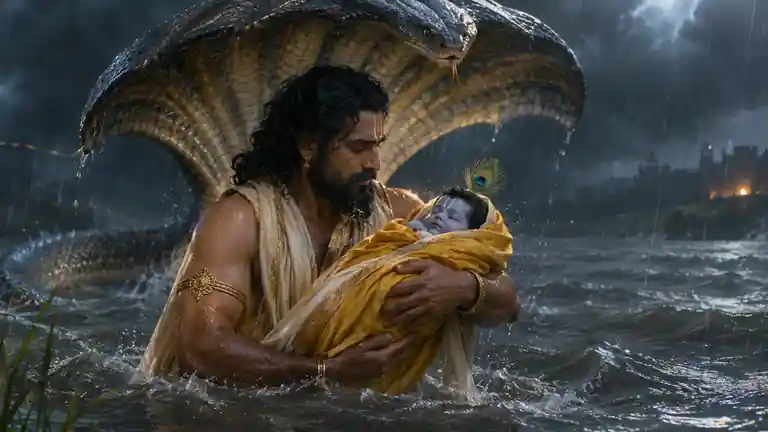
Vasudeva carried the child to Gokula. His chains gave way, the guards slept, the doors opened, and Shesha became a canopy above him. The Yamuna made way for him to reach the cowherd ruler’s home. Madhukantha says Vasudeva did not grasp the whole mystery of the two children. To the question of whose fortune lay behind those wonders on the road, Snigdhakantha answered that it was all Nanda’s good fortune.