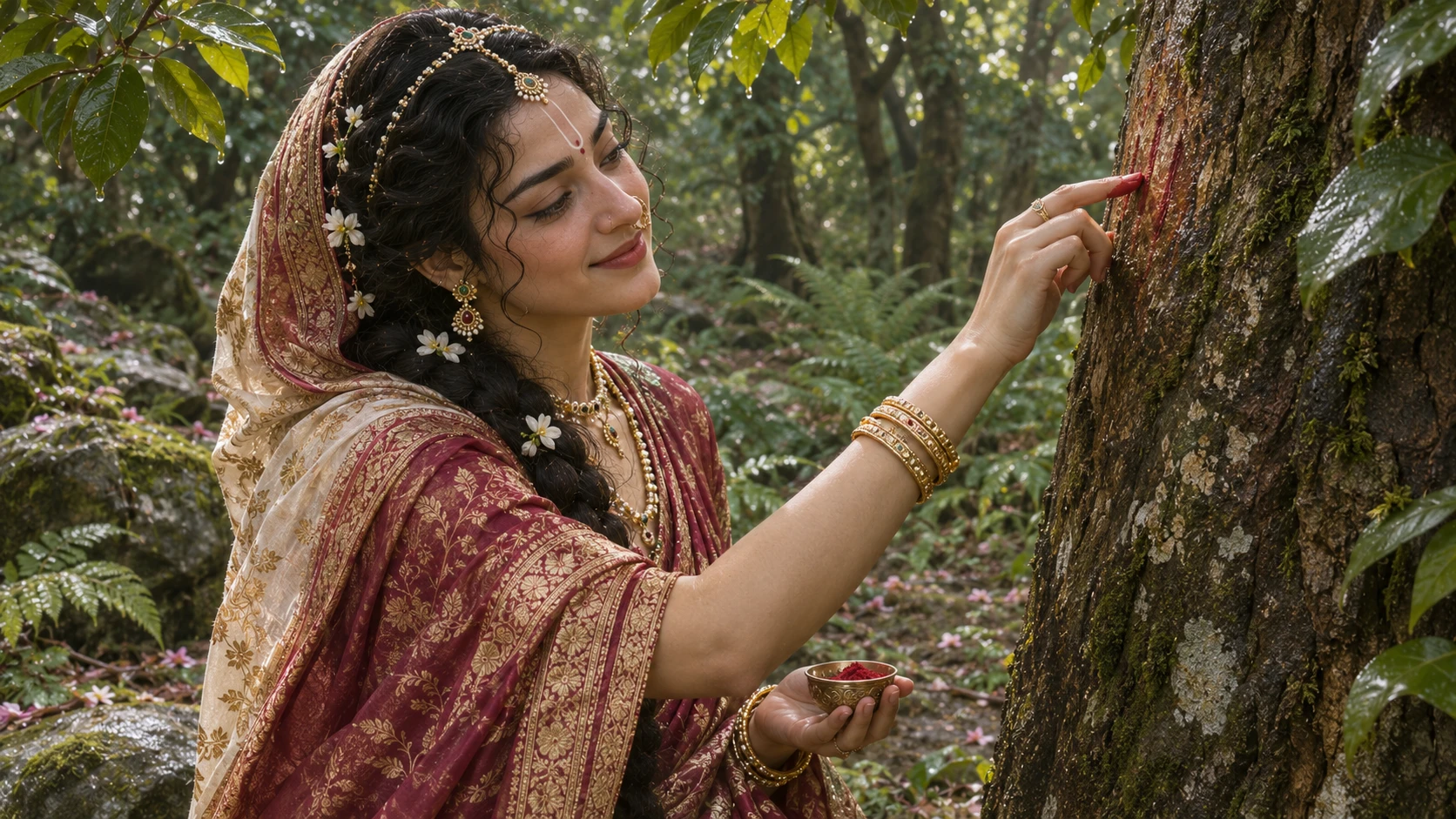
After the conversation at Paurnamasi’s hermitage, Krishna wanted to call Radha to meet him in private. He wondered how their meeting could be kept secret. A woman of the forest, bearing traces of Radha’s kumkuma, spoke to him out of compassion for Radha. She mentioned his flute, a dry reed pierced in several places. Her words drew his thoughts to the thirst and ache awakened by love. The voices of the forest divinities continued the comparison. When the god of love saw how dear the reed was to Krishna, they said, he struck the young woman with his five arrows as well.
Restless, Krishna walked through the woods and noticed words traced in kumkuma on a tamala tree. The message spoke of a heart turned toward him, of love and of the enchantment of his melody. Its writer had imagined Krishna’s dark beauty in every direction. She felt she had taken on something of Krishna himself, yet he was nowhere near her. Krishna recognized Radha by the unusual way she brought words and meanings together. He thought that regard for her family would lead her to conceal her distress. He relied on his flute to reach her through that reserve.
He practiced the melody in private through the rainy days and into the first part of autumn. The narrator describes its power in stages. First comes trembling and restlessness, then rising from one’s seat, taking a few steps, leaving the house, and following the path deeper into the woods. Every practice was directed toward Radha, though the moment of fulfillment had yet to arrive. When clear autumn arrived, Krishna compared its power to win hearts to the power Radha held over his own. In a favorable omen he saw hope that he would soon behold her face and the quick movements of her eyes again. Until the full moon he carried the flute’s sound in every direction. On those autumn nights jasmine flowers opened in abundance.
On the evening of the full moon he brought the cows home to Vraja. After sunset he looked east and saw the red moon rise among the stars. He wondered whether he was looking at a red disk, the angry face of the god of love, or Radha’s face emerging from the forest beside the Yamuna. The moon seemed to color its beloved eastern sky with a hand dipped in red powder. The light across the woods seemed a favorable sign for his journey. He went that way with Dama and three other friends. He stationed them a little way off along the path and went down to the Yamuna bank with the flute in his hand. As the moon brightened to white, he recognized it by its dark mark. Thinking of Radha, he still told it that its splendor could scarcely be compared with the brightness of her toenails. On a raised spot he turned toward Vraja and lifted the flute to his lips. Before playing, he resolved that his first call would be for Radha.