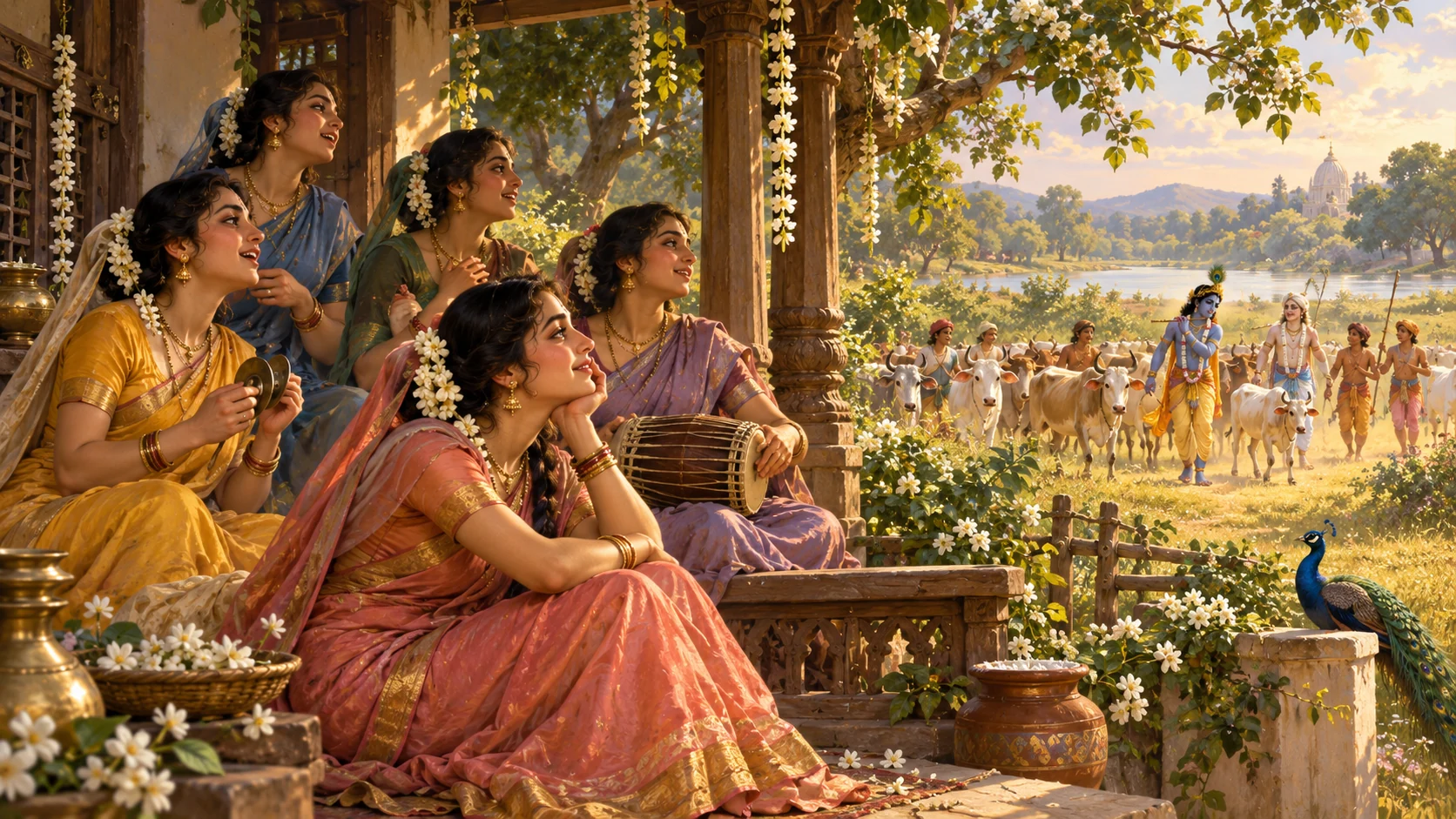
Morning in Vraja had its familiar rhythm: Krishna set out for the forest with Balarama, His friends, and the cows. Homes remained full of work, but for the gopīs the day was measured also by His absence. Amid their ordinary tasks, they spoke to one another about where He might be walking and what He might see along the forest paths.
One remembered Him standing among the trees with His flute; another pictured the herd gathered around Him. They did not witness every moment in the forest, but earlier walks and conversations gave them a wealth of memory from which to shape their song. The trees, birds, and animals in their descriptions are more than decoration: through them they speak about Krishna.
In their songs, cows and deer pause when they hear the flute. Other sounds in the countryside seem to make room for its music. The gopīs picture Krishna wearing a flower garland, with friends beside Him and cows grazing peacefully. What might be an ordinary day for cowherds becomes for them a reason to listen closely and remember.
They think of the earth beneath His feet as well. In the source song, the marks of His footsteps bring relief to ground worn by the cows' hooves. It is one gentle way the gopīs see all of Vrindavan: neither grass nor riverbank seems indifferent when Krishna has passed that way.
As evening approaches, their thoughts turn toward His return. They imagine Him gathering the cows, playing His flute, and coming along the path with dust from their hooves settling on His garland and clothing. They need no grand procession to welcome Him. Seeing Him come home among His friends and neighbors is enough.
This account has no single dramatic turning point. Its span is the whole day, from departure to anticipated return. The gopīs fill that time with conversation and song, helping one another wait for evening. Their voices make distance bearable without pretending it has disappeared.
As you read the source chapter, notice how they move from one small detail to the next: flute, flower, hoofprint, path, and glance. Together these details make a whole day of remembrance. In this scene the gopīs' love does not stop ordinary life; it gives that life a voice while they wait for Krishna.