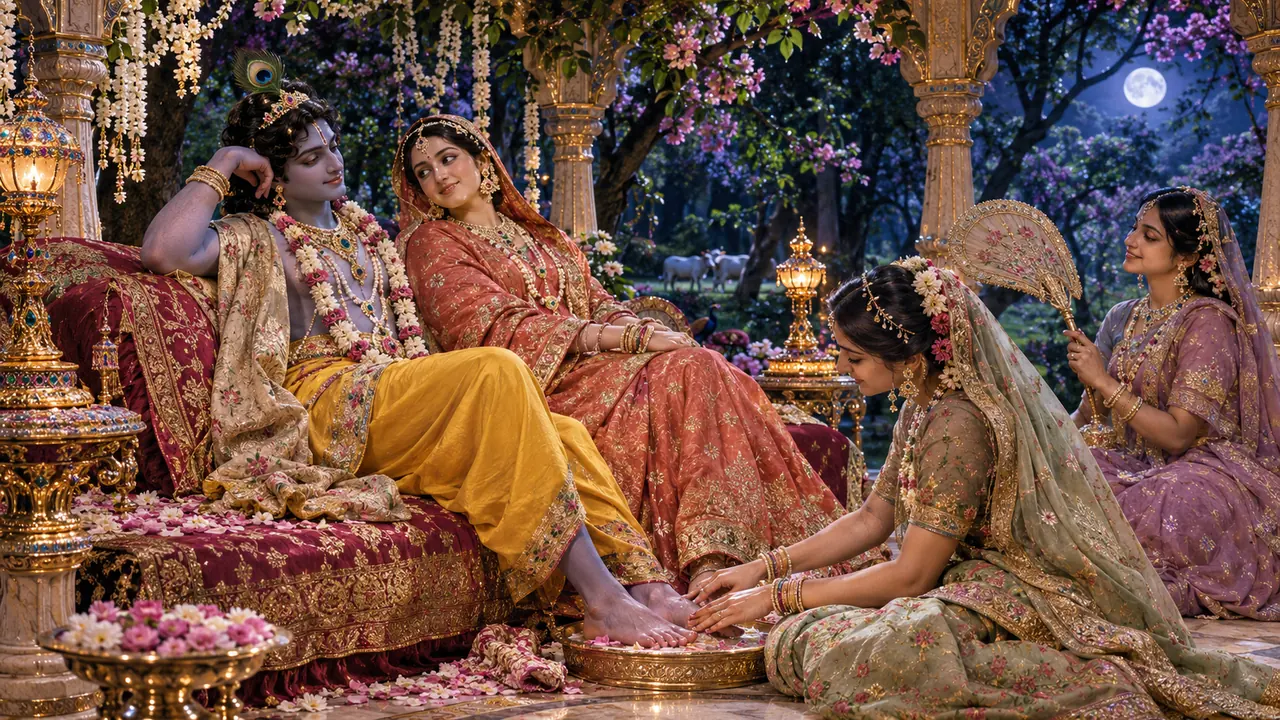
A cool breeze from the Yamuna entered through the temple’s four open doors. Its jewels shone, and the air held the fragrance of aguru incense. Inside was a bed with cushions and a soft mattress. Fresh flowers without stems lay beneath a fine cover. Krishna rested there with Radha.
Lalita and Vishakha sat on either side of the bed. They offered betel to Radha and Krishna and tasted what the two had left. Rupa and Rati Manjari massaged Their feet, while other attendants fanned Them. After serving for a while, the sakhis went to sleep in their own bowers. Rupa and the other manjaris rested on the terrace outside the temple.
Kaviraja turns here to the different kinds of closeness in Vraja. Krishna’s parents raise Him with love, His friends share the joy of play, and His servants taste the joy of service. The sakhis, together with Radha, taste the ripened sweetness of a fruit that takes shape in all of those relationships.
Krishnadasa Kaviraja says that the pastimes of Radha and Krishna in Vrindavan are new at every moment. He has shown only a glimpse in his book. He credits Rupa Gosvami with showing him the way to describe the eight periods of the day and night. To those who follow the path of raganuga bhakti, he speaks of service offered in the mind, by day and night, in a form suited to that service.
The poet gives his name as Krishnadasa. He likens himself to a bee at the lotus feet of Rupa and Raghunatha. For those who receive the account with longing, he asks Krishna to grant the service they most desire. In his closing dedication he remembers Chaitanya, Rupa, Raghunatha Dasa, Jiva and Raghunatha Bhatta. So ends the twenty-third chapter and the Govinda-lilamrita.