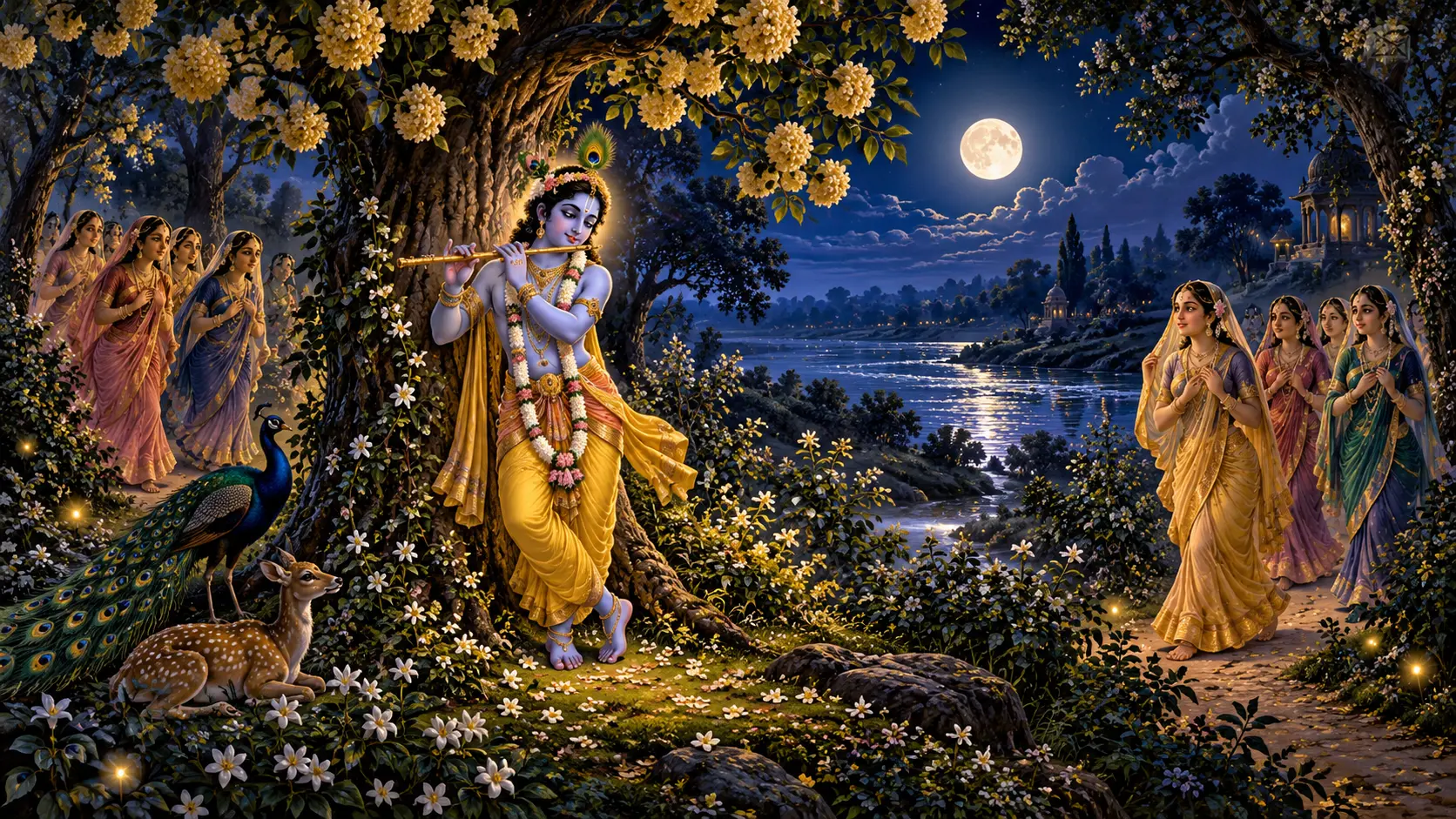
The autumn full moon lit Vrindavan with a quiet glow. Flowers filled the air with fragrance. The Yamuna flowed beside the forest like a silver path. Krishna saw the beauty of the night and remembered the gopis. They had longed for a meeting with Him. Under the trees at Vamsivata He lifted His flute. Its first notes traveled through forest and village. For the gopis this was more than music. They recognized the One to whom they had given their hearts. So begins chapter twenty-nine of Krishna Book.
One gopi was in the middle of household work. Another was preparing food for her family. A third had not finished dressing and adorning herself. When they heard the flute, all felt drawn in the same direction. They left different homes for one forest path. There was no time to prepare their departure carefully. In their haste, ornaments remained unfinished. Their attention was already with Krishna. The night filled with footsteps toward Vamsivata. Each followed the sound she loved most.
Some relatives tried to stop them. Not everyone could reach the forest. Those kept inside closed their eyes. In their thoughts they saw Krishna and heard His flute. The source account honors their inward devotion too. The journey toward Him was not only a movement of feet. It also unfolded in a heart unable to leave home. The moon shone over their houses as well. The call did not end because a doorway stayed shut. The night gathered both the present and the absent.
Those who arrived saw Krishna among the trees. Moonlight made the forest unusually clear. He welcomed them and asked why they had come so late. He reminded them that the forest held dangers at night. He spoke of their homes and the people looking for them. He suggested they return and remember Him there. The words sounded unexpected after the flute's invitation. The gopis fell silent, looked at the ground, and grieved. Their steps toward Him had been full of hope. Now they had to answer with words.
They had not understood the call as a chance encounter. They told Him that their affection could not simply be ordered home. They saw Krishna as the dearest friend of every living being. In Him they found the meaning of their love. They did not want to replace presence with an empty consolation. They asked Him not to turn them away. Pain, faith, and tenderness mingled in their speech. Their answer was not an argument to win. It was an opening of the heart before the One who had called. Krishna listened amid the scent of autumn flowers.
The book does not present this as an ordinary nighttime festivity. Its center is the gopis' devotion to Krishna. They ask neither for reward nor for praise from the village. They seek to serve Him and to remain with Him. The source distinguishes spiritual love from self-seeking desire. That distinction matters when reading the scene. Its outward form can resemble a human meeting. The inward purpose emphasized by the book is different. The gopis are not competing for worldly gain. Their gaze returns again and again to Krishna.
Krishna walked with them through the illuminated forest. The breeze stirred the leaves above the path. The river and flowering bushes accompanied them. After their first sorrow came the joy of being near Him. They saw Him and spoke with Him. Every moment seemed precious after the uncertainty at the start. Their closeness is told in the language of love. Yet the book keeps its meaning centered on the divine. Krishna is free and cannot be possessed like an object. That is why the meeting cannot simply be claimed.
As the gopis felt specially fortunate, pride arose. Any gift can tempt a person to feel above others. Krishna saw this change in their hearts. He suddenly vanished from their sight. The forest remained, but the center of the night was gone. The flowers still smelled sweet, but the flute was silent. The gopis had to seek the One who had been so near. Joy turned into a question. Where was Krishna, and what was love without pride? That question opens the next chapter.
His disappearance did not make their meeting worthless. It showed how deeply the meeting had touched them. They could not keep it as a comfortable memory. They would search for His trace in the forest itself. They would question trees, earth, and deer. They would remember His words and His steps. Thus the end of this chapter begins a search. The flute's call opens the story. Absence deepens it. Both turn their thoughts toward Krishna.
When you read this night, look beyond the beautiful moon. Hear the question the gopis carry on the path. What remains when love cannot be kept for oneself? The book does not answer immediately. The answer unfolds through search, song, and reunion. This is the first of five connected chapters. It has its own beginning, conversation, and turning point. This new retelling does not replace the source chapter. It invites you to open it and see its detail. At the end the flute grows quiet, but love goes on seeking.