Krishna rejoined His friends, and they rejoiced. The two watches of the day that had passed like a moment for Him had felt to them like an entire age. They gathered around Him and asked where He had been so long and why He had left their game. Krishna answered with a gentle smile. He told them that the summer heat had led Him to the Yamuna with His young attendants, who were skilled at serving Him. With His friends still there, the cows had been able to graze undisturbed. He told them it was time to go back to Vraja. He asked them to finish their play in the forest, gather the herds, and sound their flutes and horns. Balarama, Rohini’s son, and several of the friends took up the task. Leaf whistles, flutes, and horns rang out. “Shavali, Pishangi, Kali, Nili, Harini, Vilohini, Dhumali, Sushili, this way, this way! Let us go home,” they called the cows by name. The cows answered from the forest with lowing. Some, full of tender grass, moved slowly with heavy udders, and the earth broke beneath their hooves.
Krishna and Balarama left the forest with the groups of cowherd boys. The poet likens the two brothers, one dark and one fair, to two young elephants. Bees landed at Krishna’s feet, taking them for lotuses. In their dark procession the poet sees the tears of the forest at His departure. Birds called softly and beat their wings as if in pain at the parting. The does watched Him without blinking, as if begging for one more glance. Peacocks followed Him, their splendid tails trailing on the ground. From pool to pool and path to path, waterbirds accompanied Him too, their calls subdued with sorrow. With Krishna and Balarama tending the herd, the cows headed toward Vraja. The poet sees the procession as a river in two colors, emerald and silver. The cows hurried toward their calves, then slowed out of affection for Krishna, who walked ahead. Their heavy udders changed the rhythm of their steps. Dust rose beneath their hooves. The poet imagines the earth taking that form to touch the rest of Krishna’s body after already feeling the touch of His feet. A light wind carried the dust onto Krishna’s curls, like pollen on bees. It also settled on the white cloth on His head, on His Vaijayanti garland, and on the Kaustubha jewel. Brahma, Shiva, and other gods came to honor Him in the forest. To the gopis waiting to see Him, each delay along the road felt as long as an age. Wherever His gaze fell, the poet sees it as a rain of love and mercy that makes the vines of longing blossom. Krishna approached the village slowly, playing His flute, with Balarama and the other boys.
The dust of the herds reached the villagers first. Then came the flute, then the lowing of the cows. At that, the mothers came out into the street. The gopis looked upon Krishna’s moonlike face. After the long day, their eyes seemed to break a fast on that sight. Krishna looked affectionately at each one, so that each thought He would visit her that night. From jeweled terraces they watched Him with glances the poet compares to a rain of blue lotus petals. The children and elders also came out of their houses. Krishna looked kindly at the children, bowed His head to the elders, and reached the heart of the settlement with a smile. He paid His respects to His friends’ mothers too. Yashoda already stood by the road, her eyes long fixed on the direction from which her son would come. When the cows had been settled in their clean stalls, Krishna came with Balarama and the boys and bowed to Yashoda. She folded both brothers in her arms. In a gentle voice she sent the friends to their homes. Then she took her two sons into her own courtyard.
Yashoda lingered in the courtyard and carefully assigned duties to the young attendants. One took Krishna’s flute, horn, and staff, another removed His forest garland, and a third took off His ornaments. They unbound His head cloth and soft jacket, brushed away the dust from the herd, and washed His face and feet. One attendant gently combed His thick hair. With fragrant oils they gently massaged Him from His head down to His nails. They then applied a fine scented powder with saffron, sandalwood, and camphor. For His hair they used a fragrant amalaki wash, and they rinsed His body with camphor-scented water. They dried Him with soft white cloth and pressed the water from His hair with another cloth. They replaced His wet clothes with soft yellow garments. They laid a yellow shawl over His chest, combed His hair again, and gathered it with a thin white cloth. They drew a scented tilak on His forehead. They anointed Him with sandalwood paste and camphor, put jeweled ornaments on Him, and washed His feet again on the decorated footrest. Krishna entered the house holding a friend’s hand. He took off His sandals and bowed humbly to His father. Nanda held Him tightly and affectionately smelled the crown of His head. Then he invited Him to sit. Balarama, now dressed by His own attendants, also came to bow and joyfully embraced His father.
For the two brothers’ second meal, Rohini and Yashoda saw that the preparations began on time. At Yashoda’s signal the attendants brought jeweled seats, dishes, and pitchers and put them in place. When feet had been washed and father and sons were seated, Rohini began serving with affection. She first offered food to the brahmana boys who ate with them every day. Then she served Nanda and Balarama, followed by Krishna and His companions. The evening meal was prepared to be delicious, wholesome, and well proportioned. Krishna and Balarama sat respectfully beside Their father. Yashoda noticed that the friends, too, spoke more quietly in his presence. Nanda took pleasure in eating with them. After the meal they rinsed with cool, fragrant water brought in gold vessels set with gems. The attendants again saw to Krishna’s dress, ornaments, and feet. With His mouth freshened and a gentle smile, Krishna bowed to His parents and went out into the courtyard. He put on His jeweled sandals and listened as His friends praised Him. He rested His left arm on a friend’s shoulder. With His other hand He took the betel leaf another companion offered Him and entered the cowherd settlement.
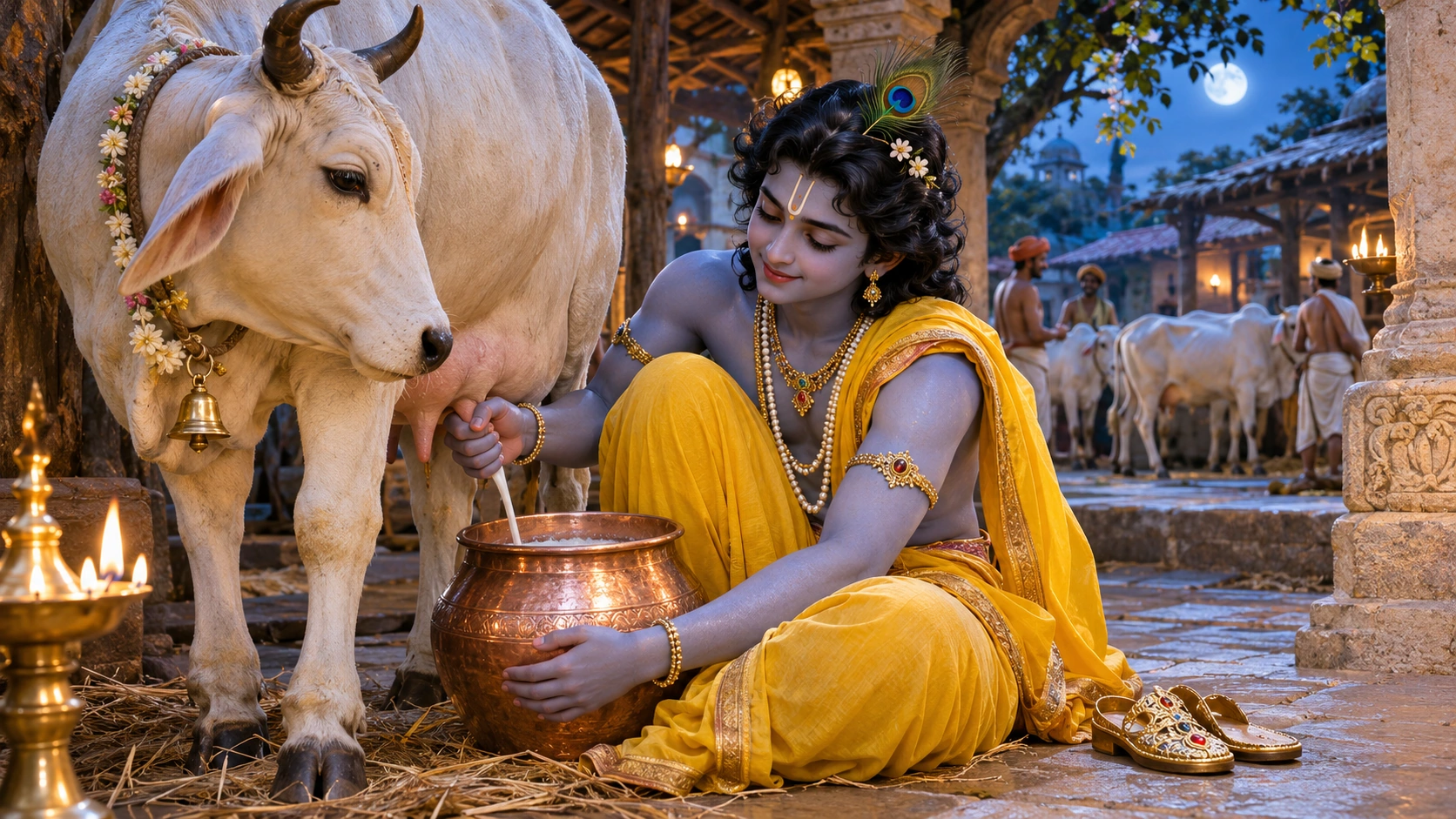
Evening came, and the birds were returning to their nests. Lamps were lit in the houses as the sky dimmed. Calves called from every side, and their mothers answered them. The settlement was already beginning the second milking. When Krishna arrived, lighted lamps and the voices of the cows filled the stalls. The poet hears their lowing as a ceremonial welcome for His arrival. The moon rose in the east like a face emerging from a veil of darkness. The white cows blended with the moonlight, their dark hooves and horns outlining each animal. The bulls settled in their places like silver boulders. Krishna looked with pleasure at the cowshed courtyards with their broad crystal pillars. As the cows were milked together, the streams of milk rang deep inside the pots. Krishna took pleasure in that sound for a long while. Eager to milk them Himself, Krishna drew His garment aside, steadied a pot on His knee, and gently milked even cows that were difficult to approach. At the touch of His hand and the sight of His face, their milk flowed of its own accord. This is how the poem depicts their affection for Him.
After passing the first part of the night, Krishna bowed at His parents’ feet. They embraced Him tenderly and gave Him leave to retire. His home was near Nanda’s, adorned with jewels and gold. The garden held rows of young trees, flowering bowers, and pools with swans, and cuckoos called from the branches. In that garden the poet also describes young women setting out for meetings on moonlit nights, in white garments, pearl ornaments, and ivory earrings, scented with sandalwood and camphor. The attendants had cleaned and sprinkled the sleeping chamber. It was cool and scented with dark agarwood incense, with flower garlands and pennants above jeweled vessels. The bed was adorned with gold, jewels, and carved ivory, its bedding and pillows soft as milk foam. Moonbeams came through the windows past jeweled cages of parrots. With His young attendants beside Him, Krishna entered the chamber to rest.