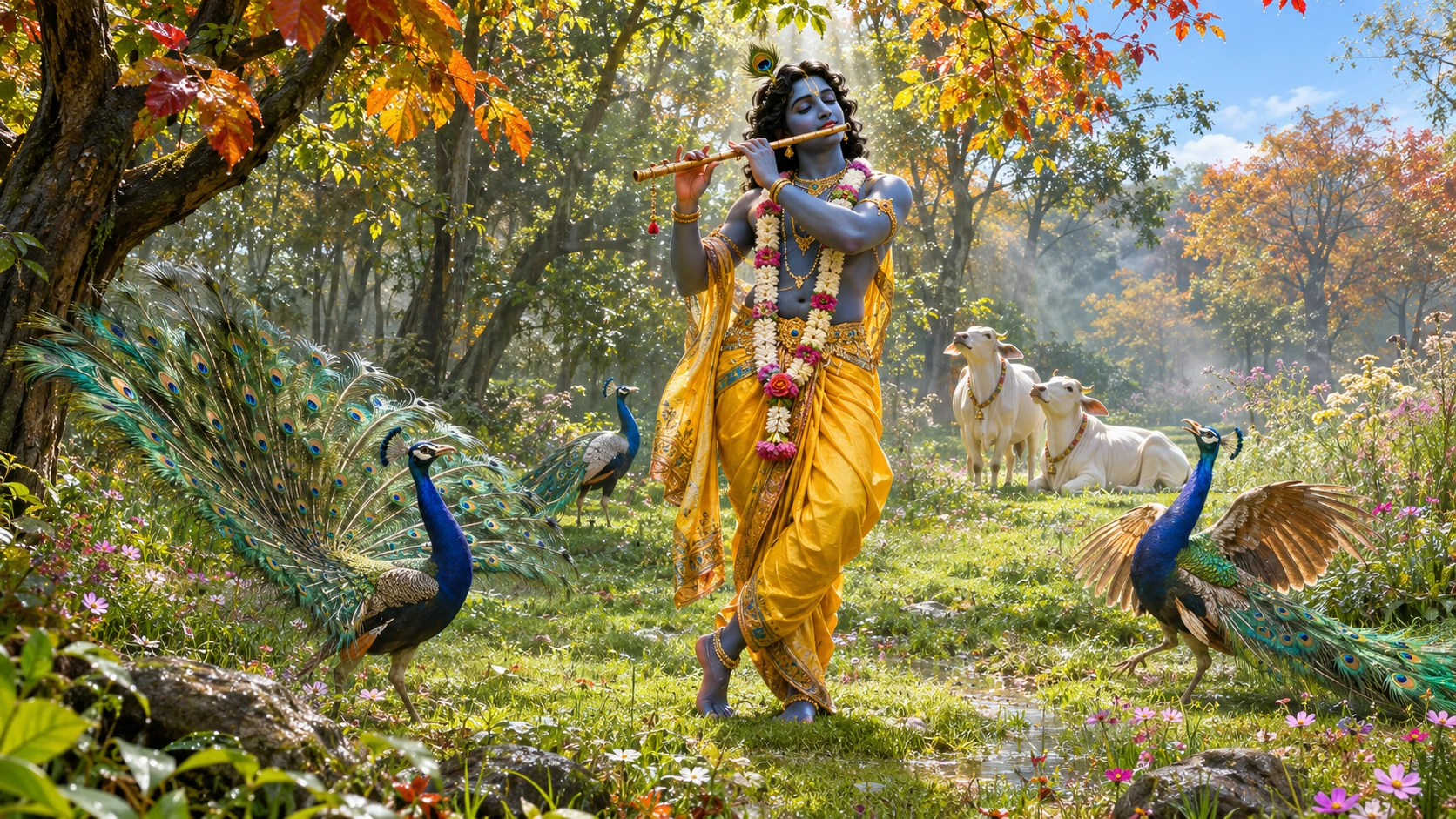
Rupa Gosvami opens the poem in praise of the pastimes of Krishna, the champion of the cowherds, that awaken love. The vina of Narada, Brahma’s son, carries their sweetness. When the rainy season is at its height and the rain pours down, Krishna finds shelter in the hollow of a tree. The dense forest is ringed with kadamba and arjuna blossoms. There He grants the wishes of those devoted to Him.
With autumn the forest grows lovely and fills with birds. Krishna shines there in the attire of a master dancer. Peacock feathers adorn His hair. At the sight of Him the gopis lose their composure and begin to speak of Him. The sight of His face as He brings the flute to His lips is a reward for the eyes. The flute, in which the poem gathers the fruit of all good deeds, brings color to His lips.
At the sweet sound the peacocks begin to dance. Even the clouds offer Him service. The cows leave off grazing. The sound takes hold of their hearts. Even the women of heaven are entranced by Krishna’s movements and the radiance of His body. The young women of the Bhila people delight in the saffron from His feet left on the tender grass. The clear-eyed does rejoice at His lotus face. The hill is absorbed in service, and Krishna wears the cattle rope as an ornament. The poet turns to Him for protection and honors the rare chance to serve Him.
The closing verse returns to the deep love of the women of Vraja, stirred by His play. Word of that play reaches the three worlds. Krishna delights in the hidden places of the forest shining in autumn. Rupa Gosvami prays that love for Him may spring up freely and strongly in his heart.