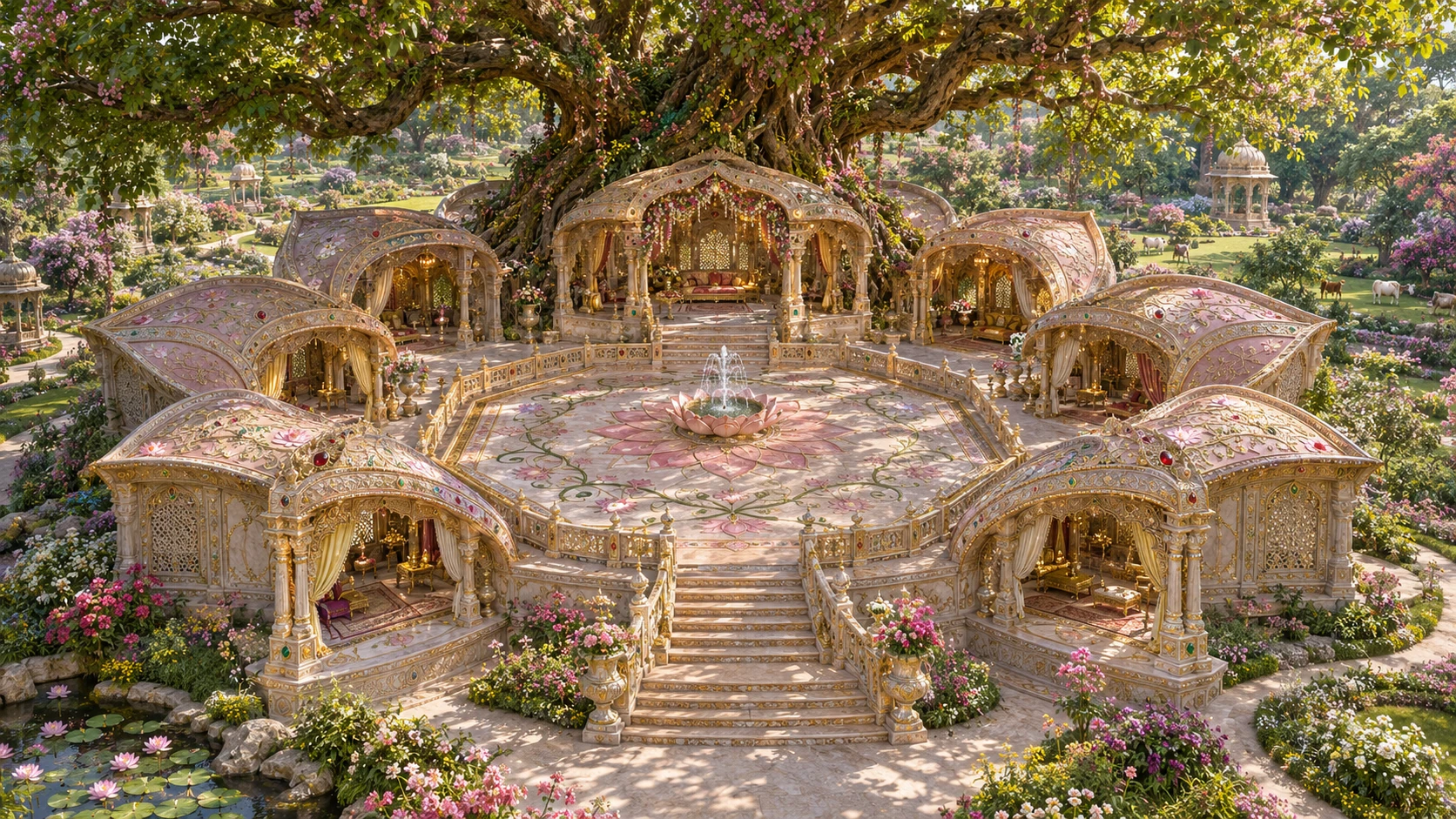
Ancient mango trees and many other trees stand along the Yamuna and all around Vrindavan. The poet describes their bowers as a delight to Krishna’s eyes. Vines hung with grapes, flower gardens, and stands of plantain follow one another. A golden expanse lies in their midst, with a hill of jewels and a grove of wish-fulfilling trees. Some rows of trees run long and straight as a guide cord, while others bend into circles. There may be two or three rows of one species or a place where many species grow together. The mango trees rise on well-developed upper branches. The poet wonders what a crafted imitation could do to match their height or the beauty of those ranks of blossoms. Dark tamala trees fill some stands, and mixed trees crowd others. The groves within lie beyond the reach of even a rival’s gaze. Secret bowers stand amidst some of these trees, jeweled palaces shine among others, and the companions of Vrinda have their own quarters in yet other parts.
The forest of Vrindavan resembles the forests of earth. Its gardens delight Krishna as a royal pleasure ground and enchant even the inhabitants of the spiritual world. Each of the six seasons has a realm with its own qualities. Here Krishna, the moon of Vrindavan, can experience the pastimes of all the seasons every day. The seasons offer continuous service in Vrindavan. The gopis make ornaments from their flowers and adorn Krishna with them in affection. The bowers of Krishna’s beloved companions shine throughout the forest. The poet says that a seed’s measure of their light can make one long for more than the bliss of Brahman. When Krishna rises as the moon of Vrindavan, the animals, birds, trees, and creeping vines all turn toward Him.
One tree is a kalpa-vriksha, a wish-fulfilling tree, by its very nature. The other trees show the same power as it serves the pastimes of Vrindavan’s Lord. Among all those trees the poet singles out one of incomparable beauty. Beneath it, in a lovely forest bower, stands a palace of precious stones. Parts of this palace rise five stories high, others six, eight, or nine. Each arrangement has a center like the heart of a lotus, with eight rooms ranged around it like petals. Farther out are repeated chambers where those who serve may take their rest. The palace courtyard also holds eight smaller palaces. The eight smaller palaces face the eight directions, with the main palace at the center. The tree folds its branches around them, shielding them from those unsympathetic to the pastimes within. The bower beneath the tree has nine palaces. Eight other bowers surround it, each with nine palaces of its own, and still more bowers lie beyond them. In the finest bower shines the home of Radha, Vrindavan’s queen. The dwellings of Her sakhis come next, followed by the residences of Her attendants. Where a leader of a group or a smaller circle stays with her beloved, the finest central palace is her residence. The other dwellings lie around it. The tree, the bower at its foot, and its extraordinary palaces manifest as Mukunda’s beloved desires. Their number and variety lie beyond reckoning.