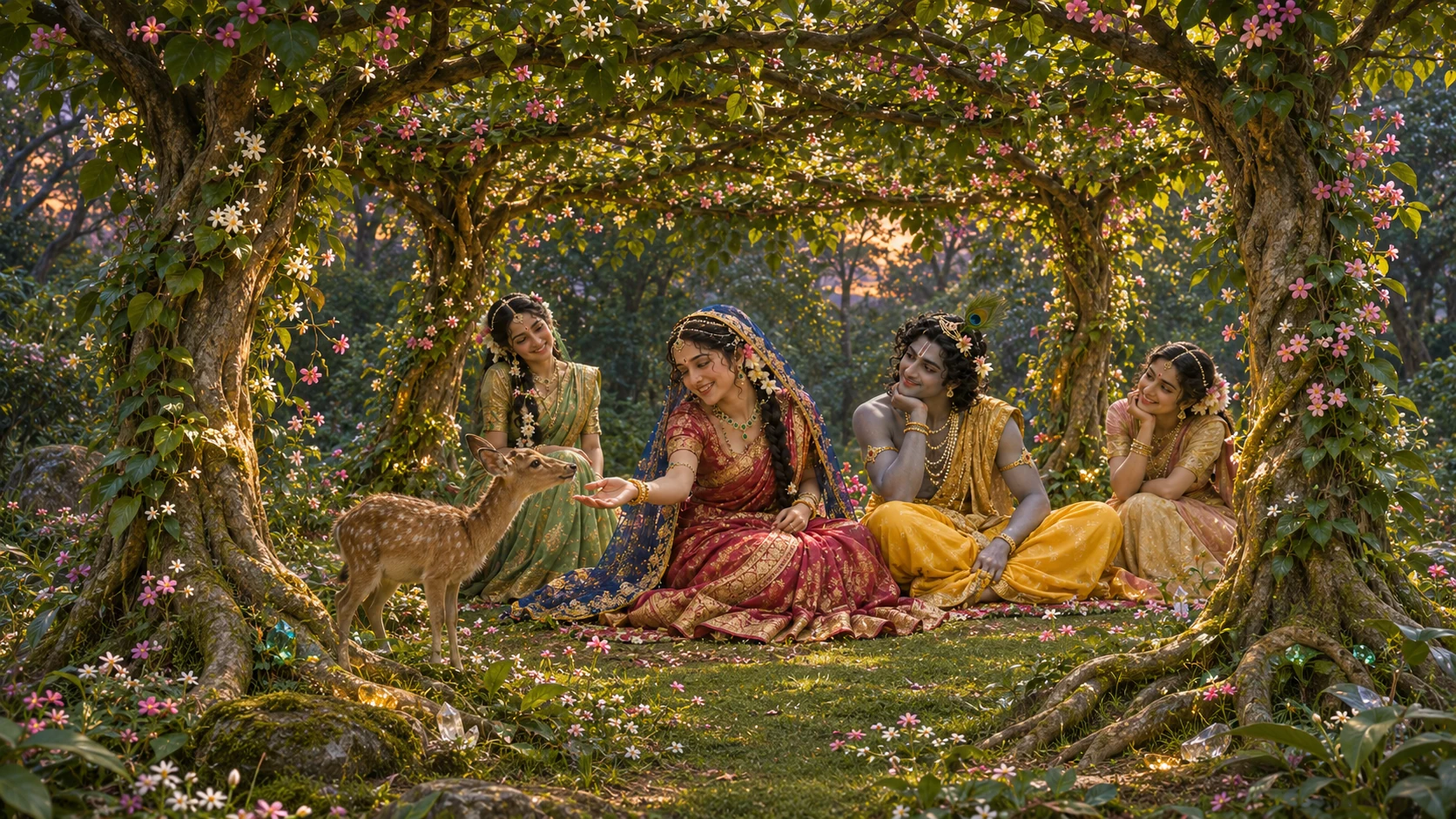
In one place the land glitters in the colors of many precious stones. In another it shines an emerald green. A printed reading of the verse gives that same color to the fresh grass grazed by the cows. Elsewhere the ground shines with Jambu gold or the deep blue of sapphire. When Radha and Krishna stand there together, someone watching from the rival side may distinguish only one figure, as the other’s color blends into the setting. Golden shrubs, trees, and climbers rise from emerald ground. In another place green plants gleam against a floor of gold. Where the ground is ruby, the plants and trees are crystal. Elsewhere a floor of crystal sets off the red of ruby vines.
Golden vines wind around emerald trees. In other parts emerald vines twine through stands of golden trees. Farther on, ruby vines twist around crystal trunks, while clear crystal shoots wrap around trees of ruby. A tree of precious stones sends out many jeweled branches, with buds and shoots of different colors. Clusters of gemlike flowers open there, each with a fragrance of its own. Jeweled drops and fallen stones gather in a little basin around the roots. The birds in these trees glint like precious stones too.
The poet describes Brahmas and Shivas arising from the trees’ roots and branches. The trees shine like the sun, give sheltering shade, and have the youthful beauty of Sanaka and the other Kumaras. They arise without seed and thrive without planting or tending. At all times they carry leaves, flowers, and fruit at every stage, from newly formed to ripe. In the poem, these potent trees have a spiritual nature, and the poet compares them to the Lord’s appearances. To human eyes they can look like trees in their own world. Climbers adorned with remarkable leaves and shoots entwine the young trees. The poet sees in them young women held in the arms of their beloveds. New buds, open flowers, and fruit are always present on the same vines. Their wish-granting gift serves Achyuta, the unfailing Krishna.
The trees and vines bloom all the way to their roots. Bowers open among them across the forest, where Krishna, the moon of Vraja, plays and rests. There the cuckoos sing and the bees hum. Herbs glow like lamps, chamari animals sweep with their tails, and musk deer scent the bower. Four trees stand at the four corners, each flanked by two flowering vines. Together they form a small dwelling with the luster of a jewel. The trunks are its pillars, and branches large and small make the roof. Vines form walls and a doorway, and the flowers hang like spires and ornamental finials. Bowers like these stand throughout the woods of Vraja. Their artistry eclipses the splendor of celestial chariots and draws even the inhabitants of Vaikuntha. When Mukunda looks upon them, forests and bowers, vines and trees, birds and wild animals all bloom at once. As they wait for His glance, their blossoms remain closed.