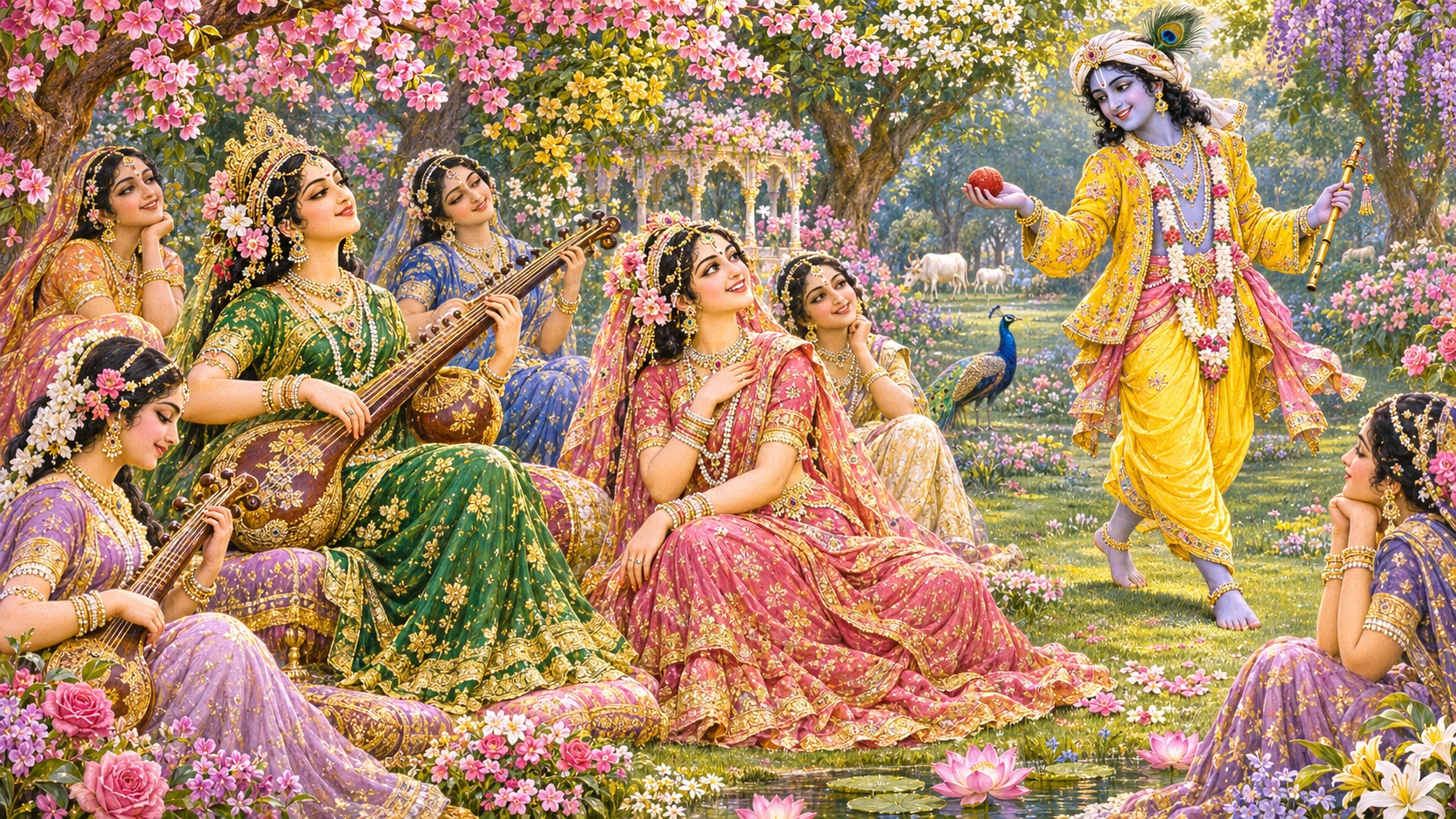
Krishna wished to arrange a spring celebration for the young women of Gokula. The forest goddesses understood His intention. With their skill they decorated the already flowering forest. The poet depicts chamari deer sweeping the ground with their tails. Musk deer filled the place with their fragrance. Trees sprinkled it with drops of flower nectar. Bees sang, and the vines seemed to dance. News of the festival was announced along the lanes. Hearing it, the young women grew eager to come. Radha, Chandravali, and Shyama arrived with their companions.
Vrinda and the other forest goddesses received them respectfully. They adorned them with clothes and ornaments for the spring celebration. Vrinda herself decorated Radha with flowers. She placed punnaga flowers and bakula buds in Her hair. Ashoka adorned Her hair parting, and mango buds Her ears. The other companions also prepared flower ornaments. The wish-fulfilling trees supplied jewelry, clothes, and fragrant garlands. They also supplied colored powders and musk paste. Flower bows, balls, and elaborate sprinklers were ready for play. The trees also supplied betel and various fragrant ointments.
Then Matangi, the goddess of musical art, appeared. Her companions were skilled in playing different vinas. In this poetic scene, musical sounds themselves assumed human forms. The raga Vasanta appeared in female dress. With her were the seven notes, sa, ri, ga, ma, pa, dha, and ni. The twenty-two shrutis, the fine distinctions of pitch, were present too. Matangi approached Radha respectfully. Vrinda introduced her as an outstanding master of music. She had brought her instruments to delight Radha. Vrinda also introduced her accomplished companions.
Vrinda pointed out the personified raga Vasanta. She had dark-blue beauty, a peacock-feather ornament, and mango buds. Her resemblance to Krishna attracted Radha's glance. Matangi also presented the personified notes and shrutis. Lalita asked about distinguishing them with the voice. Matangi answered that the voice does not always express them clearly. She then spoke of two vinas, moving and fixed. She explained this through the four shrutis of the note shadja. First she sang them, but the personified forms did not respond in agreement. When she played them on the strings, the corresponding shrutis agreed.
One of Radha's companions praised that skill in a teasing manner. She said that Lalita too could distinguish the shrutis with her voice. She offered to have Lalita demonstrate if there was interest. The forest goddesses joined the discussion of musical knowledge. Radha's eyebrows curved as She listened to the discussion. She addressed Matangi to put an end to the exaggeration. She said that what is so difficult for deities is not achieved easily. She did not accept such praise of Lalita's abilities. Instead of a contest, She asked Matangi to sing. The song should please Vrinda and her goddesses.
Vrinda set one condition for the choice of raga. Vasanta should wait until Krishna came singing it. Matangi therefore began a different raga, Velavali. Her companions joined her with their vinas. The varied instruments produced a harmonious musical flow. Radha, the gopis, and the forest goddesses listened attentively. Then another, extraordinary sound arrived from a distance. It combined vina, flute, mridanga, and metal instruments. The different sounds blended into a single whole. The poet compares that harmony to the shared fragrance of mixed ingredients.
The gopis turned their ears toward the distant music. Their eyes began searching for it in every direction. Now the raga Vasanta sounded from that quarter. Its personified form, present among them, also responded. The forest goddesses recognized Krishna approaching with His celebration. They announced His approach to Radha. They described Him ready for play with His companions. He wore a white headwrap with a peacock feather and a floral ornament. His earrings shone, and a mango bud adorned His ear. A fragrant flower garland decorated His neck and hair.
Krishna was dressed in a yellow upper garment. His ornaments and small bells moved with His steps. He held the flute in His left hand. With His right He played with a red festival ball. The song of the raga Vasanta did not leave His lips. Subala and the other friends sang with Him. Two companions at His sides offered Him betel. The air filled with light, fragrant festival powder. The friends threw red balls at one another, sang, and danced. In this way the music heralded Krishna before He reached the gopis.