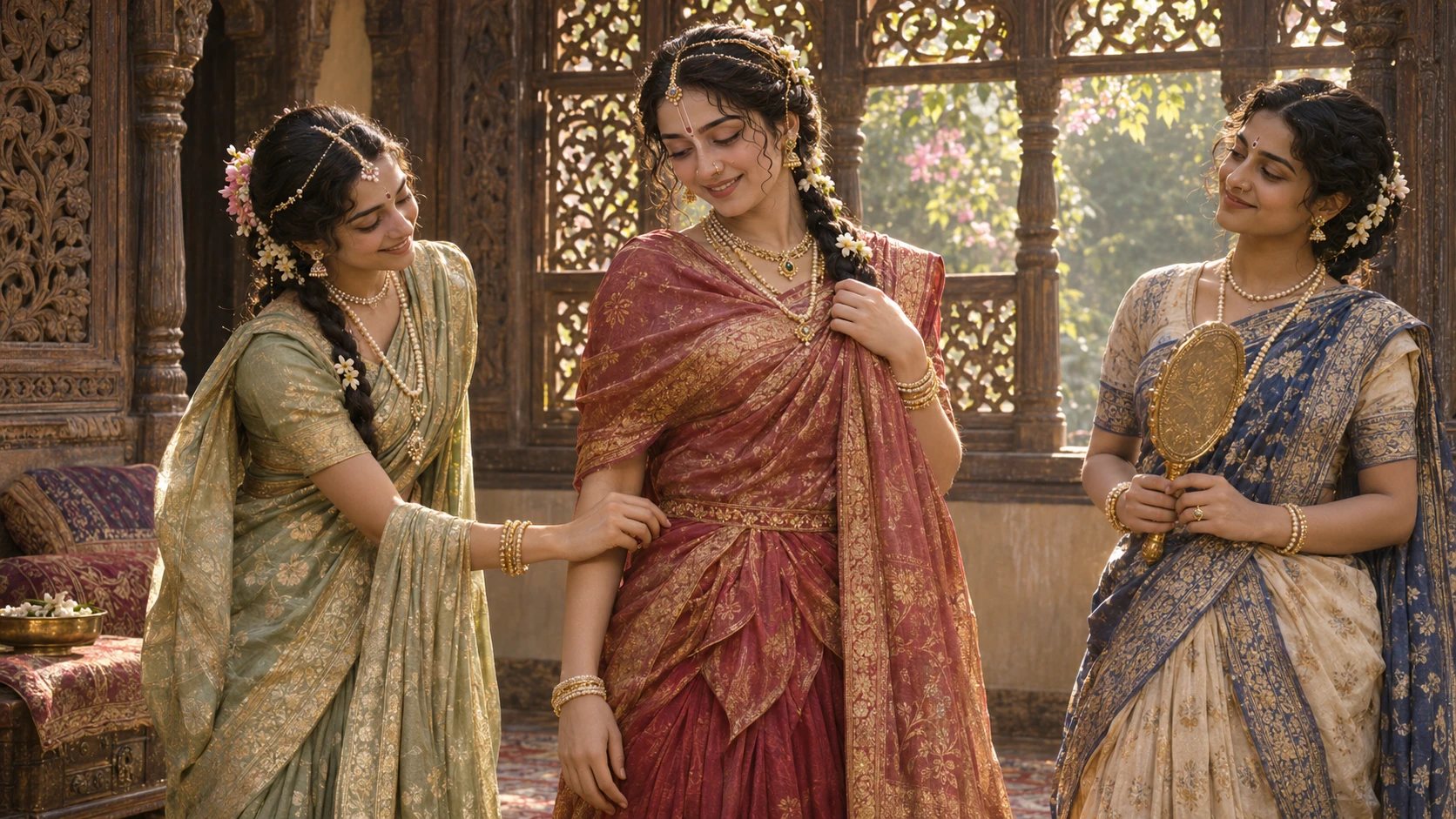
Radha took her place on the golden seat. Sudevi stood beside her, supported the hair with her left hand, and drew the comb gently through it with her right. The dark hair flowed around the luminous face, suggesting the Yamuna passing through a golden net. Sudevi made a part above Radha’s forehead. The friends followed it with their eyes. The poet pictures a current along which little boats could pass.
Lalita placed a jewel on the crown of Radha’s head. It seemed like the sun rising in her dark hair, with pearls along the part like stars come to warm themselves. Sudevi threaded the decorations into the hair, drew it into a long braid, and tucked flowers among the strands. She hung a lotus worked in gold, diamonds, and pearls at its end. Lalita joked that Sudevi had bound every strand securely. Her joke about fastening turned into one about freedom. Hari, she said, would know how to undo what Sudevi had bound.
Lalita gently lifted Radha’s head. With a small brush she made a circle of fragrant musk and agarwood paste. Inside she drew a red lotus and placed a tilaka of sandalwood and camphor. A crescent shone on her brow as if the god of love had fetched it from Shiva’s forehead. Lalita traced Radha’s eyes with dark color. The poet compares the eyes to lotuses set within the night, where their brightness could be seen even more clearly.
Lalita smiled and teased Radha’s eyes for their fondness for dark color. She told them to dance when the dark cloud Krishna appeared. Radha drew her brows together and answered that before her eyes could dance, they would have to learn from Lalita’s glances.
Lalita set a jeweled pearl ornament at Radha’s nose. It looked like a star come close to the moon. The poet sees it as the seed of a vine of beauty and as bait for Hari’s restless gaze. Lalita jokingly urged the pearl to draw that gaze quickly. Vishakha laughed and wondered who could hold that gaze when it had already overcome the fear and patience of the women of Vraja. Radha answered them with a play on who might attract whom.
Lalita set hoops at Radha’s ears beside the kunda blossoms, with jeweled ornaments hanging below. Then she painted little makaras, creatures of poetic waters, on Radha’s cheeks. In the flash of the diamonds the painted creatures seemed to spy grains and open their mouths. Lalita playfully imagined Radha’s ornaments meeting Krishna’s earrings. Radha tried to stop the teasing. Lalita kept comparing their earrings and armlets to creatures looking for a resting place.
Lalita put a dark dot of musk on Radha’s chin. In the poem it is a small piece of night that the moon has kept close. Lalita jested that Krishna would recognize his own deep color in it. Chitra used a fragrant paste of camphor, agarwood, sandalwood, and kunkuma to paint tender shoots and leaves. The poet turns the design into a pool of loveliness that would draw Krishna near.
Champakavallika and Indulekha fastened jeweled armlets on Radha. The friends played on the name of the armlets, as if they had been given the task of bringing the beloved to the one who wore them. Radha smiled with downcast eyes. She replied that her friends were already speaking as though Hari held both the ornament and the remedy for longing.
At her wrists they placed sapphire bangles patterned with gold. The deep blue and gold recalled the color of Krishna’s body and the light of his clothing. To the poet they looked like a strand of prayer beads made from those two colors. The slender hand cord suggested a net to catch a chakora bird. Rings stood around her luminous nails like stars beside moons. The friends left three fingers on the right hand without rings.
Vishakha arranged a crimson blouse embroidered with pearls. She laid the necklaces in order so the shining strands fell at different lengths. The poet sees the clear Ganga flowing from a golden conch. Vishakha added the bright dhruva ornament, polished like a mirror in which Hari might appear.
Tungavidya fastened the belt with little bells. Rangavati put on Radha’s jeweled anklets with swan ornaments, then added rings at her toes. The sound of the bells seemed to invite others to sing of Radha’s feet. Her friends applied red lac to the feet, already rosy in color. The poet compares the service to offering a little lamp to the sun. The friends told the lac to rejoice because it might one day adorn Hari’s forehead.
Radha pretended to take offense. She told the friends that she would tease them too if she ever saw the lac from their feet color someone’s forehead. Rasa Manjari applied a fragrant paste with sandalwood, camphor, and musk. Radha’s own fragrance, the poet says, still had the greater strength. Tulasi placed a garland of atimukta flowers about her neck and laid a lotus in her palm.
Ranganamala brought the jeweled mirror. The ornaments acquired reflections, so that the array seemed to have doubled. Surprised by her own radiance, Radha thought how Krishna might rejoice to see it. She wondered when that moment would come, and what use beauty had while her beloved was still out of sight. Her longing unsettled her patience, but she grew composed again lest the others notice. Then Kundalatika arrived from Nandishvara at Yashoda’s bidding. She and Radha greeted one another with smiles and asked how each was faring. The friends shared the joy of their meeting.