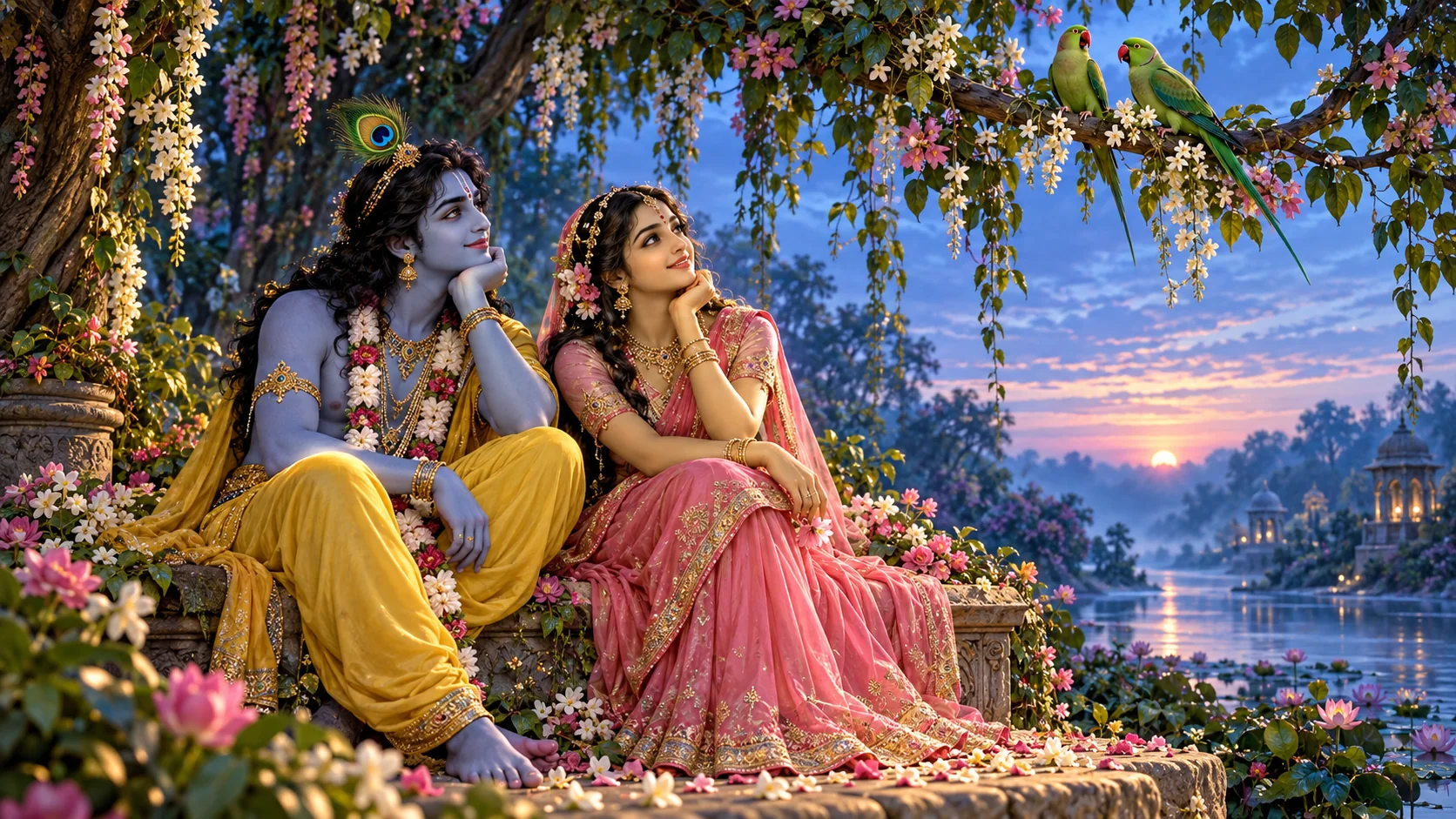
At Vrinda’s signal, the roosters wake, shake their wings and stretch their necks. They crow five or six times, and Radha awakes. Upset that they have interrupted her rest beside Krishna, she scolds them and sends them to call in Yama’s realm. She draws away from Krishna a little. When the roosters fall silent, she comes close to him again, and sleep lightly returns.
Then the tittibha birds call. At their sound, Radha stretches and asks them to allow her another moment of sleep. Near the water the kadambas, karandavas, swans and cranes begin to sing. Pigeons, shari birds, parrots, peacocks and cuckoos answer from the woods. The poet likens their chorus to the sweetness of stories about Krishna.
Radha and Krishna awaken at the same moment. As they stretch, their forms remind the poet of two bent bows, one golden as a champaka and the other blue as a lotus. They briefly feel the pain of drawing apart, and then they embrace again. The attendants realize that both are awake. They ease the door open and enter quietly, with only the soft ringing of their anklets. Radha wants to rise at once, but Krishna’s embrace keeps her near him.
Daksha and Vicakshana, the parrots that understood Vrinda’s signal, address Krishna. The poet compares their art to that of Shukadeva, who rouses people by speaking of the Lord. Daksha praises Krishna as a delight to the eyes of the gopis. The night that gave them so many precious moments, he reminds Krishna, has now come to its end.
Vicakshana urges him to leave sleep behind, hasten to Vraja and bring happiness to his kin by returning to them. He calls him the moon over the ocean of Nanda’s heart and the flower on the vine of Yashoda’s piety. Then the shari birds Shubha and Sukshmadhi turn to Radha. They praise a loveliness that even those renowned for beauty long to possess. They ask her to rise and go home, reminding her that her friends learn from her how to conduct themselves in Vraja.
Radha and Krishna rise from the bed of flowers. Their ornaments ring, loose curls fall beside their cheeks, and the radiance of the earrings lights their faces. While putting their garments in order and trying to shake off sleep, they lean on each other. To the poet their faces seem to trace a circle around one another. Their smiles become the lights with which they honor one another.
Both wish for one more brief moment of sleep and sink back onto the uneven flower bed. The poet pictures sleep as a companion reluctant to leave them. Still the birds keep singing, their voices heralding the hour when the two must part. Here the first canto, devoted to the wonder of rising from their resting place, comes to its close.