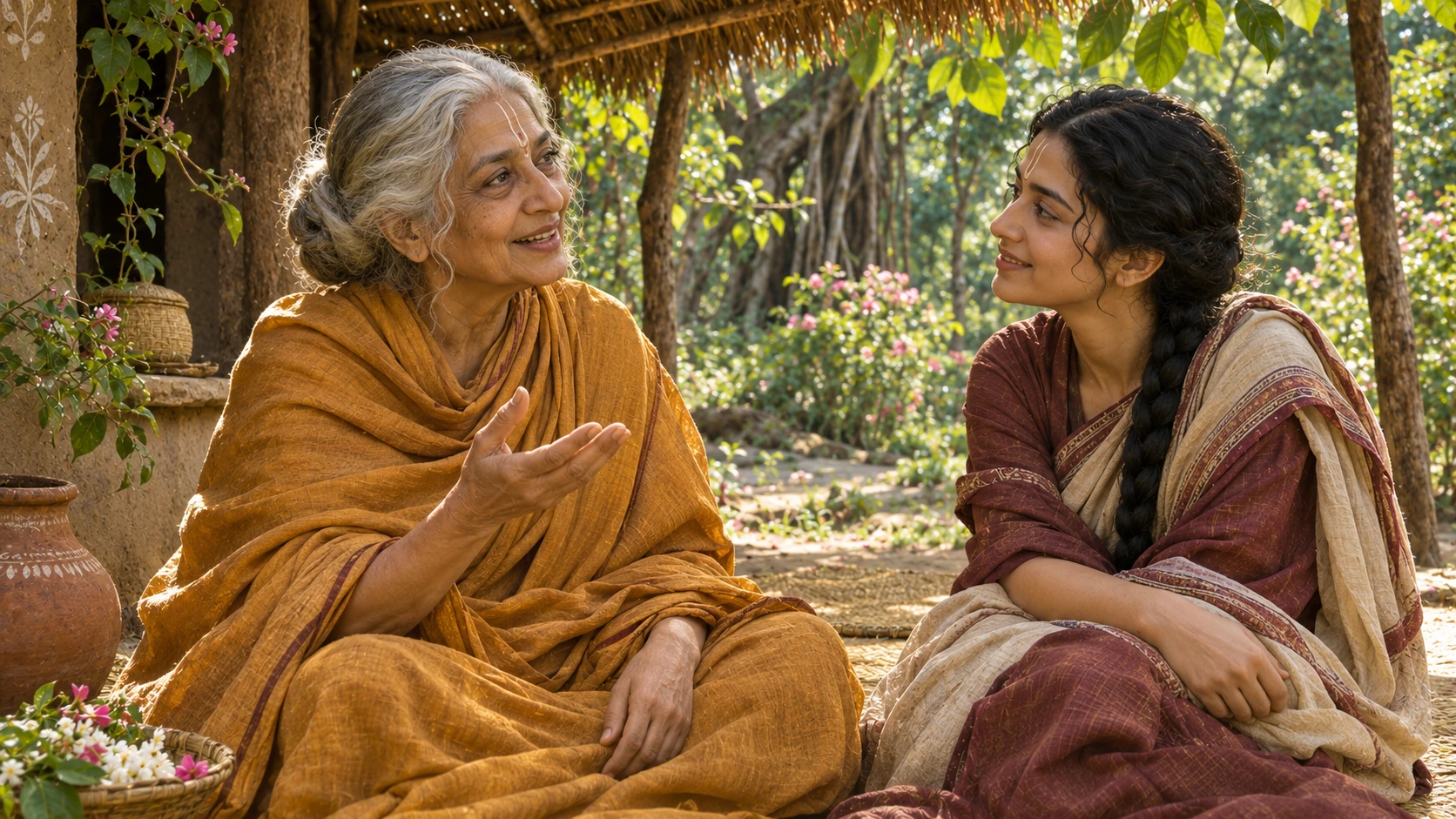
Nandimukhi began with what she knew of the previous day. Krishna had approached Paurnamasi respectfully as an experienced ascetic versed in mantras, precious stones, and potent herbs. He asked what counsel could bring Radha down from the mountain of Her reserve and give joy to Her and Her friends.
Krishna explained to her that even innumerable other gopis could never bring Him the same delight. Radha alone adorns the land of His heart. In the words Nandimukhi conveyed, Radha is like a wish-fulfilling vine, like awareness itself bringing the heart to life, or like a banner of victory. Each image speaks to how irreplaceable She is to Him.
Paurnamasi heard Him out. Her reply sounded like refusal. Radha was honorable and deeply modest, she said, so how could She hasten to Him like someone who readily changes Her word? Still, the comparison of Radha to lightning and Krishna to a dense cloud also holds a hint of consolation. Lightning may be seen beside its cloud.
Nandimukhi went on to say what happened afterward. Krishna returned home, and Paurnamasi reviewed her mantra texts during the night. When she directed Nandimukhi to deliver the letter, Nandimukhi took it and left at once. She told the friends what she knew about carrying the letter. She had not read its contents.
Radha drew Her own conclusion from the account. She supposed that Paurnamasi had sent a mantra and Krishna had chosen a secluded place to repeat it. So She asked Her friends to return home and perform the worship of the sun there. For the place where Hari had gone, She offered a bow.
Kundalata laughed at the suggestion. Even the smallest gleam from Krishna was already enough to unsettle Radha’s composure. Why would He need a mantra for that? Radha replied with solemn praise of Paurnamasi’s unusual ascetic life, of the detachment of her follower Nandimukhi, and of Kundalata’s wisdom. She joked that it was just such venerable women who guided honorable householders into samadhi.