Vishvanatha Chakravarti opens his poem by seeking refuge in Shri Krishna Chaitanya. He likens him to a cloud whose brilliance drives out darkness and pours light over the whole world. Then he holds in his heart the eternal forms of Radha and Krishna, the sovereigns of the Vraja woodland. His words for their eternal form also suggest the names of Rupa and Sanatana. He wishes to follow the path of those whose loving service is devoted to Radha and Krishna.
The night in the grove is drawing to an end. Radha and Krishna have been vying in playfulness, until fatigue calls Nidra, the goddess of sleep, to quiet their contest. Their attendants are accustomed to waking whenever their time for service arrives. The poet wonders whether sleep, sensing that the night is nearly over, has withdrawn of its own accord and brought them to wakefulness.
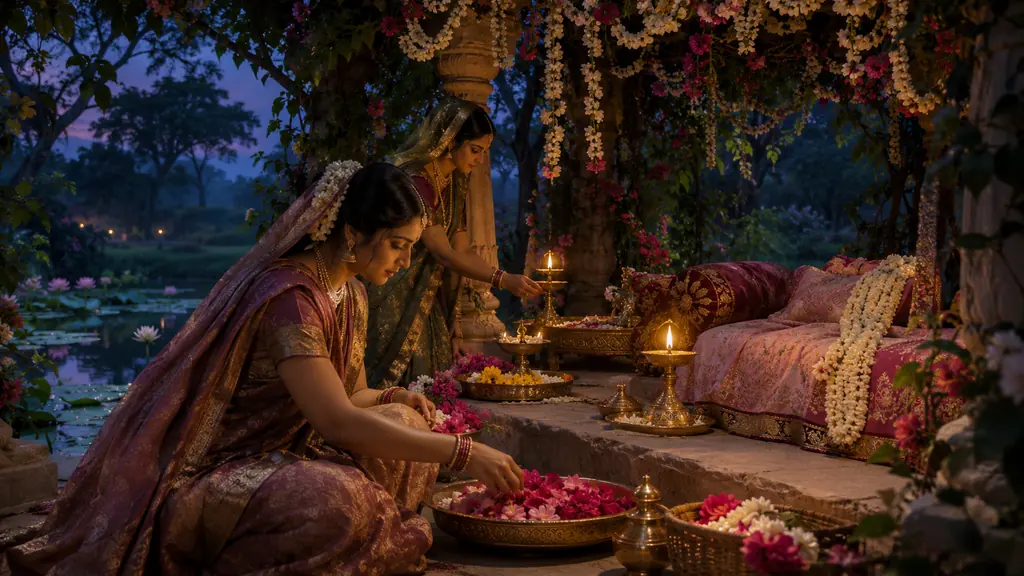
The attendants rise, concerned that the hour for their morning duties might already have passed. Finding Radha and Krishna still resting undisturbed in the retreat, they sit quietly on their own beds. Some yawn as they jokingly ask one another who stayed awake. Others are already preparing flowers for the garlands and betel leaves to offer when Radha and Krishna rise.
Fragrance drifts from the retreat and draws one of the attendants near. She invites her friends to look through the lattice and see how sleep is keeping the pair in its care before dawn. Jeweled lamps are set in several places. Near Krishna, their radiance resembles blue lotuses in bloom. Near Radha, the same light takes on the golden hue of champaka flowers.
The sight prompts a series of playful comparisons about adornment, love and modesty. One attendant imagines love taking over the work of a decorator. Another sees the golden radiance of Radha and the dark-blue glow of Krishna as two silks that complement each other. The poet imagines modesty as the guardian of a kingdom. The sakhis wonder where she has withdrawn and whether she will return with even more splendor after the pair has awakened. In their comparisons, the dark cloud of Krishna and the gold lightning of Radha make the sight a gift the attendants receive before offering their service.
Meanwhile, they finish the garlands, the betel leaves and the fragrant pastes. They set out embers and agarwood for incense. Several moments pass in these customary preparations, and a gentle breeze makes its way into the grove. The poet pictures it as newly awake and still too languid to hurry.
The breeze passes among flowering trees and vines. It carries their scent in every direction, and the bees awaken and begin to hum. The humming rouses Vrinda. She looks around, recognizes the hour, and entrusts the birds with waking Radha and Krishna.