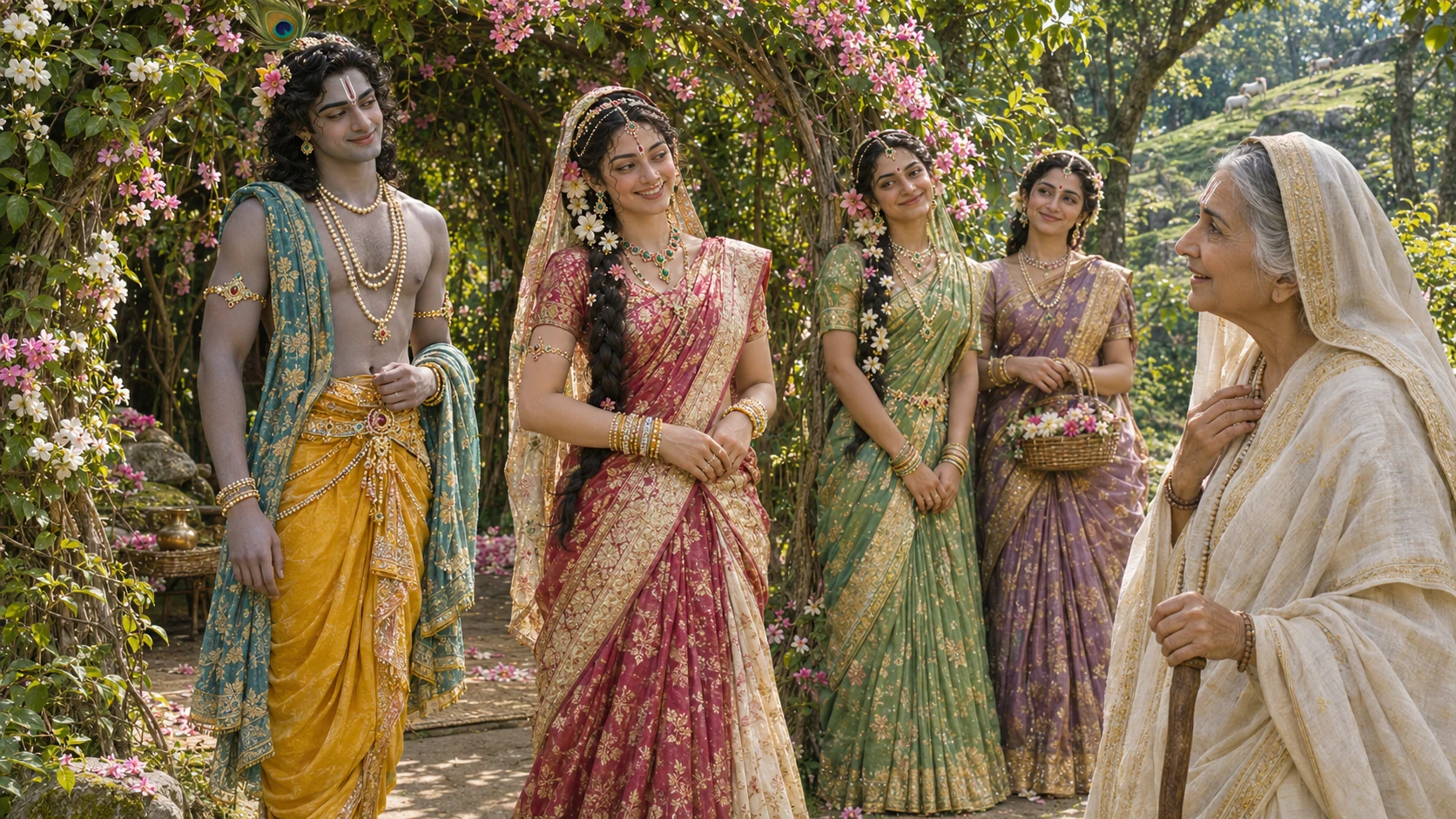
At the crossing, Paurnamasi quietly told Krishna that the beautiful girl’s jewel already adorned His throat. What need had He of some further trifling toll? Her words could point to the jewel in the necklace and also to Radha herself. Krishna was delighted in His heart. He thought that Paurnamasi had named as toll the very Radhika for whom He longed. Aloud He said that a jewel bathed in the moonlight of deep love could come to Him only through her favor.
Paurnamasi smiled. She had spoken of a cintāmaṇi, a wish-fulfilling jewel, and He had understood the beloved herself to be the jewel. Krishna answered with a shy smile, crediting the extraordinary skill of her companion Nandimukhi for bringing about the meeting. Paurnamasi continued the play on words. Whoever gained the wish-fulfilling jewel would gain the beloved as well. She asked how the light of dawn could pass the sky by. In the commentary, the word for the sky also points to Vishnu’s feet, while the dawn light suggests Radha’s beauty in Krishna’s service. Thus Paurnamasi told Krishna that He had come to His fullness that day.
Vrinda asked how the moon could be anything but full once the full-moon night had arrived. Paurnamasi replied that the moon sweetened the spring full-moon night by following Radha. The commentary hears Krishna and the star Viśākhā in those words as well. Vrinda asked Radha, Vishakha’s friend, to behold Krishna in His fullness before Paurnamasi.
In his commentary, Viśvanātha Cakravartin describes what happened after these words. At Paurnamasi’s prompting, Lalita and the other sakhis directed Radha and Madhava into a secluded forest bower. A little while later the two returned in splendid festive attire. When Paurnamasi saw them, she addressed Krishna as the moon that shed the light of wit.