Narada told Bahulashva about gopis who had formerly lived in Ayodhya. Their account begins in Champaka, a city in the land of Sindhu. Its king, Vimala, was devoted to Vishnu and faithful to dharma. He possessed great wealth and ruled with a peaceful mind. Yet he and his many queens had no children. For years he wondered what sacred act might bring him offspring. One day the sage Yajnavalkya visited the king. Vimala bowed, worshiped him, and stood before him. The sage noticed the king's distress and asked what troubled him. Vimala explained his longing for children and asked about austerity and charity.
Yajnavalkya became still in meditation, considering past and future. He told Vimala that daughters, rather than sons, would be born to him. The king remained anxious about his duties toward his ancestors. The sage asked him to put aside his grief. He instructed him to offer his future daughters in marriage to Krishna. Through that dedication, he said, the king would be freed from his sacred debts. Vimala then asked where and how the Lord would appear. Yajnavalkya described His birth among the Yadus in Mathura, to Devaki and Vasudeva. He spoke of midnight on the dark eighth day of Bhadra. He described the Lord's dark complexion, yellow garments, lotus eyes, four arms, and forest garland.
After the sage's departure, Vimala rejoiced. The women of Ayodhya, blessed by Rama, were born as his daughters. When they became eligible for marriage, the king remembered the prophecy. He sent a messenger to Mathura to seek Vasudeva's son. The messenger was to look for the auspicious marks Yajnavalkya had described. In Mathura he questioned the townspeople. Afraid of Kamsa, they answered him privately and in low voices. They said that Kamsa had killed Vasudeva's sons. A remaining daughter, they said, had escaped into the sky. They warned the messenger not to speak openly about Vasudeva's children.
The messenger returned to Champaka with what he had learned. He told Vimala of Vasudeva's sorrow and Kamsa's cruelty. Then he described something unexpected from his journey. Near the Kalindi in Vrindavan, he had seen a beautiful cowherd boy. The boy stood among cows and cowherds. His dark complexion, forest garland, and Shrivatsa mark matched the description. But the messenger had seen only two arms. The prophecy had spoken of Vasudeva's four-armed son. He therefore asked the king what he should do next. He was ready to travel wherever Vimala directed him.
While the king considered the difficulty, Bhishma came from Hastinapura. Vimala honored him with gifts and presented his question. He repeated Yajnavalkya's prophecy and asked how it could be fulfilled. Bhishma answered with an account he had heard from Vyasa. Krishna had indeed been born in Vasudeva's home. Because of Kamsa, Vasudeva had carried Him to Gokula at midnight. There he had left Krishna and returned with Yashoda's daughter. Krishna was now living in the forest in the guise of a cowherd. Bhishma urged Vimala to fulfill the sage's instruction without delay. After Bhishma left, the king sent his messenger to Nanda's son again.
The messenger found Krishna beside the Yamuna in Vrindavan. He bowed, walked reverently around Him, and spoke in private. He praised the Lord who had appeared to protect dharma and overcome Kamsa. He called the people of Vraja and Nanda's household fortunate. He also praised the forest where Krishna had revealed Himself. Addressing Krishna, he called Him the jewel adorning Radha. He spoke of Him as the life of the gopis. Though Krishna remained in cowherd dress, His fame spread everywhere. The messenger compared that hidden presence to musk known by its fragrance. He acknowledged Krishna as the witness who knows the thoughts of every heart.
Then he spoke of Vimala, the ruler of Champaka. The king, he said, had performed sacrifices, given charity, and practiced devotion for Krishna. He asked Krishna to grant that devotee His presence. Vimala's daughters also longed to serve Him and observed vows for Him. The messenger conveyed the invitation that Krishna accept them in marriage. Pleased by his words, Krishna went with him to Champaka in a moment. They descended from the sky into the king's great sacrificial gathering. The sound of Vedic recitation filled the place. Vimala saw the dark Lord in yellow garments, adorned with His forest garland. Overwhelmed with devotion, he rose and bowed at Krishna's feet.
The king seated Krishna on a seat inlaid with gold and jewels. He offered worship and stood before Him. Krishna noticed Vimala's daughters looking from the palace windows. In a voice deep as a cloud, He invited Vimala to choose a blessing. The king asked that his mind remain at Krishna's feet. He compared that mind to a bee dwelling upon a lotus. He said that he desired nothing else. Then he dedicated his wealth, elephants, horses, chariots, and himself to the Lord. He duly gave his daughters in marriage to Krishna and bowed again. The people cried out in celebration, and the gods showered flowers.
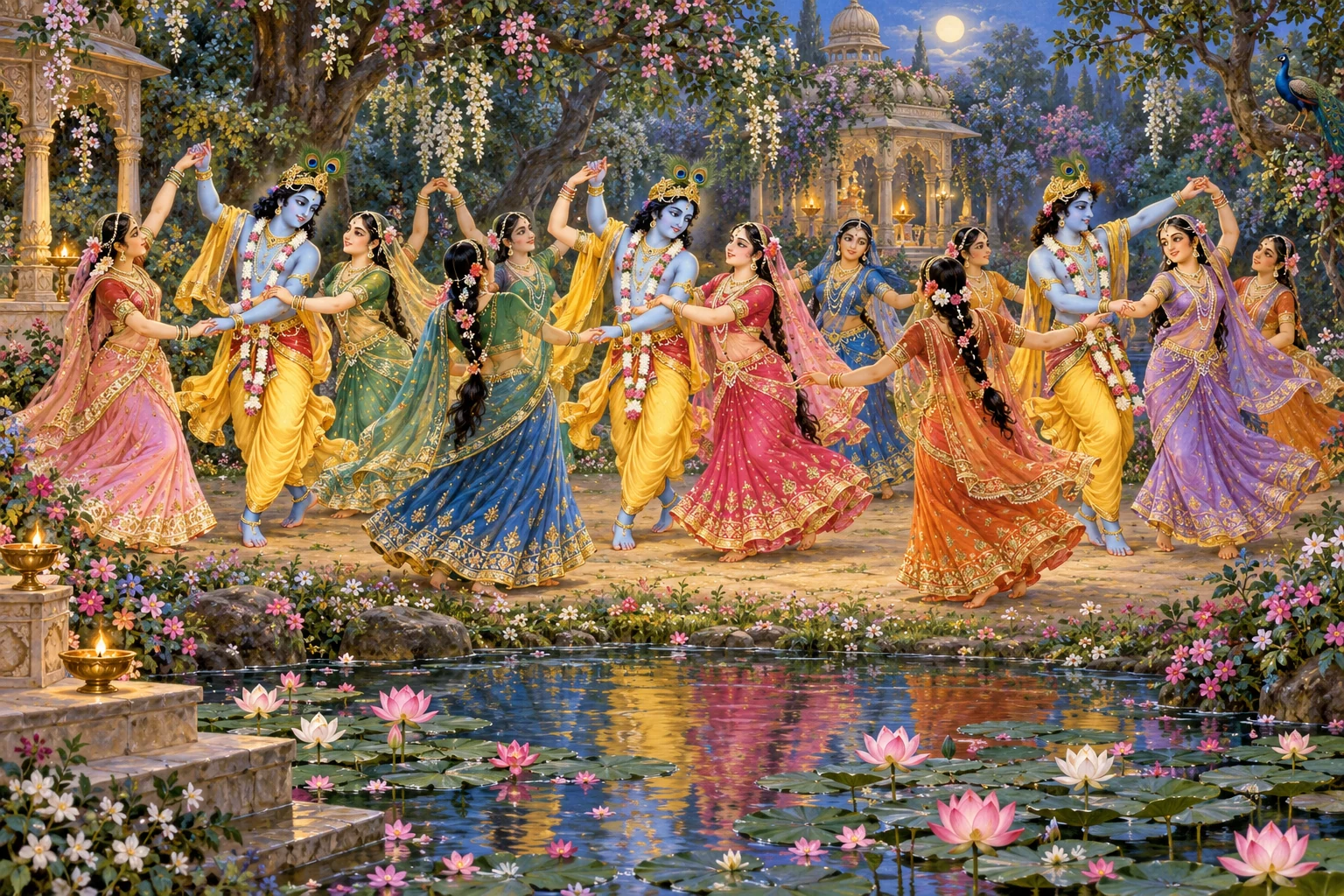
Vimala received a radiant form resembling the Lord's. The text compares his splendor to a hundred suns. Together with his queens, he bowed to Krishna. Before the watching people, they mounted Garuda. Vimala and his queens departed for Vaikuntha. Krishna then brought the king's daughters to Vraja. They stayed in Kamavana, in a beautiful dwelling. There the chapter describes them playing ball games. Krishna manifested as many forms as there were companions. With those forms He joined them in the rasa dance.
His presence in the dance delighted their hearts. The account links their joy with the origin of a sacred pond. Drops of water arising from that joy fell during the rasa. From them, Narada says, Vimala-kunda came into being. He praises it as an outstanding holy place. The chapter speaks of seeing its waters, drinking them, bathing, and offering worship. It presents these acts as a means of release from sin. It also praises hearing the account of the women of Ayodhya. For the devoted listener, it promises the supreme abode of Goloka. Thus the story reaches Kamavana, where their long-awaited closeness to Krishna is fulfilled.