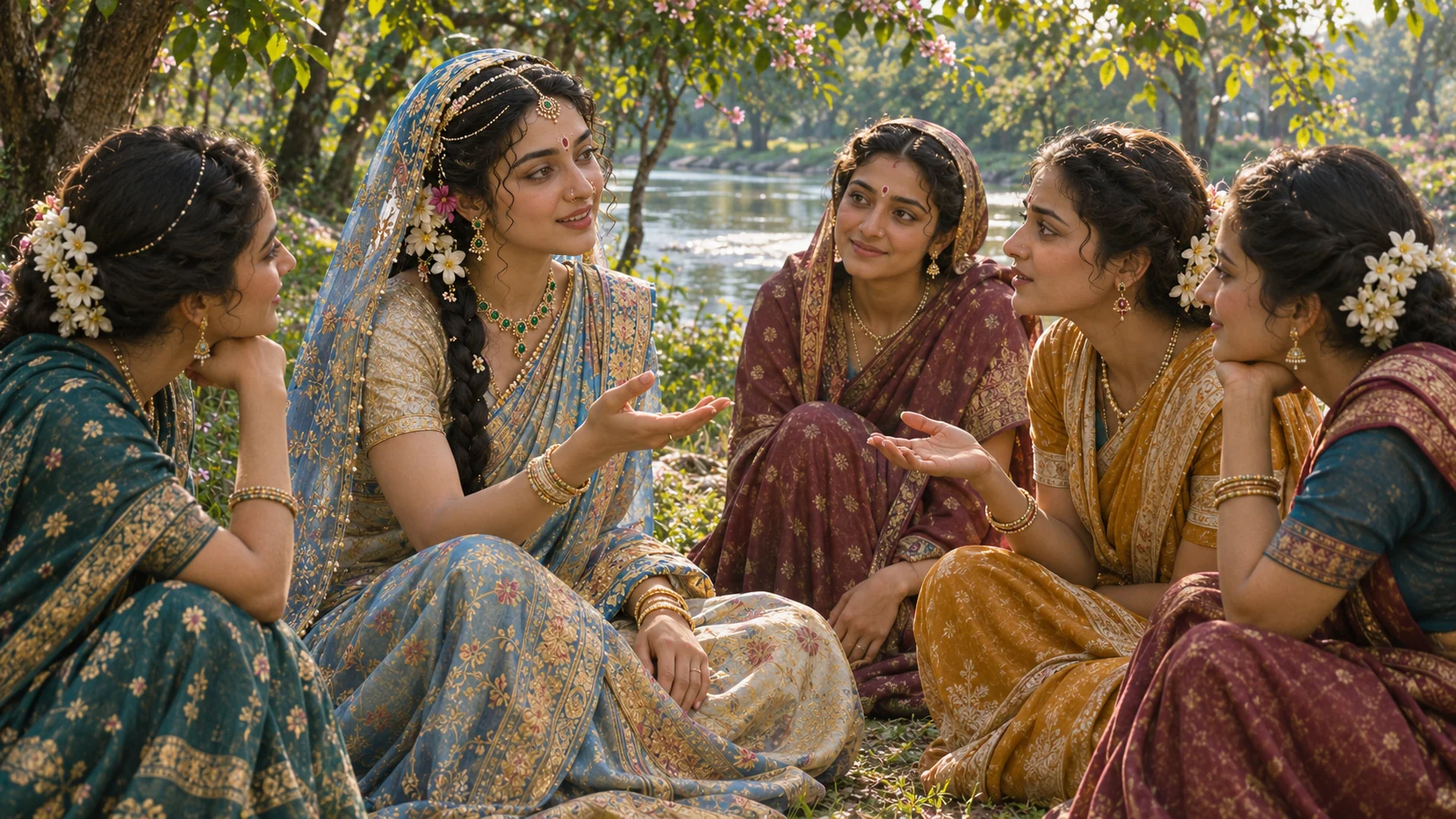
Narada told the king about the gopis he calls the Yajna-Sitas and how they came to Vraja. Their families had lived in the southern country of Ushinara, where no rain fell for ten years. Alarmed by the drought, the cowherds set out for Vraja with their families and herds. With King Nanda’s help they settled in sacred Vrindavan near the Kalindi, another name for the Yamuna.
Through Shri Rama’s blessing, the Yajna-Sita gopis were born in those homes. The beauty of Shri Krishna captivated them when they saw Him. They went to Radha to learn what vow they might observe to please Him. They addressed her by name and as the lotus-eyed daughter of Vrishabhanu. They said that even the gods found Nanda’s son hard to approach, although He was close to Radha. They also praised her for knowing the meaning of the scriptures.
Radha told them to observe the Ekadashi vow for Krishna’s pleasure. She assured them that by keeping it they would win His favor. The gopis asked to hear the names of the Ekadashis throughout the year. They also wanted to know how to observe the vow in each month.
Radha began with the origin of Ekadashi. In the dark fortnight of Margashirsha, Ekadashi arose from Vishnu’s body to overcome Mura. Radha called it foremost among vows and said that it appears in different forms over the year. She began by naming Utpatti, Moksha, Saphala, Putrada, Shattila, Jaya, and Vijaya. Then came Amalaki, Papamochani, Kamada, and Varuthini. After them she listed Mohini, Apara, Nirjala, Yogini, Devashayani, and Kamini. She went on to Pavitra, Aja, Padma, Indira, Pashankusha, Rama, and Prabodhini. She called both observances in the additional month Sarva-sampat-prada. She said that whoever recited all twenty-six names would receive the fruit of observing the vows throughout the year.
Radha then spoke of Dashami, the day before Ekadashi. She described taking one meal, practicing restraint, and sleeping on the ground. On Ekadashi, she said, a person rises before dawn and bows to Hari. Of the places she described for ritual bathing, she placed a river first. She spoke of laying aside anger and greed and keeping away from false speech, gossip, theft, and violence. She set out the dietary restraints for Dashami and Dvadashi and the actions to refrain from on Ekadashi.
Radha spoke of honoring Keshava with an offering of food. She told them to light a lamp at home with a heart full of devotion. After hearing sacred accounts from the brahmanas, they were to give them a gift. They were to spend the night awake, singing verses about Krishna.
The gopis then asked when to keep the vow and what the scriptures say about its fruit. Radha explained the relationship between Dashami, Ekadashi, and Dvadashi. When Dashami overlaps Ekadashi in the way she described, the fast is observed on Dvadashi. She compared that overlap to a drop of wine falling into a vessel of Ganges water.
Radha then spoke of the fruit of the vow. She compared it to the merit of feeding eighty-eight thousand brahmanas. For those sinking in the ocean of samsara, she called the Dvadashi vow a means of deliverance. She compared a person who devotedly offers tulasi to Hari on Dvadashi to a lotus leaf that water runs off without clinging. The vow bears equal fruit in the bright and dark fortnights, she said, just as both a white cow and a black cow give milk. A single Ekadashi, she said, can burn sins accumulated over many lifetimes as a heap of cotton burns.
She likened a small gift on Dvadashi to Mount Meru. She compared hearing accounts of Hari on Ekadashi to giving the earth with its seven islands. She named pilgrimage places such as Prabhasa, Kurukshetra, Kedara, Badari, Kashi, and Sukara to describe the merit of fasting. As Garuda stands out among birds, Vishnu among the gods, and tulasi among leaves, so Ekadashi stands out among vows.
Radha said that a person who observes the Dvadashi vow receives the fruit of ten thousand years of austerity. When she had finished, she urged the women of Vraja to observe it. Then she asked what else they wished to hear.