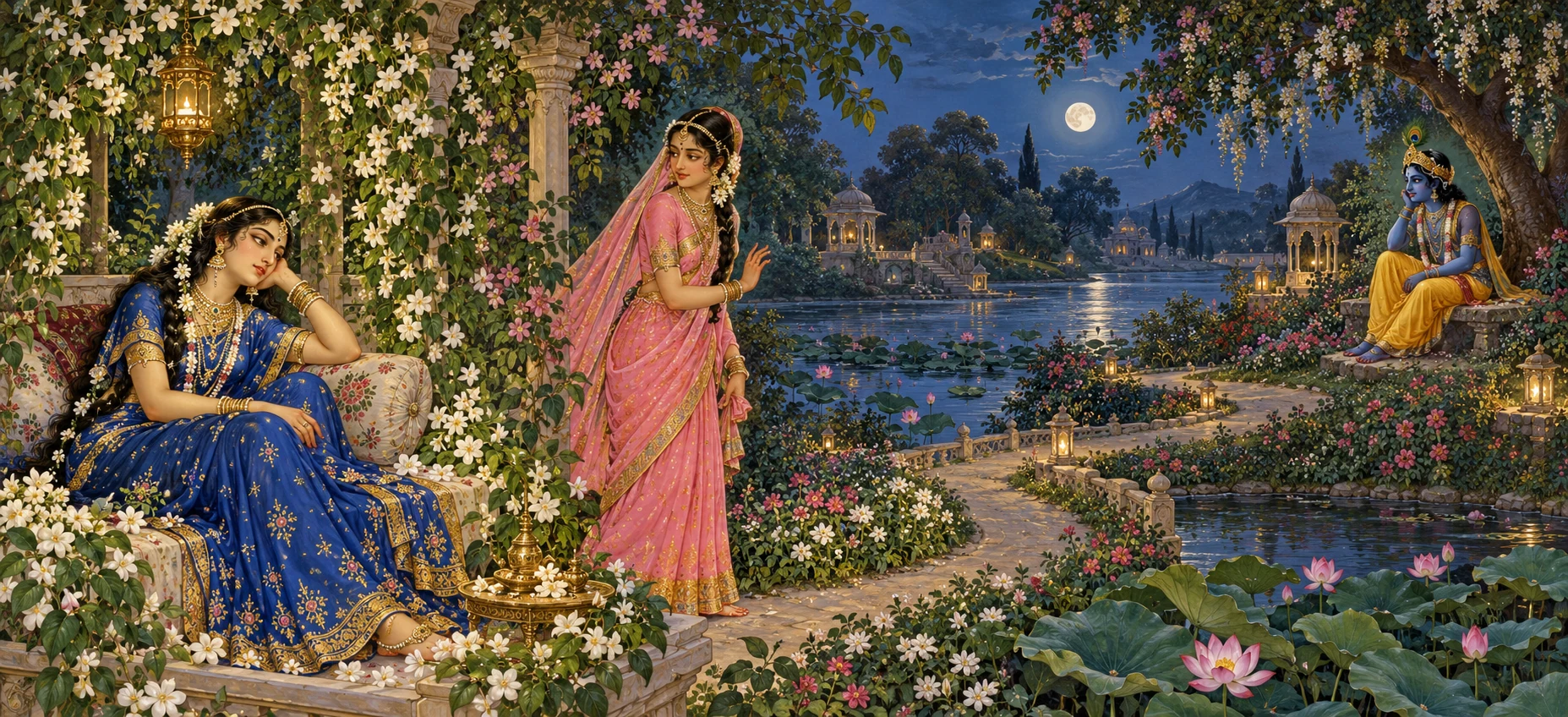
Radha remained waiting in the flower bower. Vines surrounded Her with gentle green shade. The Yamuna could be heard in the distance. The sakhi had already brought Krishna's invitation. Radha treasured every thought of Him. She wished to shorten the distance between Them. But longing filled Her so strongly that even a step became difficult. Her friend noticed Her hesitation. She stayed beside Her to help.
Radha tried to rise. She looked toward the path among the trees. She took a few uncertain steps. Her heart was already hastening toward Krishna. But Her body could not follow it. She returned once more to the bower. The sakhi watched over Her with care. There was no need to repeat the invitation. Radha already wanted to go. Now She needed patience and closeness.
Fresh lotus leaves brought a little coolness. Radha touched them with Her hands. Their tenderness calmed Her for a moment. But the thought of Krishna returned again. As though He were in every direction. She could imagine Him beneath the nearby tree. Then again on the path toward the river. Her eyes searched for the familiar face. Everything She saw became connected with Him. And the bower became a place of deep remembrance.
Then She looked at Her ornaments. She adjusted one decoration and paused again. The thought of meeting guided Her hands. In the poem Her remembrance becomes especially strong. She even imagines Krishna's appearance within Herself. Her own ornaments remind Her of His. Her gaze becomes absorbed in that imagining. For a moment the distance seems to disappear. But when She looks toward the path again, Krishna's footsteps are still absent there.
The night air changed the garden's light. A dark cloud shadow passed across the leaves. For Radha the dark color awakened His memory. She turned with joyful expectation. As though His presence were approaching. Then She saw that it was only a shadow. The sakhi understood Her gaze. She did not laugh at Her strong hope. She simply remained beside Her. Waiting needed such faithful company.
A petal fell from the vine. It gently touched Radha's garment. She raised Her eyes once more. A small sound came from far away. For a moment She wished it were His arrival. But the path remained empty again. Hope mingled with fresh sorrow. Radha turned toward Her friend. There were many questions in Her gaze. The strongest was when Krishna would arrive.
The sakhi listened to Her concern. Her task was no longer only to invite. She needed to bring this waiting closer to Krishna. To tell Him how much Radha wished to see Him. And how difficult it was for Her to set out. Radha received that promise attentively. Her friend knew the path. She could find Krishna again. And carry Her feelings to Him. Thus care gained a next step.
We may imagine the sakhi rising. She looks carefully at Radha before departing. She leaves Her a peaceful space in the bower. Then she goes among the flowering branches. She carries no adorned gift in her hands. She carries news of a waiting heart. Its truth matters more than beautiful phrasing. She will tell Krishna what she has seen. Without diminishing Radha's longing. And without forgetting Her tenderness.
The friend appeared before Krishna again. She began to speak to Him about Radha. About Her gaze that searched everywhere for Him. About the few steps She could not complete. About the remembrance filling the bower. His name lived within Her feelings. The sakhi wished Him truly to hear that. Her words became absent Radha's voice. A connection opened again between the two places. And the story continued through her message.
This is a literary retelling of the sixth chapter. Jayadeva describes the waiting through the sakhi's song. She tells Krishna about Radha's condition. The additional descriptions are imagined elaborations. The text is not a literal translation of the poem. The source chapter can be read through the link. Radha remains at the center of her care. Krishna is the one whom the news must reach. And the sakhi preserves the closeness between Them. With attentive words and faithful friendship.