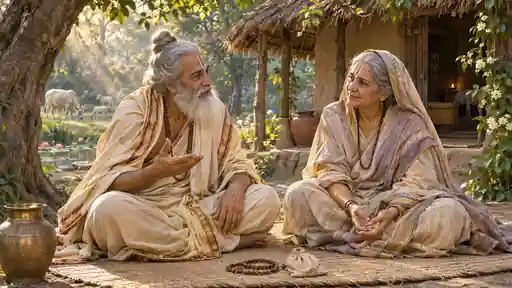
When Garga learned what the families wished, he remembered Vasudeva’s counsel. The course of Krishna’s pastimes was difficult to understand, he thought, even for those given a place in them. He had to speak so that the girls would come to no harm, their hope would be fulfilled later and in time all would come to fullness. He went to Vraja without delay. At her hut he found Paurnamasi deep in meditation. He told her what the families were considering and asked her to see that the apparent ties others would see remained mere appearances.
He spoke with Nanda and then went to the other households. They received him with respect and asked what to do. Before long, he said, all Vraja would undergo a long separation from Krishna, how much more those who loved Him so deeply. Even when He was away, no one would be able to turn them from the image of Krishna in their hearts. Despite Garga’s words, Nanda and Yashoda grieved for their earlier hope, especially when they thought of Radha. The poet asks who would fail to delight in a jewel set in gold, in autumn joining the waters of a lake or in the moon joining the bright half of its month.
Some of the fathers came again to Nanda in private. With a sigh, he told them they should not arrange such a match with his son. Their children, he said, were as dear to him as to them, and he would help them. Without any eagerness the elders began outwardly to follow the counsel. The girls were busy with their childhood games and noticed little of what the adults were discussing.