In the center of the lotus of Gokula shines a home built of jewels of many colors. Here the son of Vraja’s king lives out his pastimes. The cowherds, his close companions and kin, live all around it like the filaments surrounding the heart of a lotus.
The word for kin gives Jiva a way to speak of those who share an inheritance. The cowherds have a share in Krishna, and he in them. Their love reaches even into their ordinary occupations. Jiva cites the verse in which Krishna returns with Balarama after vanquishing Arishta, praised by his own people and a joy to the gopis’ eyes.
On the petals open separate groves for pastimes. Among their wish-granting trees are houses of cintamani where Mukunda enjoys the intimacy those places shelter. Jiva recalls the tradition that Krishna entrusted rule of the realm to Radha. He then delights in the thought that such a gift was hardly needed when Krishna himself was already won over by her qualities.
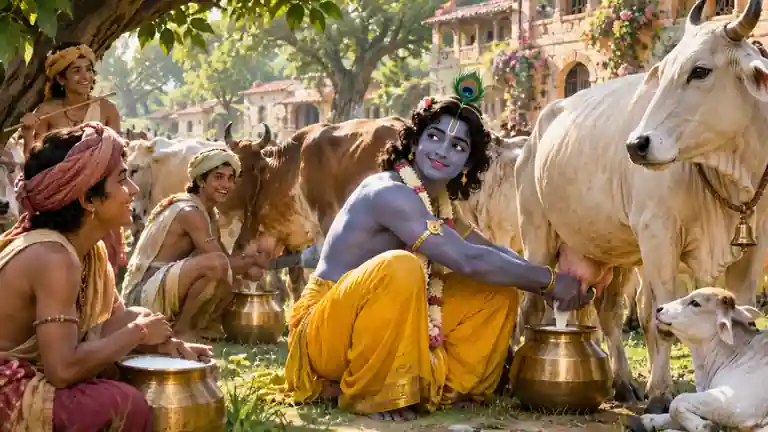
The petals curl a little, with raised edges. Broad stretches lie between them, and the cowherd settlements shine at their junctions. At milking time Krishna is with the people who tend the herd. He watches and protects the surabhi cows among the houses and trees around the lotus.
The four-sided region around the lotus is called Vrindavan. The wider shining region is known as Shvetadvipa or Goloka. Farther out, in a space as expansive as the sea, the poet sees worlds free from grief. He calls the groves on the petals smaller Vrindavans, places for pastimes within the great Vrindavan.