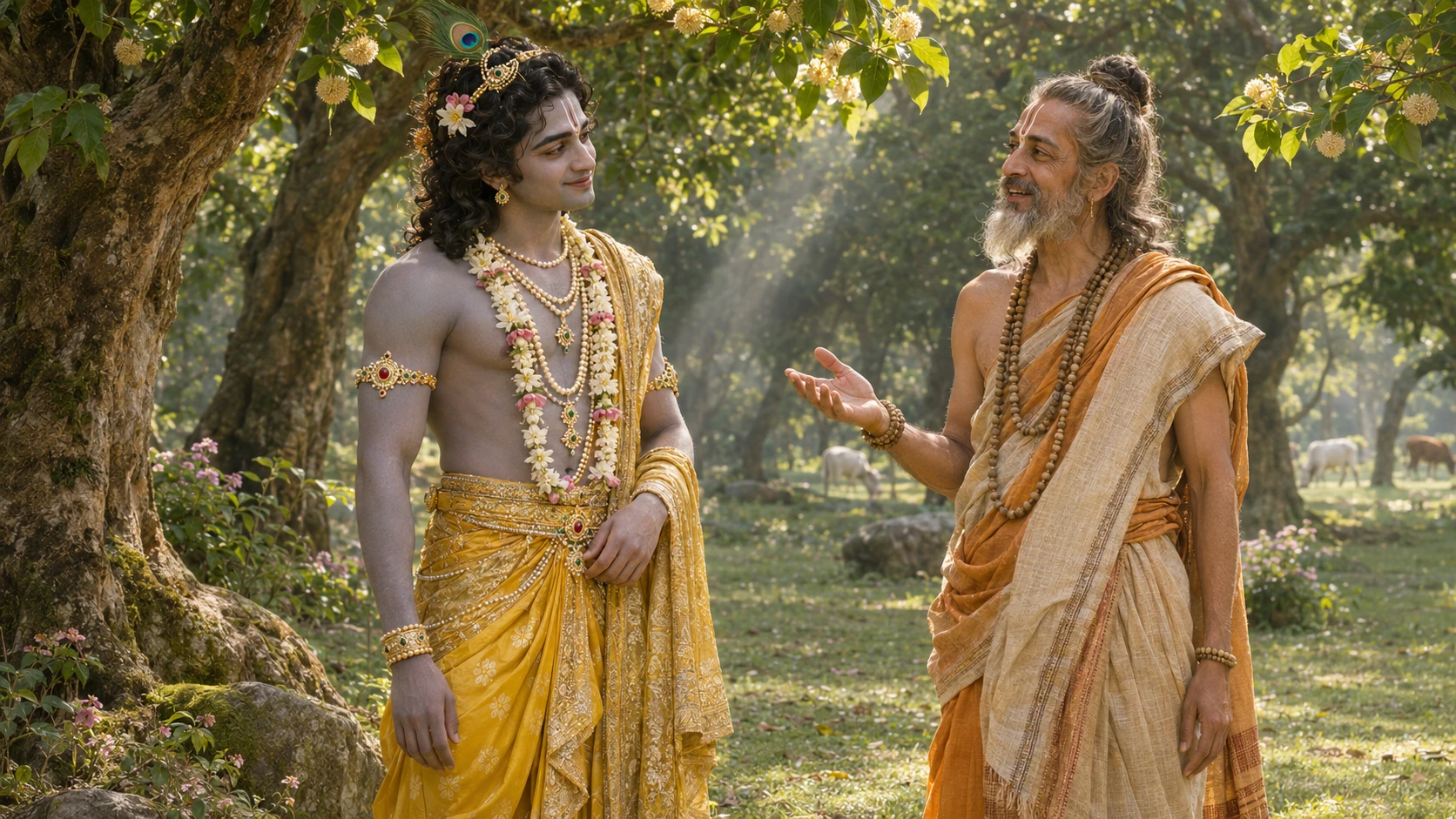
On the morning before Keshi appeared, Krishna thought of the affairs still awaiting him with Kamsa. He wondered how long they might keep him away from Vraja. He recalled that his father did not drink water before him and that his mother sighed deeply without him. He thought of all the people devoted to him, and even of the animals. He wished to share the thought with his elder brother, for a person who feels another’s grief knows how to be compassionate. After Keshi was overcome, Krishna went into the woods on foot with the cows. In a secluded spot the celestial sage Narada came to meet him. Krishna saw him as though he descended like the Ganga from Vishnu’s feet. The divine names resounded in Narada’s singing as though he carried them within himself. Narada took in the gentle dark face, yellow clothing, eyes, and peacock feather. In Krishna he recognized traits the traditions ascribe to other appearances of the Lord.
The sage addressed him in praise. He recalled how easily Krishna had faced the dangers sent against him even in childhood. His fame, said Narada, brightened everything. If even Kamsa seemed to have turned white in its presence, it was fear that had made him pale. Narada then stated his reason for coming. Love wins over everything, he said, and it held Krishna so close to Vraja that it was difficult for him to turn his thoughts to what lay ahead. He said there were many other devotees whom Krishna was to protect. The events ahead would unfold in their own order. Kamsa would send Akrura for him, the sage said. The hour would come for Krishna to set out and part from his mother and the rest of his family. Krishna’s face changed color at those words. Narada noticed and told him what was to happen in the city.
Akrura would be the person to open the way for the journey. In Mathura, Krishna would pass the bow, the elephant and the wrestlers, end Kamsa’s rule, and free his parents. The kingdom would be handed over to Ugrasena, Narada said. Inwardly Krishna thought this fitting, since what was dear to him was to return to Vraja. Aloud he asked what would happen next. Narada answered that the townspeople and the gods above would see him and Balarama together. The townspeople would wonder how they could see such sweetness and such strength in the same face. Even the tears of Kamsa’s wives would move Krishna’s heart. Krishna asked which parents the sage meant. Smiling, Narada repeated Garga’s words that Nanda’s son had also once been born as Vasudeva’s son and was therefore known to the discerning as Vāsudeva. Krishna smiled with surprise and again asked what came next. Narada said that Vasudeva and his family would receive him like a precious gem found again and would find it hard to let him go.
Some days would be needed to bring back the Yadavas who had scattered. Until then Nanda and the others from Vraja would wait in their encampment of carts. Ugrasena would have to set in order the capital that had long suffered under Kamsa. Even with Krishna’s help, this would require time and attention. Narada said that Krishna would go with Balarama to Nanda and settle on returning to Vraja as something he must do. Krishna asked whether Nanda and the others really would leave without him. Only at his insistence would they leave, said Narada. In Vraja their bodies would be seen, but their hearts would remain with him. Krishna asked what he should tell them. Narada gave him the words he would say to Nanda. Let them return to Vraja, and both brothers would come to see their loved ones as soon as they had cared for those who needed them. Those very words, Narada said, would bring them comfort and a reason to wait.
Krishna asked when he would return. The sage answered that it would be when he had secured the happiness of the loved ones who needed him. Krishna asked when that hour would come and how far he would have to go for it. Narada told him that one duty would follow another and that the separation would last. Krishna found the answer hard to hear. He told the sage that the long delay itself would bind him and bring him great sorrow. Narada offered comfort by speaking of Krishna’s own nature. To relieve the sorrow of those farther away, he sometimes bore the pain of his closest companions as though it were pain in his own body.