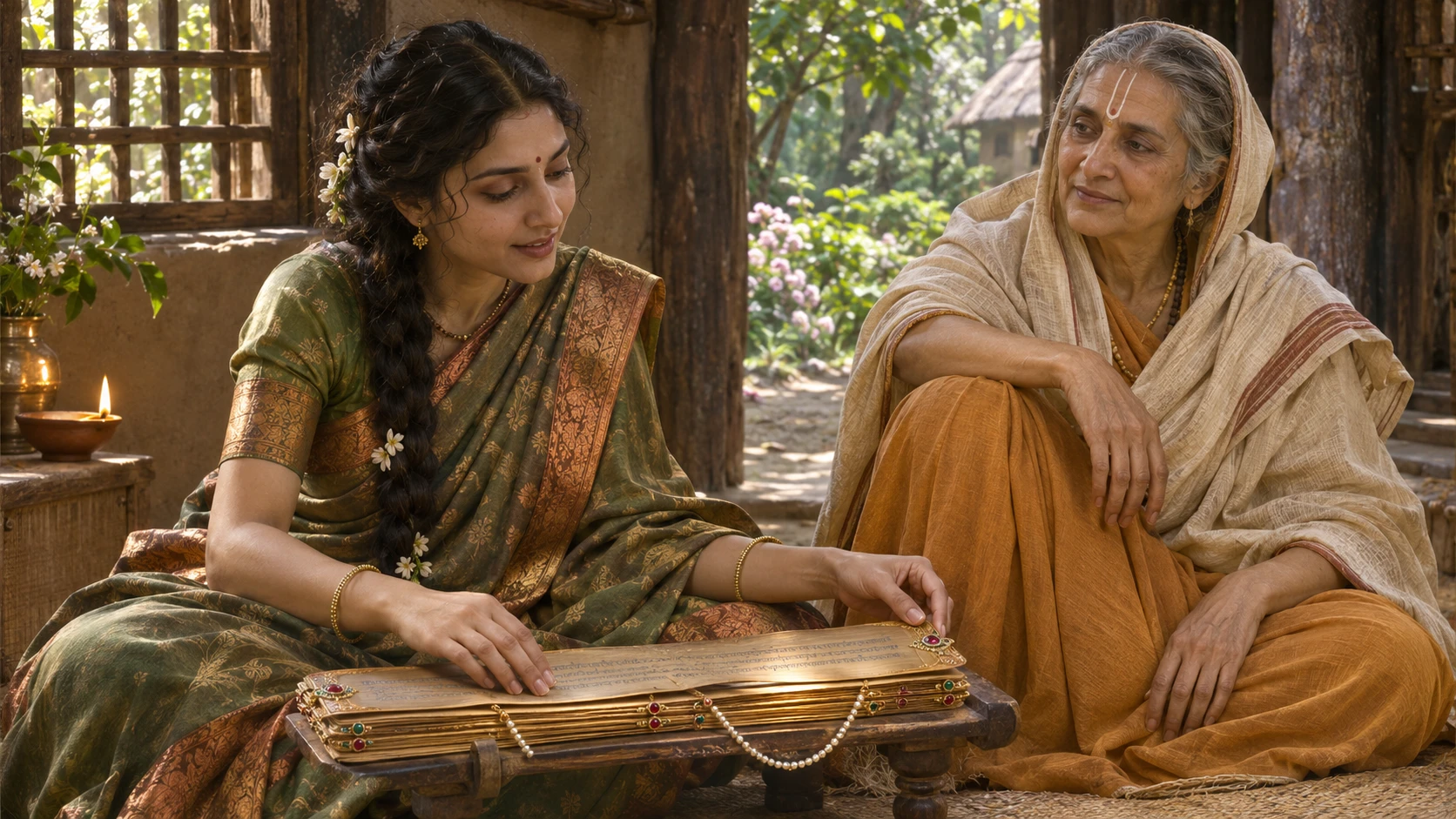
After Krishna left for Mathura, Vrinda and Paurnamasi could scarcely bear the grief of the people of Vraja. With Madhumangala they withdrew to a secluded woodland retreat, where they talked over what had happened. Much later, when news of the conflict with Shalva brought fresh anxiety to Vraja, Vrinda asked Paurnamasi through tears what would happen next. Paurnamasi said grief had dimmed even what was before her eyes, and that what still lay ahead was harder to see. Vrinda wondered how Paurnamasi’s knowledge could be clouded when by Yogamaya she concealed her true form under the dress of an ascetic. Paurnamasi reminded her that Vrinda felt the same pain. She explained that the power of love carries away even Krishna. She recalled the moment when he searched the forest for the calves and their herders. Closeness to the devotees makes that power visible. Both of them, and Krishna himself, were at times immersed in Vraja’s love as if in a river, Paurnamasi said.
Vrinda asked what hope was left to them. Paurnamasi told her that after a night spent lamenting, an unknown man had come to her. He had placed a book in her hands, told her to examine it, and gone away. Because Paurnamasi’s eyes kept filling with tears, she asked Vrinda to read for her. The book had golden leaves with letters as deep in color as blue jewels. Gems adorned it, and a strand of clear pearls held it together. To Vrinda the gold, dark sheen, and pearls recalled Krishna’s garments and ornaments. She felt as if he himself had appeared there. Paurnamasi was delighted and asked her to begin at once. In the note on the manuscript, Vrinda found that it contained passages from the Padma Purana, Srimad-Bhagavatam, and other writings that illuminate them. They read of the encounter with Dantavakra and paused over the difference between the two accounts. Paurnamasi suggested reading them together, since a detail in one could explain a detail in the other. When she reached the words about the return to Vraja, Vrinda grew animated. In the account, Krishna crossed the Yamuna, paid respects to his parents, and received their tearful embrace. The account also told how he bowed to the elder cowherds, comforted them, and gave joy to the people there with jeweled ornaments.
Vrinda wondered whether the people might still disappear from her forest and have to bear separation again. Paurnamasi asked her to keep reading. In one text Vrinda found a description of a kadamba east of Kaliya’s pool. The tree has a hundred branches and blooms through all twelve months of the year. Another passage spoke of a white-shining ashoka north of Brahma-kunda which flowers on the twelfth day of the bright half of Vaishakha. From the Skanda Purana she read that in Vrindavan, under Vrinda’s care, Madhava is always playing with the calves, with Balarama, and with the cowherd boys. How could he always be playing there, Vrinda asked, when everyone felt that he had been away so long? Paurnamasi said that in his eternal presence the periods of visible separation are like a single moment. Then Vrinda read a conversation in which Narada asks about the twelve forests. Krishna tells him that Vrindavan is his home and counts the animals, birds, trees, and people who live there as his own. In the same text Krishna says that he never leaves the forest, though from age to age he appears and withdraws from sight. Its beauty, he says, cannot be seen with ordinary eyes. Paurnamasi explained that the scriptures were speaking here of the visible and hidden pastimes. The splendor of Goloka, she said, is always present in Vrindavan. To explain it she asked why anyone would climb far to find honey if it was already close. At that moment neither Vrinda nor the people of Vraja could see the full extent of the place where they lived.
Vrinda asked again why, if Krishna could comfort the people of Vraja, he had allowed them to undergo separation when he set out for Mathura. Paurnamasi answered that separation too has a place in the course of the pastimes. It enlarges the joy of Krishna’s reappearance and deepens their longing love. They continued with Shuka’s words about Krishna, whose smiling face nourishes the love of the people of Vraja and of the city. Paurnamasi heard in them testimony to his continuing pastimes. Paurnamasi also mentioned the temple in Dvaraka spared by the sea, as another image of a presence that endures when the place around it has changed. Vrinda read Brahma’s prayer to be born even in the forest so that he might receive the dust of the feet of Gokula’s people. They already had Krishna as their dear friend, Paurnamasi said. When Vrinda read about the shelter beneath Govardhan, Paurnamasi recognized Krishna’s commitment to care for those who had taken refuge in him. At the end Vrinda bowed. She said the book had filled her heart and asked leave to set it like a jewel at the center of a necklace. Paurnamasi told her to do so at once, and Vrinda did.