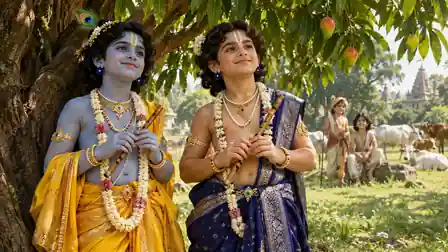
Krishna saw that the girls lived under stern glances and reproaches. Finding no other way to share His thought with them, He began practicing the flute in a new way. At first He played as a pair with His elder brother. While tending the cows He delighted in improving the music with Balarama day after day. Even His companions in the forest were surprised by the sound. The girls did not see Him, yet His form appeared so clearly in their thoughts that the storyteller jokingly calls them scholars of logic. From what they heard they could sense what was beyond their sight.
The closest friends felt the others’ distress so keenly that they seldom spoke of their own. Lalita, Vishakha and her companion Anuradha were with Radha. Shaivya and Padma were with Chandravali. Once they knew they could trust one another, they began to tell what was in their hearts. In their first song they described Krishna together with Balarama, so they could say something in the song and still keep something within.
They sang of the brothers as skilled dancers. Tender mango leaves fluttered above their heads. In the hair with peacock feathers and jewels they saw a cloud beside a rainbow and stars. Fresh dark lotuses by the ears added another radiance. Krishna turned a lotus in His fingers, and bees around the garlands seemed to compete in humming. One brother was fair and dressed in dark cloth, the other dark and wearing yellow. To the girls, when such music reached Gokula, sorrow no longer held the same place.
They were most drawn to the moment when the brothers entered the settlement with the cows and friends. The poet singles out the younger brother’s face, the light of the flute, and an eye that in the same instant seems to be looking for someone. That eye, the gopis say, reaches their hearts even while Krishna laughs, plays and passes His time as usual.