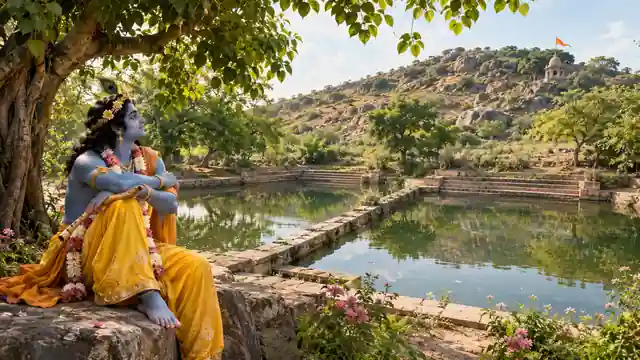
At the beginning of Gopala-campu, Vrindavan is the good fortune of the Earth. The forest shelters the world and even its passing breeze, the poet says, has an uncommon power to purify. He sets out its gifts in paradoxes. The forest can grant liberation, yet those who have caught the scent of freedom can find themselves bound anew, this time by affection for it.
Even Brahma longs to take birth there. A place so difficult to describe can awaken a poetic voice in someone who has never thought of himself as a poet. In that forest the joy of Nanda’s son continually renews itself. Jiva recalls Shuka’s account of the delight Balarama and Krishna felt at the sight of Vrindavan, Govardhan and the banks of the Yamuna.
The poet pauses first at Govardhan. Gokula is the home of the one the sacred accounts call its lord. The cows give the place its pastoral character, and the hill that nourishes them with pasture is a treasure house for all Gokula.
Manasa-ganga passes through Govardhan. In its current the poet imagines a stream of Krishna’s love entering the heart of the hill. The nearby pools of Hari and Radha seem like their mutual love given visible form. The waters appear to touch and share their fragrance, and their quiet trembling softens the hearts of devotees.
The Yamuna is the daughter of the sun. Her dark waters carry Krishna’s sweetness, so that a glance at the river can call him to mind. The poet wonders whether she came from a drop from his body or whether her flowing waters took on Vrindavan’s very affection for him.
The sandy banks show the same love. Those who look on them and remember the rasa dance taste its delight anew. The poet imagines the Yamuna continually dusting her banks with a powder that renews that joy.
He remembers Bhandira as well. The poet imagines that place drawing out of sight when Hari withdrew, as if it no longer had the strength to show its tenderness and must leave that to Govardhan and the other beloved places.
In the still trees he sees the rapture that leaves one motionless, in the moving leaves its tremor, and in the young shoots a thrill passing through the forest. When Nanda’s son appears in Vraja, the grace of his home becomes visible too. Jiva connects this with the verse about the abundance of Nanda’s Vraja and with the sacred accounts of the enduring forest, where the pastimes of Balarama, Krishna, the cows and the cowherds have their home.