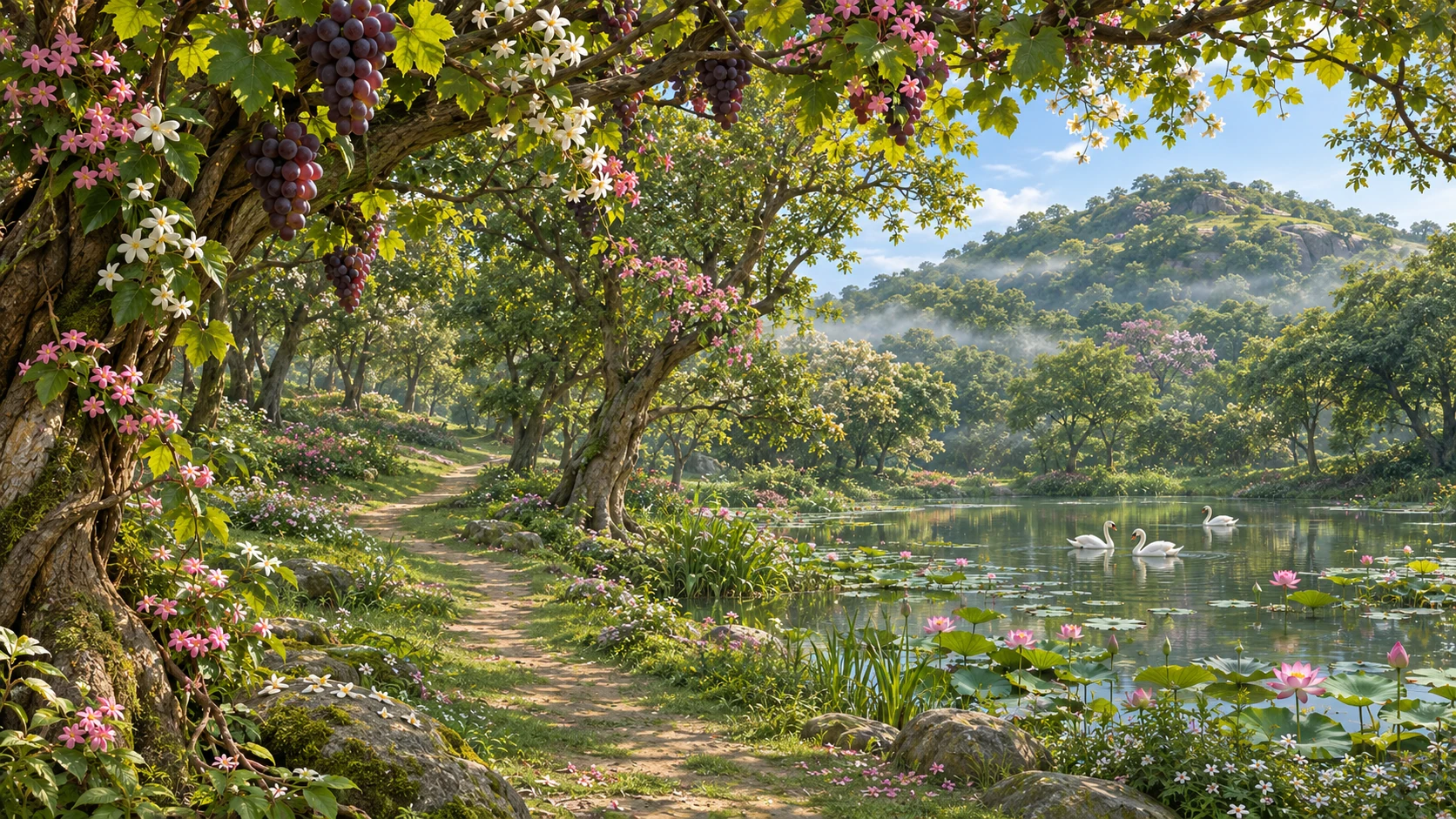
Vrinda led Radha and Krishna into the woodland. She likened it to their closest friends when love becomes visible in the body. Here moving creatures stand still, motionless things stir, stones give out drops of water, and fresh shoots appear like a tremor upon the skin. In the beating of wings Vrinda heard the sound of a voice beginning to falter with feeling.
Spring adorned the forest with madhavi and bakula, summer with jasmine, roses, and shirisha. At the rains it opened yuthika, kadamba, and ketaki. Autumn brought jati, lotuses, and blue blossoms. Early winter offered lodhra and amlana, and the cold season brought bandhuka and kunda. In one place cuckoos sang with bees, in another cranes called with swans. Different branches bore buds, green or pale leaves, and fruit at every stage of ripeness.
The forest had prepared for the arrival of Radha and Krishna. Airborne pollen made a canopy, and the fallen flowers clothed the paths in many colors. When their moonlike faces appeared, the moonstone altars, in the poet’s image, released water for washing their feet. Grass, shoots, and lotuses formed a welcome offering. Clove buds and fragrant fruit answered to the water for rinsing the mouth. Trees bowed with honey on their flowers while the cool breeze carried drops of water for bathing.
Vrinda showed what garments and jewelry the woodland could make of its flowers and leaves. There were jasmine strands, malati earrings, amlana for the hair, and little bells of kunda. The air carried pollen scented with sandalwood, aguru, musk, and vermilion. Garlands included tulasi, buds, and new leaves. Bees rose in the scented air like incense smoke, and the fruit of the trees became food for the offering.
The champaka tips swung like lamps at arati. Birds played the instruments, bees sustained the sound of the offering song, and cuckoos sang a fifth note. Parrots called out praises of Radha and Krishna while peacocks danced. A swirl of flowers looked like a parasol. Vines and banana leaves cooled the pair like whisks and fans. Vrinda called the breeze a weaver for making them a canopy of colored pollen the bees seemed to hold up.
Vrinda next pointed out Vasanta-kanta, the woodland of spring. Krishna described to Radha the bees leaving kunda for the mango blossoms. Cuckoos broke their silence beside the mango, where in His comparison their voices grew sweeter. Madhavi, yuthika, and jasmine vines twined about trees, with champaka and bakula among them. Krishna drew attention to the white lotus and the golden stamens set against the colors of the spring woods.
Krishna found in the name atimukta a word that could speak to a maker of chariots, a weaver of madhavi garlands, and one seeking liberation. He pictured bees inspecting flowers for the arrows of love. A bee saw her own reflection beside her mate inside a flower, mistook it for a rival, and gave up the honey. Krishna showed Radha the banana fruits as the tree’s smile. In the final image bees danced a ring dance over the vines and disappeared among lotuses.