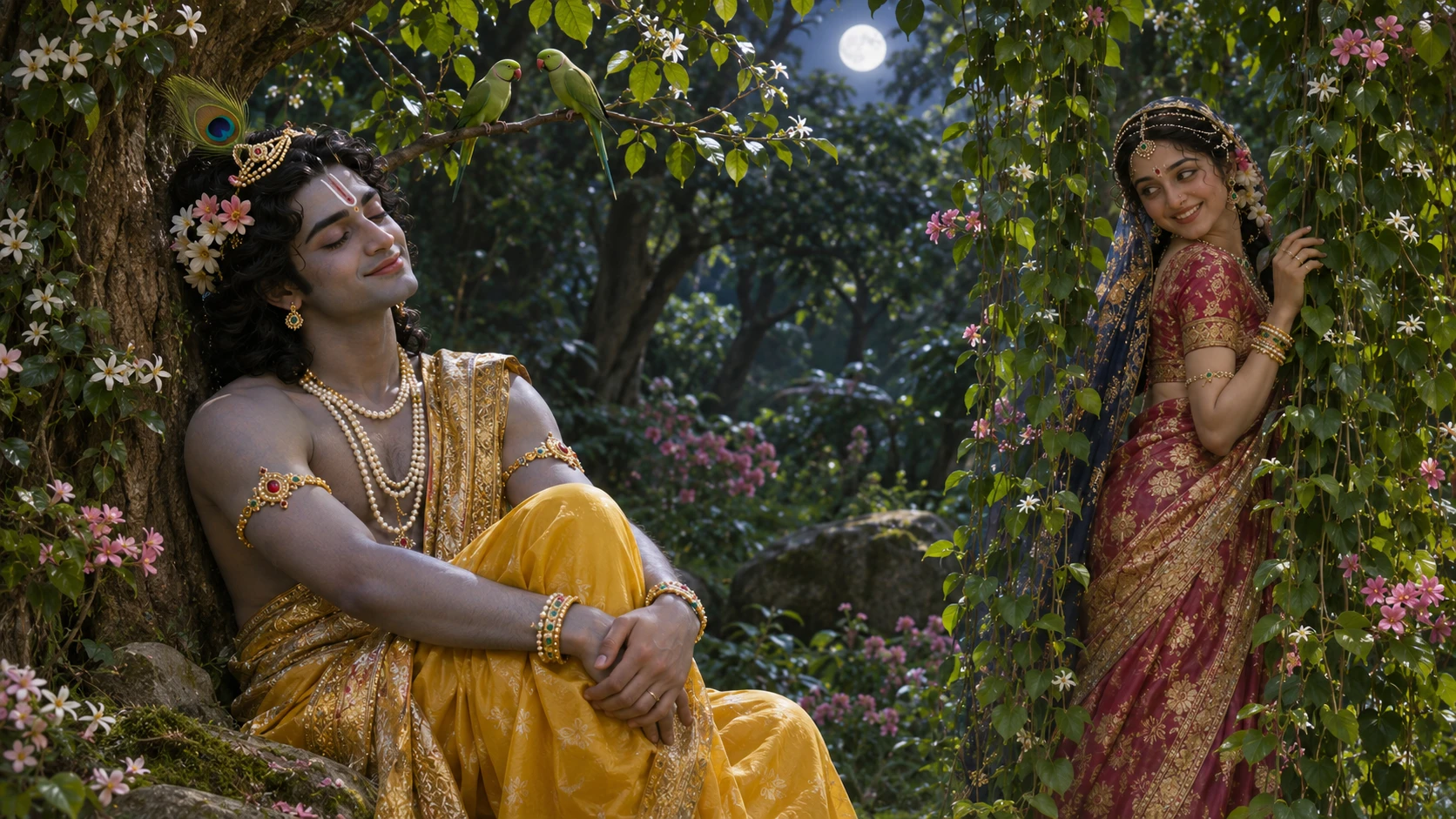
The birds continued their praise with an image of Radha. When She saw Her face reflected in Krishna’s shining chest, She thought She saw another girl and turned away. In the next verse Krishna’s attention is a bee that stays with the sweetest lotus. Just as the sun warms, the moon cools and the ocean is deep, Krishna is naturally drawn by love. The birds sang of His steadiness and of the restlessness that Radha’s glance can awaken in Him.
Even Lakshmi is drawn from a distance by His qualities, the birds sang. In Vraja every sign of affection can become an offering. The sakhis’ tender words were like water offered in worship and their gentle smiles like flowers. To those who long for wealth Krishna is a giver, to the distressed a merciful deliverer, and to the people of Vraja a friend. The birds placed devotion above inherited rank and praised His compassion even as they recalled Putana.
The song then sounded like a conversation between two sakhis. One pointed out a stream of the Yamuna, a blooming lotus and a swarm of bees, in which Krishna’s form, face and hair could be recognized. Then came the flute. In the verse it stills creatures that move and stirs those that stand still. The sakhis addressed it as a friend and wondered whether its melody carried nectar or poison, so powerfully could it revive and unsettle them.
The birds mentioned a gopi who came home and saw an older woman. The memory of Krishna’s hand on her shoulder was so clear that she spoke to Him as if He were still beside her. The song then returned to His strength and kindness. He lifted Govardhana unperturbed and brings blessing even to those who oppose Him. When He returns in the morning, the red traces of Radha’s dye blend with the mineral colors on His brow. Her love grows each day, and with it the joy of the sakhis.
Krishna’s fame was like the purifying Ganga, and His flute answered a variety of longings. His jokes multiplied with the games of His companions. Subala and the others understood His wishes and prepared a bed for Him in the bower. In the forest itself, vines offered Him ripe fruit, flowers and new shoots. The Pulinda women found on the grass the red powder that had passed from Radha to Krishna’s feet. Even in the caves of Govardhana, where there was shelter and food for the wives of defeated adversaries, praise of Him was heard. Recalling the collapse of Kamsa’s confidence, the birds admitted they had tried to touch only one drop of Krishna’s innumerable qualities.
The parrot and the sarika seemed to dive into the ocean of praise and rise from it again. The first eight-stanza hymn, the Krishna-chandrashtaka, turns to the son of the cowherds’ king. His dark hue surpasses clouds and sapphires, and His garment blazes like sunrise and lightning. His makara earrings sway over His cheeks, and His friends always find something fresh in His games. The gods bow before Him, while He pays His respects to elders every day. The hymn remembers Indra, Kaliya, Kamsa and Vatsasura and likens His pastimes to rain for the chataka birds that wait for it.
The later stanzas praise the rasa dance, the jokes that delight Radha and the sakhis, and the glance with which Krishna shows what He feels. In the last, Radha is picking flowers and Krishna watches Her shy reserve with delight. The same wish runs through all eight stanzas, the wish to serve Krishna. The concluding verse connects singing the hymn with serving Him in the forest of Vraja while He is with Radha.
The second hymn, the Radhikashtaka, addresses the same request to Radha. Her luster outshines a golden lotus touched with red powder. Her silk sari is brighter than coral, and Radha’s garden is where Krishna comes as a bee. She worships the Sun to be with Him always. Her tenderness surpasses that of fresh petals, and the verse gathers around Her the coolness of camphor, sandalwood and lotus. Even Lakshmi honors Her, says the hymn, for Her beauty, character and pastimes.
The final stanzas praise Radha’s skill in rasa, singing and wit. Her love is ever fresh, and Her thoughts stay with Krishna’s appearance, dress and play. Joy, reserve, trembling and tears show Her feelings as ornaments that Krishna notices. Even a short separation brings Her sorrow, which passes when Her effort brings Him near again. The closing verse promises that Radha will soon bring the one who sings to Her into service that delights Her sakhis. When the two birds finished, the narrator compared the gathering’s joy to a sea without shores.