Madhumangala showed Radha and Krishna the woods of summer. In the birds’ calls he heard different drums, in the crickets small cymbals, and in the cuckoos the notes of a vina. Parrots sang their praises, bees hummed, and vines swayed. In his description the forest offered roses for a garment, shirisha for earrings, and jasmine for ornaments.
Madhumangala named ripe pilu, mango, bilva, jackfruit, and palm fruits and admitted how much he liked them himself. Beneath the sun the trees shaded the pair with their leaves. The clusters and the drops on flowering banana trees made him think of mothers caring for their children. When the friends saw a cuckoo with its beak in a ripe mango, they laughed at the resemblance they saw to Krishna and Radha. She lowered Her head.
Beside the lake a jasmine creeper wrapped around a tamala tree. Madhumangala saw a smile in its flowers, eyebrows in its bees, and in the whole picture a ring dance of Krishna and the gopis. Radha and Krishna smiled. Vrinda brought shirisha flowers, which they placed on one another’s ears. Krishna scattered pollen through Radha’s curls. She shook pollen over His hair and peacock feather.
At the edge of the summer woods Krishna spoke to Radha of coolness as a treasure hiding from the heat. In His poetic image Radha’s moon-bright face caused the moonstone in the little dams to give out water. Birds were drawn to the bridges to bathe, drink, and cool themselves.
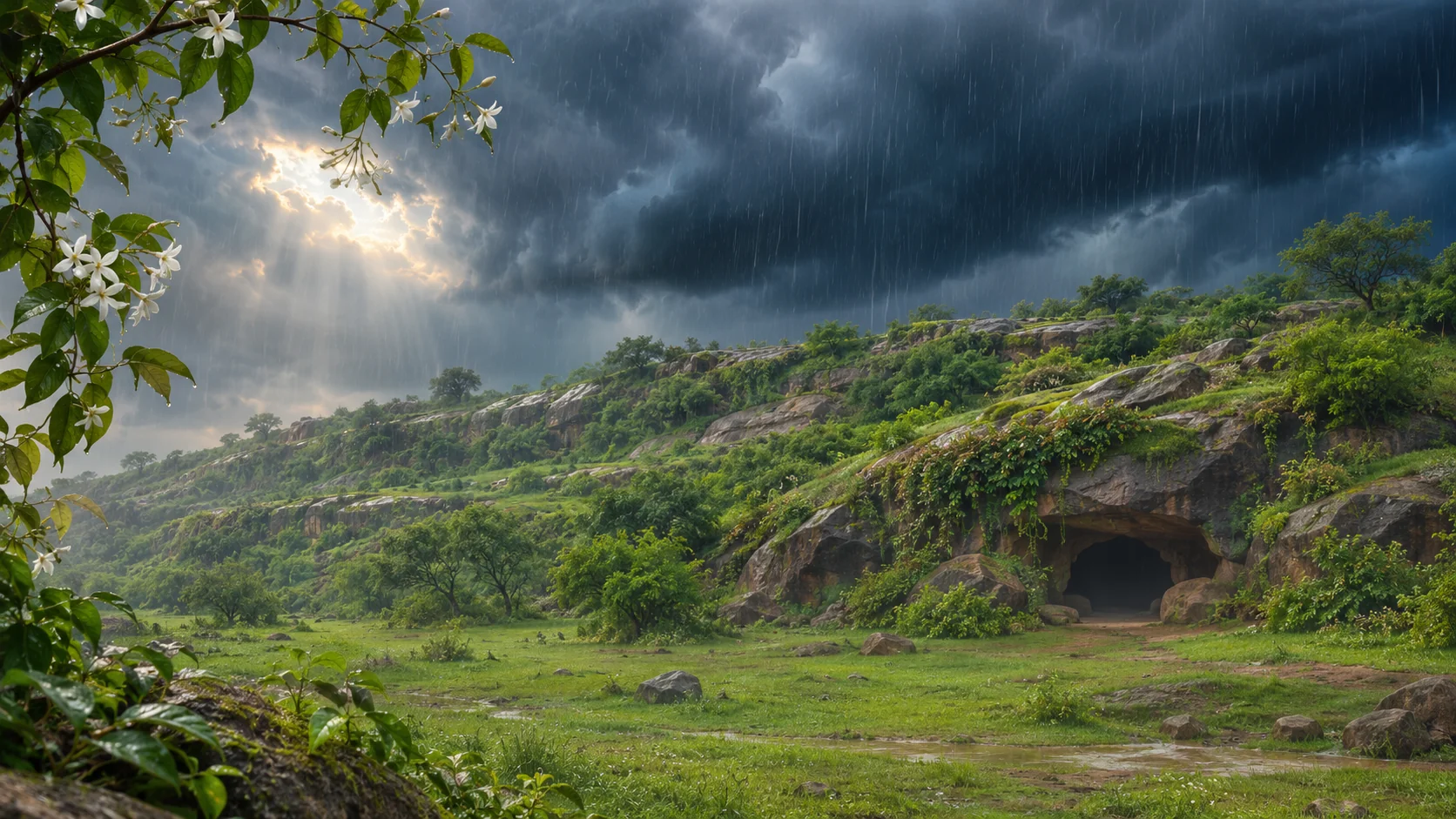
Subala pointed out the monsoon woods. Peacocks danced the way they do before a cloud and a flash of lightning, for in Radha and Krishna they saw both. Yuthika drew bees from the jasmine. The sky darkened, the earth grew wet, and arjuna, nipa, and kadamba flowered in every direction. Among the sounds of birds and frogs were the calls of cranes, swans, peacocks, and waterfowl.
Subala described the clouds as a blue robe, the line of birds as pearls, and the rainbow as jewels. Among the monsoon’s gifts were kadamba garlands, mountain jasmine for the hair, ketaki and rangana crowns, fragrant necklaces, and ripe fruits. He even heard the birds’ cries asking who could take Krishna’s place and where else He could play but Vraja. Frogs made fun of the rain cloud, whose showers, unlike the joy of Krishna’s pastimes, did not reach every season.
Honey fell from the kadambas and bees hung above them like dark clouds. A peacock spread his tail and danced before the other peahens, keeping his own companion out of sight. In the closing image Radha was lightning beside Krishna’s cloud. The sakhis received the sight as thirsty chataka birds receive a drop of rain.
When they reached the edge of autumn, Krishna likened the change to leaving childhood and coming into youth. Bees left the spent yuthika vine for fresh flowers. Red gunja seeds colored the woods, white kasha flowers lay across the ground, and fallen peacock feathers lay among them. The peacocks were quiet and the swans could be heard. The strewn shephali flowers reminded Krishna of the sakhis scattering when He sought His flute.
Kundalata presented autumn as a friend clothed in white clouds, with a lotus face and the calls of cranes for anklets. That friend, she said, was waiting with jati and rangana, white lotuses for their heads, and red and blue ones for their ears. Shephali flowers falling by themselves would make a bed in the bower. The chatima trees sent out a strong fragrance, and swans, bees, and birds sounded around them as they entered the autumn woods.