Beyond the first ring of groves at Radha-kunda, trees shade the paths on either side. The middle of the clear crystal walk glitters with emeralds in such a way that it seems to ripple like a current. Here even a gate can look like a wall and a wall like a gateway to someone who does not know the gardens.
Near the northern bathing steps stand eight groves in the shape of lotuses with eight petals each. A temple there, Ananga-rangambuja, is compared to a lotus of a thousand petals. Golden banana trees form its filaments and a bright gold platform sits where the seed cup would be. The platform seems to grow or draw in as the play of Krishna requires. Lalita's disciple Kalavalli cares for the place, which offers the pleasures of all the seasons.
In Lalita's own grove, Lalitanandada, jewel colours distinguish one petal and gallery from another. Platforms of gold, lapis, sapphire, crystal and ruby surround the centre. The jewel pictures include pairs of animals, birds, heavenly beings and people. Five colours run through the flowers, leaves and canopies, and flowering ashoka vines define eight smaller groves. Toward the northeast lies a bower devoted to spring, Vasanta-sukhada, alive with the sound of bees and cuckoos.
A lotus temple toward the southwest has gates and windows on four sides. Lalita keeps jewel-inlaid pictures of Krishna's pastimes on its walls, including the rasa dance and His defeat of Putana and Arishtasura. Sixteen petal-like chambers enclose its centre. Crystal columns support open coral balconies, and canopies above the spires shelter them from rain. Radha and Krishna look out over the woods from the high terrace, where strings of pearls hang along its sides. Below are more decorated platforms and rows of fruiting and flowering trees.
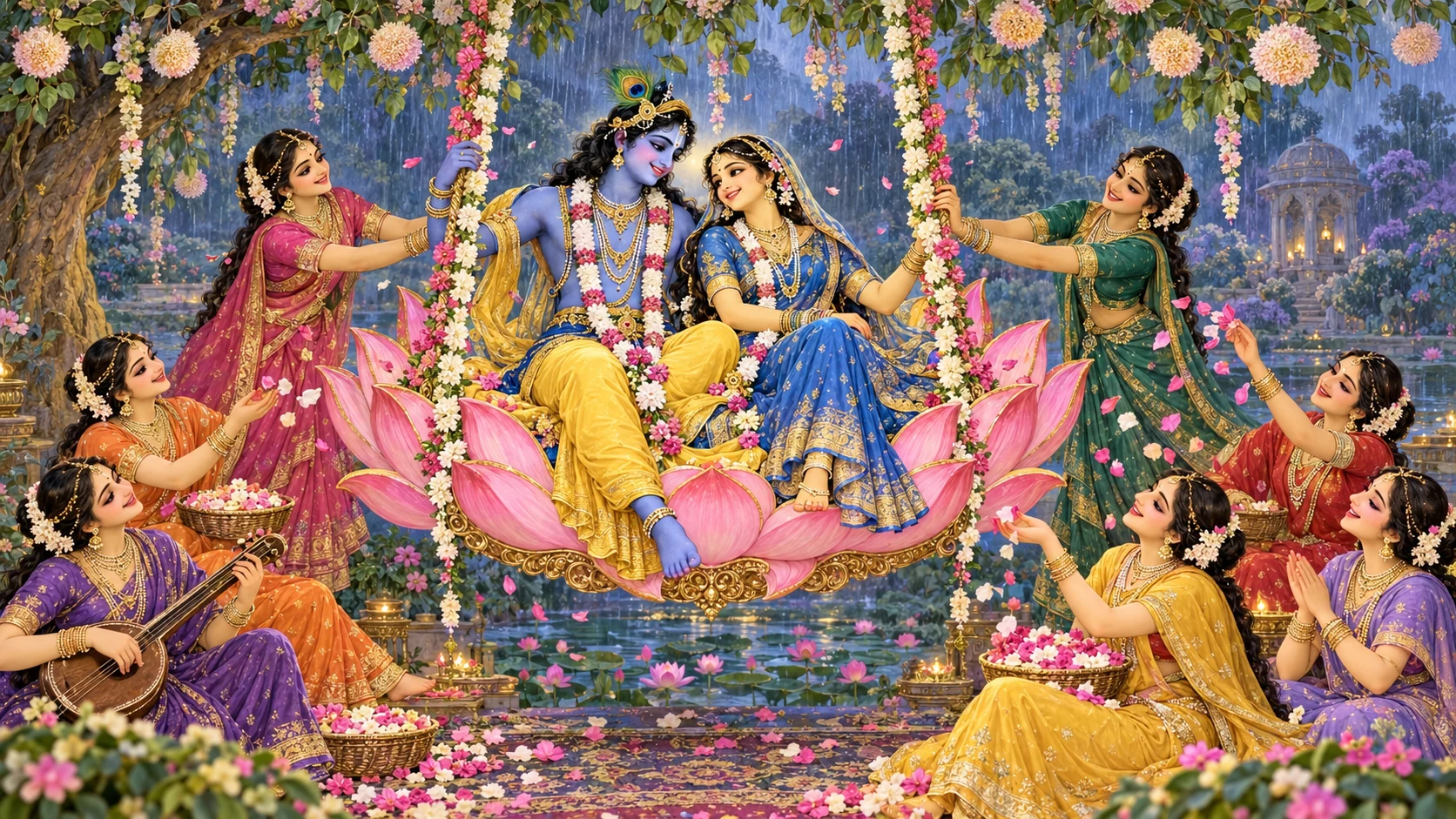
The swing platform in the southeast sits beneath the meeting branches of two bakula trees. Four silk cords hold the swing, and ruby seats and hand-sized coral lotuses surround the central place. The poet notices footrests, back supports, soft cushions, and a canopy of leaves and pearl strings. Vrinda swings with singing gopis a little below the upper lotus. When Radha and Krishna sit on Madanandolana, the arrangement gives those around them the impression that the couple faces each one of them.
Other bowers take the colours of lotuses. The white one has jasmine, moonstone and gold. Eastward, the blue one holds tamala trees and is ringed with golden-centred little groves. Clove vines cover the ruby-red lotus to the south, while golden champaka flowers cover the western one. The Madhavi bower has gifts that Lalita has laid out for the two beloved visitors.
The approach to Vishakha's bower is filled with the scent of champaka blossoms of different colours. The madhavi vines and drooping branches shape a pavilion like a palace. Its four little gates are woven with leaves and flowers, and humming bees seem to stand guard. Stems and petals have been worked into ornaments, cloth, beds and canopies. At the centre lies a sixteen-petalled lotus set with jewels.