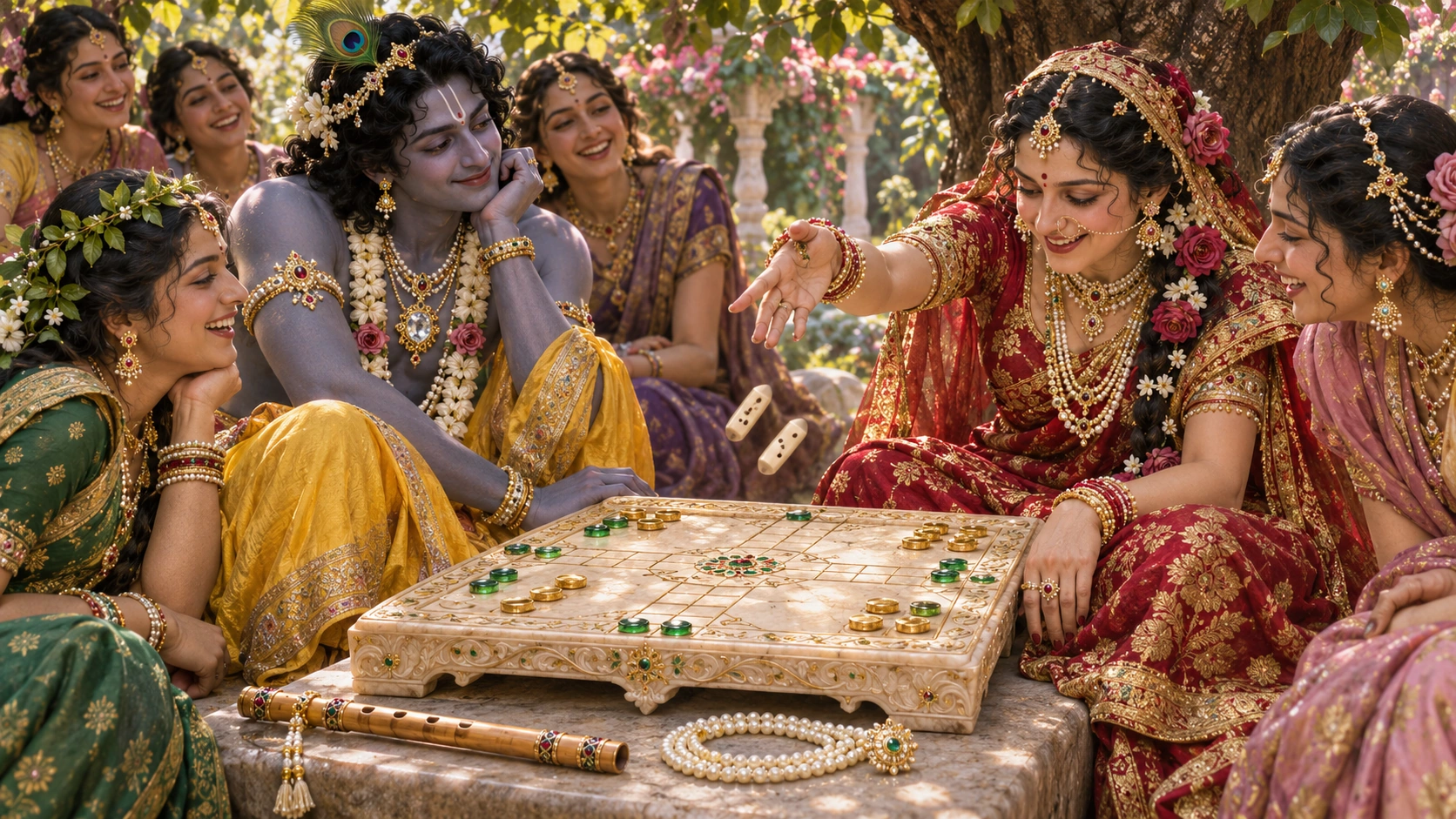
At the edge of the bower beneath a tree lay a stone seat that shone like a jewel. Krishna sat there, surrounded by gopis skilled at dice. Vrinda understood what they wanted from their gestures. She asked lotus-eyed Krishna to show His skill at the game. She showed Him the finely made shari board, with gold details and pieces of emerald and gold. She mentioned the other game, shataranga, as she offered the carved ivory board. Krishna smiled, chose shari, and called on those who wished to play to join Him. Vrinda made the arrangements, and Radha sat to play opposite Him.
Krishna proposed setting the stakes first. For the first round He offered the Kaustubha jewel and asked Radha to put up her necklace. For the second He offered His flute and proposed Lalita as Radha’s stake. Smiling, He said He would take the stake if He won and hand over the flute if He lost. Radha objected that such an exchange was unequal. How could a little piece of wood be worth as much as a jewel, she asked Him. One friend asked who would be the third stake. Radha jokingly replied that the friend herself would be her precious necklace in the game. Another said she had a suggestion for the fourth stake. Both players, she said, would be delighted by the outcome. Krishna asked her to say what she had in mind. The suggestion was for Radha to stake kisses and Krishna to stake hundreds of embraces. Radha knitted her brows as if angry and told the friend to play Krishna for such a stake herself. The friends told her to consider how little was staked on her side and how much on His. Whatever happened, they joked, she would still gain something dear. One of them took her by the hand and smilingly asked her to sit and show how she played. Radha smiled as she arranged the pieces on the board, her ring shining on her hand. She took the two dice and put them into Krishna’s palm. She told Him to cast first.
As Krishna lifted His arm to cast the dice, His bracelet flashed. A sakhi noticed Radha’s absorption and urged her to attend to the game. She encouraged her to win the Kaustubha and keep her necklace. In that way, she said, her victory would delight her friends too. The first throw favored Krishna. Radha wanted a different result and returned the dice to His palm. Krishna got the same result on the second throw. He moved the piece, and Radha grew keen for the contest. Both knew the art of dice. While they played as equals, neither could secure a victory. At last Radha deliberately accepted defeat in the first round. She took off the necklace herself and put it into Krishna’s hand. For the next throw Radha prepared herself, intent on winning. Krishna saw it and felt victory slipping away. She won the flute and placed it in Lalita’s palm. Lalita held it to herself as her own. Krishna won again in the third round, for which the friend was the stake. The gopis laughed aloud, and Radha told them to wait until they saw the skill of the goddess of dice.
The friends teased Radha that she had not paid attention and that Krishna would end up winning them all, one by one. Vrinda pointed out that He was still smiling though He had lost the flute. Someone in the company remarked that a flute was easy to find in the forest. A friend of such qualities, however, was hard to find on earth. Lalita accused Vrinda of always taking Krishna’s side and thus seeing with closed eyes even in daylight. In the Sanskrit verse the expression for “Krishna’s side” also names the dark half of the lunar month. Lalita also said Radha had played carelessly and had lost both her necklace and a dear friend. Radha took up the dice again and turned toward Krishna.
The fourth stake made Radha shy. She was ready to play to win, and the poet pictures Manmatha, the god of love, as the judge of the contest. The dice fell as each of them wished. Radha raised her arm with its bracelets and called out “dasha, dasha,” asking for a ten. The word for ten could also sound like a command to bite. In the joke that followed, Krishna was the serpent who had already bitten her mind and lips. Lalita turned the joke to Radha’s advantage. What power could that serpent have, she asked, when Radha had already overcome it with her curved brows? Krishna replied in turn, the friends laughed, and Radha lowered her face shyly. The poet observes that both would share the reward of that stake, whoever won. Radha returned to the game. With the throws she wanted, she blocked Krishna’s play and doubled the stake. Krishna could not break through the formation of pieces. He tried to distract her with a smile, asking whose stake she was so glad to increase, hers or His. Radha thought either answer would embarrass her. Krishna was already laughing, and her friends were teasing her. She smiled and played on as if she had not heard Him. Her gold bracelets rang when she cast the dice again. “They know, they know,” she said, and the friends asked who could know anything about her wish to raise the stake of kisses. Their teasing and Krishna’s words broke her concentration. She dismantled the formation with which she herself had blocked His way. Krishna seized the moment and tripled the stake. The friends told Him to set aside His pride, because their Radha would win and take everything. Radha played on with a smile. Victory mattered more to her than the prize itself. In the end neither player overcame the other. The poet jokes that the only one defeated in that game was the judge, Manmatha. Time pressed them, so they left the game unfinished. Radha returned the flute, Krishna returned the necklace, and the friends went home with Vrinda.