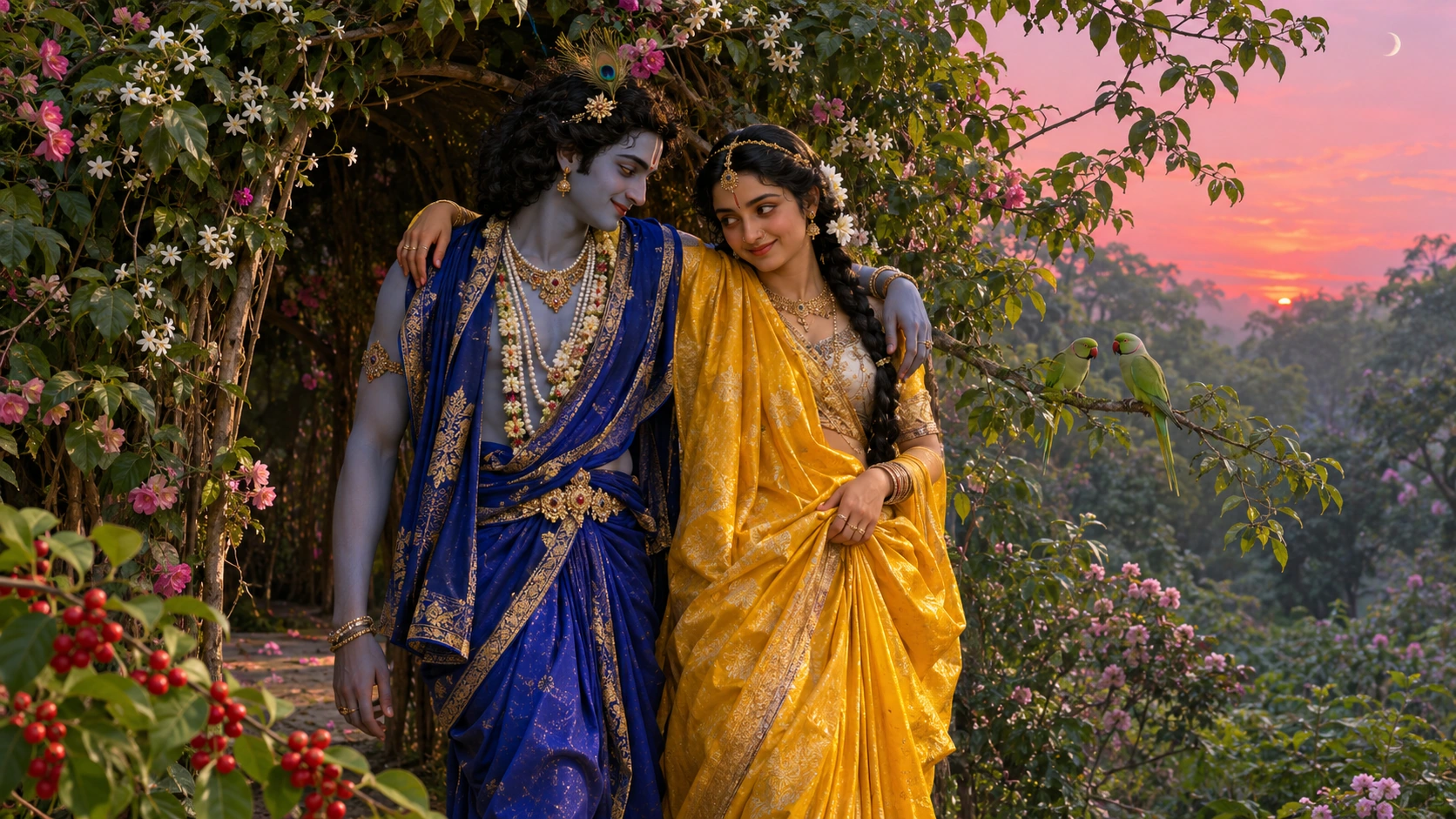
In the last watch of the night only a few stars remained. At Vrinda’s direction, flocks of mynas and parrots called softly near the bower where Radha and Krishna slept. The mynas spoke to Radha first. In gentle words they asked why she still slept so soundly in the arms of Nanda’s son when the night was nearly over. They urged her to rise from her bed in the bower where the bees hummed. They reminded her that if the elders found her there, she would be reproached and her relatives would be distressed. “Look to the east,” they said. The sky there was turning red like her lotus feet, and a chakravaki bird was already returning to her mate after their night apart. In the west the moon was setting behind the mountain peak. The birds pictured it as a rival that had longed to attain the beauty of Radha’s face and was now disappearing without attaining it. The bees that had spent the night in the water lilies were already moving toward the rows of lotuses. To the mynas their movement showed that the hour of change had come.
The mynas told Radha her friends were gathering from their homes. They were the same friends who had brought her to the shadowed bower at dusk, and now they were coming to her again. They asked her to open her eyes and let her friends help with her displaced ornaments and disordered attire. The friends’ faces, they said, shone like lightning. The few remaining stars looked like pearls from her broken necklace. For a third image the mynas pointed to the night-flowering shephalika, whose blossoms were already falling. Even the star Arundhati, they said, hid in the circle of the seven sages as if abashed to see how long Radha had slept. The doe Radha had fed from her own hand also came into the bower. The mynas asked Radha to give her one kindly glance. The doe mistook Radha’s red feet for tender leaves and came closer to taste them. The friends waved her away with their palms, and she withdrew. The mynas also described the doe’s affection. She delighted in what Radha left of her food and in the water from her feet, and grew sad when she could not see her. The mynas told how Krishna compared Radha’s eyes with the doe’s guileless gaze and with pearls. He also had something sweet to say in praise of the doe. When the mynas fell quiet, the parrots flew to the bower and paid their respects to Him.
The male parrots approached Krishna. In sweet voices they greeted Him as an ocean of virtues and as the sun to the lotuses of Vraja. They asked why He still lay on the bed beneath the vines. Dear as that place was, they said, the hour itself was showing Him it was time to rise. They showed Him how the same dawn closed the night lilies and opened the lotuses. What brought parting and sorrow to some brought reunion and joy to others. They said His mother believed He was asleep at home. As soon as she noticed the hour, she would hurry to wake Him herself. The peacock had already called. The parrots reminded Him how the bird spread its tail in a circle, its feathers brilliant as jewels, to delight Him and His loved ones. Finally they drew His attention to the copper-crested rooster. It was already announcing the hour with its call, ready to perform its service.
The voices of the birds woke Radha first and then Krishna. Their eyes were still heavy with sleep, and their glances searched for each other. When they embraced, the poet describes them as becoming one. Their goosebumps are like jeweled needles, and their eagerness is the thread with which Manmatha stitches the two together. They yawned at the same moment. The gleam of their teeth before one another’s faces reminds the poet of the lamps of arati. Tears wet their eyelashes while they held each other. In them the poet sees their sorrow at the parting that was drawing near. They rose and tied their garments. Both staying and leaving were difficult, for they already felt the pain of parting. Radha’s sleepy eyes resembled khanjana birds among open lotuses. Krishna’s, beneath heavy lashes, were like lotuses disturbed by bees.
When the east reddened like gunja seeds, they left the bower with shy glances. The bed remained behind for their friends to see. It bore traces of saffron, vermilion, musk, and kohl, a torn flower garland, and a disordered necklace. The torn garland and the necklace resembled a broken bow and bowstring. The sight amused their friends. Each left the heart with the other as their feet carried them slowly onward. In their confusion they had switched blue and yellow garments, and so they went on. With their arms resting on one another’s shoulders, they went on. They cast quick sideways glances, wary of gossips and elders. The poet says their own power of bliss kept them from other eyes in the forest, on the path, and by their homes. Their meeting was a feast for the eyes of their close attendants. They bathed as at the close of a rite and slept through what remained of the night in their homes. Just as skilled physicians heal the wounds of warriors, the poet says, the power of yoga removed the traces of the night.