The play opens with a salutation to Sri Krishna Chaitanya, praised as the moon. The first blessing pictures Mukunda’s fame as a full moon. His friends rejoice in its radiance like chakora birds thirsting for moonlight. That same moon brings grief to the wives of the gods’ enemies. The poet evokes it with chakravaka birds and lotuses that feel the coming of night. Through that image the audience receives its first wish for joy in Mukunda’s renown.
The second blessing bows to Krishna as a dense, dark rain cloud. He showers the eight directions, which the poet imagines as maidens, and adorns the graceful vines with fresh shoots. The Sun’s daughter shines on His broad chest, and the verse links that dark cloud with the bright shape of the moon.
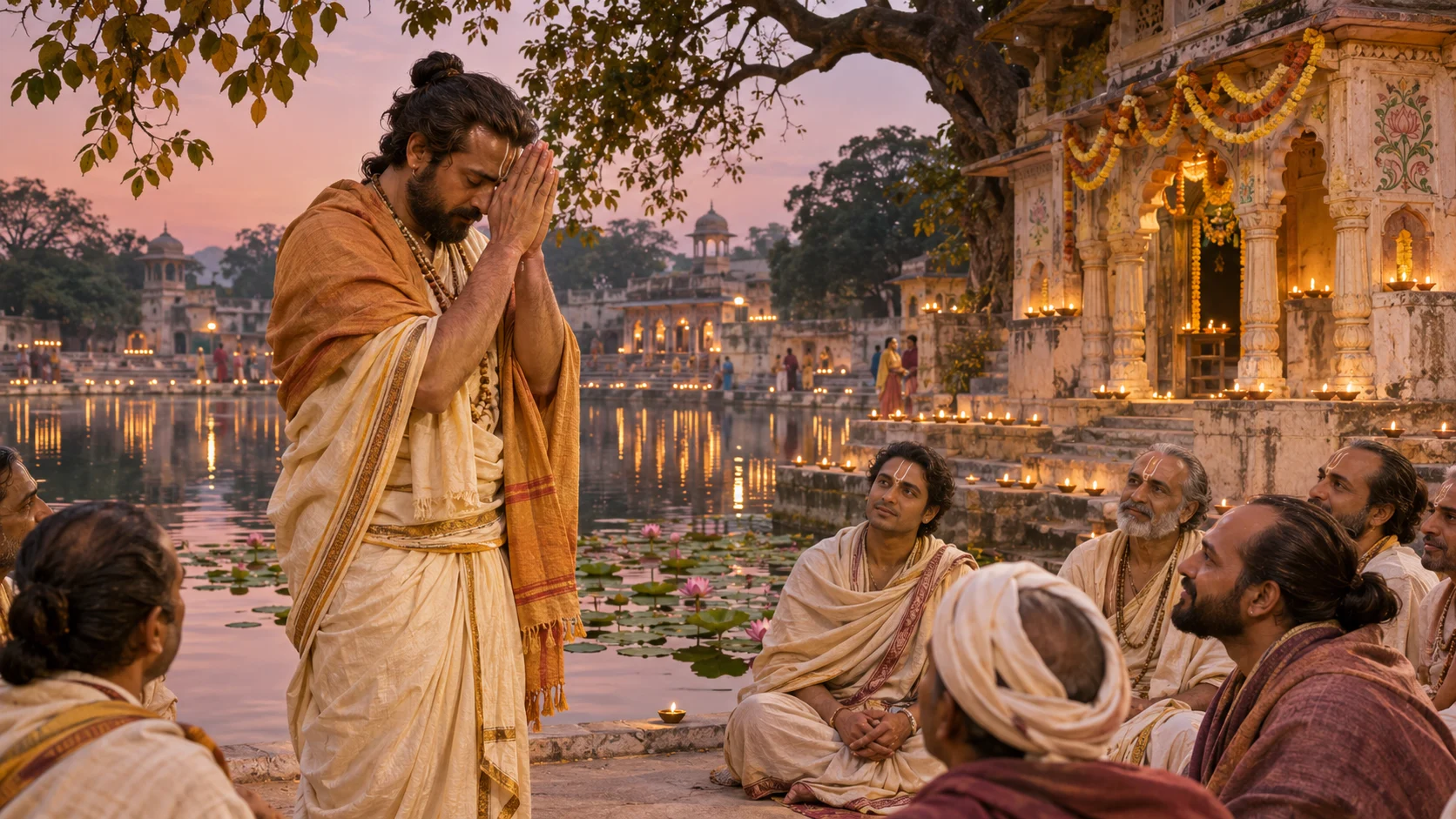
After the blessings the director looks around and breaks off the ceremonial recitation to explain his presence. The bearer of the crescent moon appeared to him in a dream. In Vrindavan He is known as Gopishvara. The director links Him with the forest bowers and the bank of Brahma-kunda, radiant with great lotuses. Gopishvara gave him a charge for the beginning of the festival of lamps, when devotees come to honor Govardhan. The Vaishnavas have already come together beside Radha-kunda, east of the shrine of Madhavi and Madhava. Before them the director longs to present his play, Lalita-madhava.
Before beginning, he invokes the son of Shachi. Like a rising moon dispelling darkness, the son of Shachi pours the nectar of His own love upon the earth and draws hearts to Himself. A question comes from beyond the stage, asking how the director dared undertake so bold a work. He acknowledges the risk. Before such a worthy gathering and under the weight of his teacher’s direction, he takes shelter in the mercy of the One who brings joy to those who seek Him.
Looking out again, the director addresses the Vaishnavas as bees gathering at Krishna’s lotus feet. He asks for their good will and says that relying on their kindness has given him courage. The pure bhagavatas can bring out good even in a mass of faults. He compares them to gentle lights that adorn the night without scorching it. He raises his joined palms to his brow. His final salutation goes to the perfect teacher of the world. The verse recalls Him as the third among the sages headed by Sanaka, who once taught the path of the paramahamsas and now imparts the mystery of bhakti-rasa to devotees.