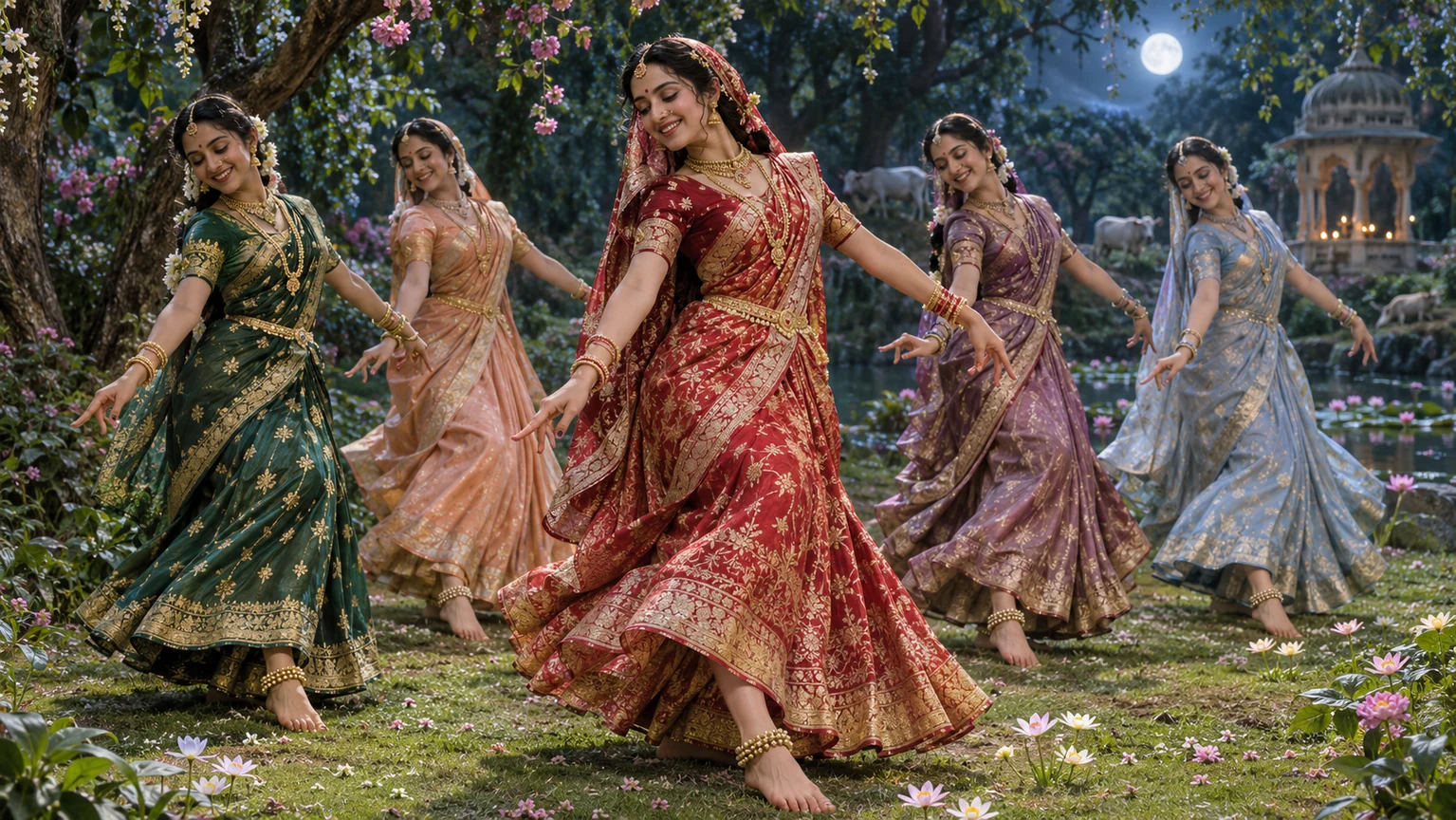
In Vrindavan’s bower, a movement of Radha’s brow enchants Krishna, the jewel of Vraja. She gleams like countless lightning flashes and is a wish-granting gem for her devotees, pouring out the sweetness of love. From the waves of her playful glance, countless gods of love seem to emerge with bows drawn. The poet asks Radha, whose blossoming loveliness fills him with wonder, to be his mistress. Neither Brahma nor Shiva has been granted one grain of the dust of her lotus foot to place on his head. It is given to those who take refuge in the gopis’ love. The poet addresses the fate that, as time passes, can make such a Radha seem ordinary. Kin, friends and servants are far away as Radha and her beloved meet in the bower. Her faithful attendant longs to stand by the entrance and hear the bells of Radha’s girdle. In meditation the poet recalls the softness of Radha’s golden form, the sweetness of her smile, the length of her glance, her measured walk and curving brows. He remembers her red lips and the moment when love leaves her still. In the morning she would exchange Radha’s yellow cloth for another and return to fetch a bodice left behind. She would bind her hair, gather the fallen pearls, darken her eyes and gently cover the marks on her skin.
The poet wants his eyes to follow Radha, whose form is revealed in Vrindavan. Her everlasting youth is filled with the nectar of affection, and the vision is scarcely reached by Shiva, Shuka or the scriptures. He honors the path of single-minded devotion to the Lord. Among all the aims of life, his heart is drawn most to the nectar of service to Radha, the jewel of Vrindavan. Radha is the heart of radiant love and the highest art of loving play. The poet praises her as the supreme independent potency and the crowned consort of Vrindavan’s Lord. He devotes his service to her. To seek Govinda’s company without Radha’s service is, for the poet, like seeking a complete moon without the night of fullness. She is the seed of the rising waves of love for Shyama, an ocean from which a seeker may receive even one drop. Some continually contemplate Radha’s beauty and love. Their deeds no longer bind them, and in devotion to the Lord they claim nothing for themselves. The poet bows to those who have reached that wondrous sweetness. The poet wonders who these deeply absorbed people are, carried by the force of their guru’s devotion. They may bear no conch or disc on their arms, mark on the forehead or necklace of tulasi at the throat. Some perform the rites taught in scripture and some set them aside. Some accept garlands and fine things and some let them go. The poet asks how someone looking only from outside could measure the secret of love for Radhika’s beloved. Talk of sense delights repels him, and the prospect of liberation apart from love frightens him. Even in the presence of devotion like Shuka’s, his prayer is for his own mind to sink into the sweetness of Radha’s feet.
Radha’s fresh loveliness, her turning glance, red lips, smile, voice and playful gait stay in his memory. Each brings her presence back to him. By Radha’s kindness alone, the attendants of Vraja receive a nearness longed for even by Lakshmi, Shuka and Narada. The poet begs the mistress of the fresh bower to grant him a gracious look and a share in that service. If granted that service, he longs to rub her lotus feet gently as she falls asleep. Then he would taste what Radha left of her food, as nectar from which joy wells up anew. Even if Radha lovingly granted her attendant closeness with the beloved, the attendant would keep her devotion. Through a smile, a glance and an embrace, her heart would still turn to Radha’s feet.
The sakhi reminds Radha of the dark half of the month, the blue lotus, the black antelope, the tamala, the dark cloud and the Yamuna called Krishna. Why turn away from dark Shyama, she asks, when so many dark things are dear to her? The poet longs to see Radha smile. In the rasa dance, the play of Radha’s eyes seems to color every direction with blue lotuses, and the sky takes on a golden gleam. As she dances with the company of gopis, the ground beneath their steps seems to burst into flower.