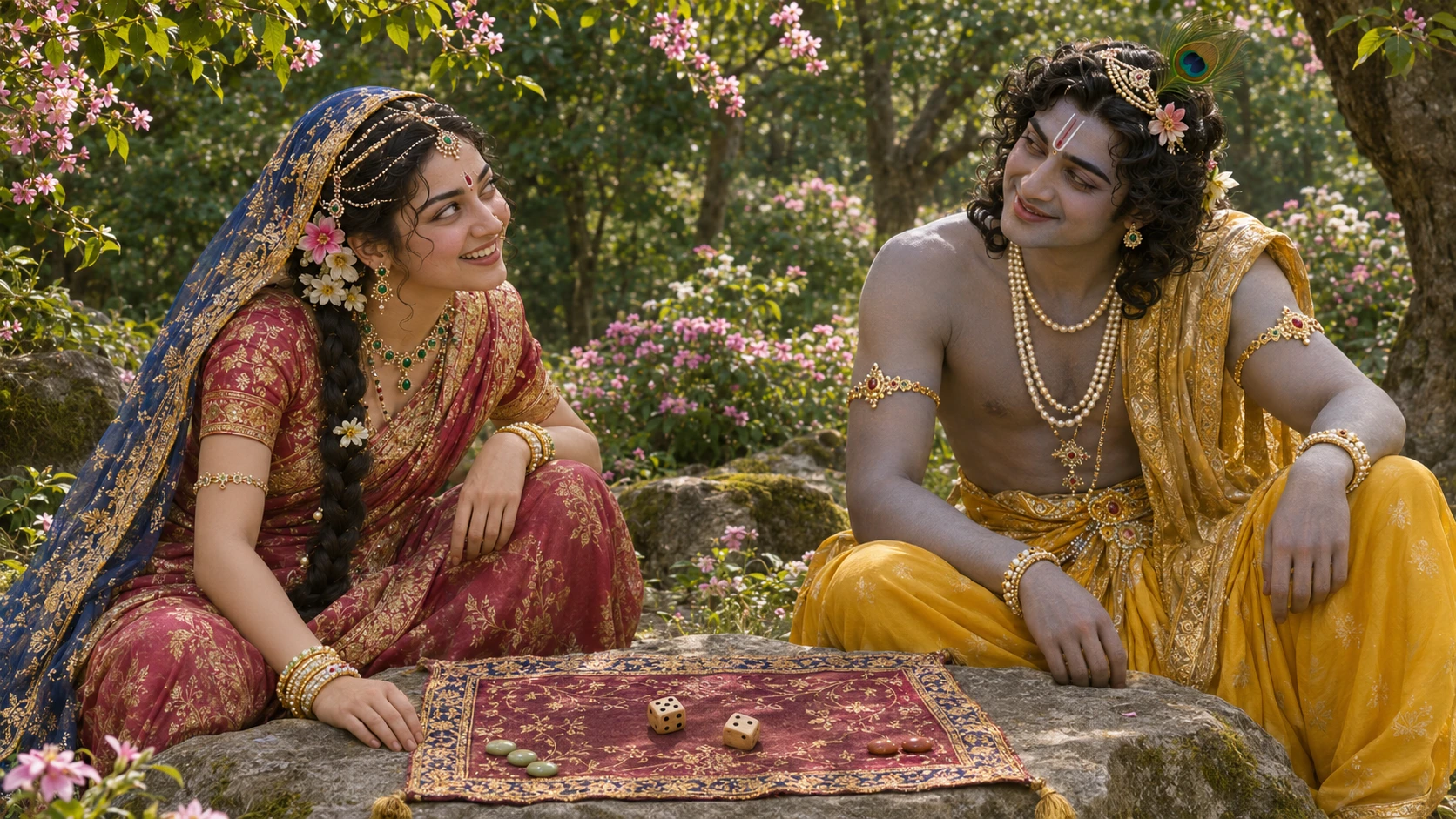
The gopi looked in every direction to catch sight of Radha and Govinda. Her eyes were like chakora birds longing for the light of their smiling faces. Moved by love, the sakhis showed her the pair and began to sing in the raga Malava Gauda. In the refrain they called on her to look at the tender prince of Gokula beside Radhika, who surpasses even the god of love.
Scented with musk, Radha sets off Krishna’s dark brilliance, like that of a fresh cloud. Her braid curves like a serpent, and a peacock feather adorns His crown. Radha flashes like lightning and shines like a golden vine, while Krishna is like a cloud pouring down rasa. His brilliance surpasses the deep color of the dark tamala tree.
They compare Radha to a lotus swaying gently in the wind, and Krishna to a bee intoxicated by its fragrance. When Radha trembles before a new meeting, Krishna knows many ways to reassure her. Her smile is like a blooming water lily beside a radiant autumn moon. The sakhis see an elephant’s grace in Radha and liken Krishna to an elephant carried away by love.
Full of the nectar of love, Radha gleams like a figure of gold. Krishna beside her is like a fresh emerald. Her reddish silk is set beside His folded yellow cloth. They sing of the pair playing dice for a stake. The two laugh and dispute the victory and the garment. At the close of the song the poet calls on the heart to taste the sweetness of what it hears.
The sakhis first show her Radha, with a fresh garland of fragrant jasmine and a glimmering upper garment. They describe her as a source of rasa flowing in every direction. Then they show her Krishna, His eyes like reddened lotuses. His body thrills with the joy He feels beside Radha.
Traces of red sindura, saffron, and black kajal are visible on Him. Elsewhere there is a slender trace from Radha’s nails or her jeweled bangle. The sakhis show her these marks as signs of His closeness with Radha. The gopi looks at Madhupati and wonders how the moon could be so dark. She thinks of a tamala tree, then wonders where the voice and movement come from. She thinks, too, of a cloud that ought to bring rain, then again of the bright autumn moon.
When she sees lotus-eyed Radha, the gopi is left in wonder again. She asks herself whether before her is the very life of the god of love or the heart of Madhupati. Perhaps she sees the source from which all beauty flows. Or rasa itself, embodied in Sri Radha’s inexpressibly sweet love.