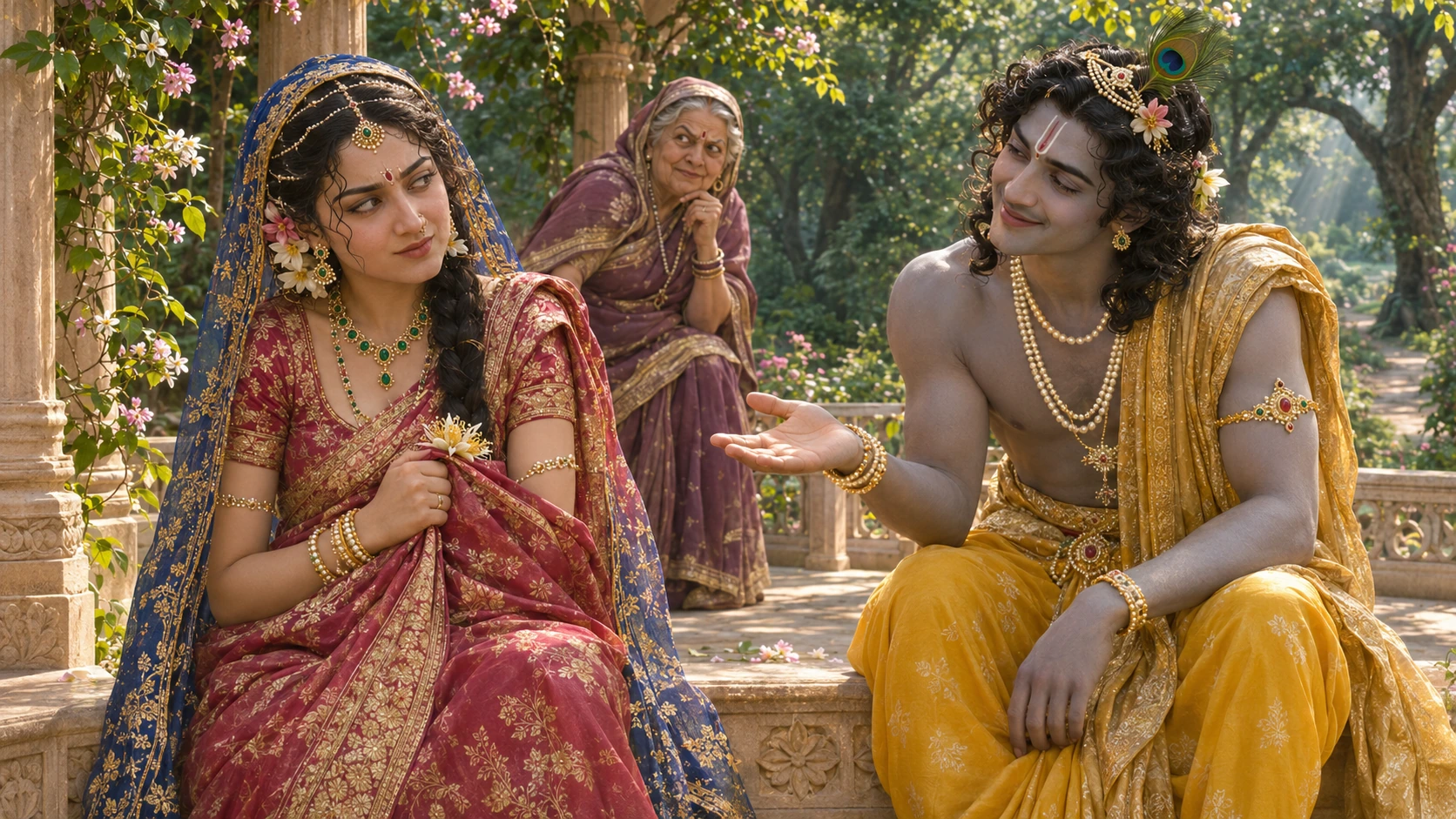
From behind the scenes, Madhumangala asked the deer whether they had seen his dear friend. Krishna wondered how Madhumangala had come there. Madhumangala entered with a garland in his hand. He had heard from Subala that Radha had stayed awake in the forest bower, so he had come to encourage Her. He approached Her and described Krishna in Sanskrit, adorned with a forest garland, gleaming bracelets and mineral colors. He likened Krishna to a dark mountain, the loftiest in the world. He asked Radha how She had managed to draw Him toward Her with a glance. Radha smiled. Krishna told Her that His friend knew how much distress the night had brought Him.
Radha wittily thanked Madhumangala. She said he had taught Her how to cross the ocean the forest had become for Her. Madhumangala joked that She was right to reproach them. They had kept an anxious vigil, mistaking even a swaying vine for Radha. She, he said, could sleep soundly at home after declaring the bower empty, although his dear friend had been there. Radha asked why he spoke in that way. In Her verse She recalled Krishna’s bower and the radiance of a row of crescent moons, likened to nail marks. She said the rising of that troublesome moon had left Her exhausted in the woods.
Madhumangala realized that Radha had also seen Chandravali in the bower. He decided to give up the deception and praise Radha. He began a verse about the son of the ruler of Gokula, who had wearied Himself seeking Her moonlike face. As soon as he said the word that sounded like Chandravali’s name, Krishna signaled with His eyebrows for him to stop. Everyone exchanged knowing looks. Madhumangala thought to himself that he had spoken rashly, like a young brahmana. Krishna said tears had caught in His friend’s throat, so He would finish the verse Himself. With a smile He turned the words toward the moon’s light. It had reminded Him of Radha, and somehow He had passed the night that way. Madhumangala replied that Krishna knew everything and surely knew the half-verse he had kept in his heart.
Lalita called on Radha to look at the traces of Krishna’s love play. She advised Her to draw back Her heart from Him, who stole glances at the young women of Gokula and left traces of disgrace when He departed. Radha exclaimed that She had been deceived. Krishna said She was angry with Him without cause. With reproach She answered that His eyes must be red from pollen falling into them as He watched unblinking for Her on the path. She mentioned the small wound on His lip that the cold woodland wind had made, as Her teasing account had it. She told Him to put aside His embarrassment. Fate had already dealt Her pain enough.
Krishna told Her He was in Her power and that even His reserve was an ornament. Radha asked how He, known everywhere for His independence, could be in Her power. Krishna answered that His ten incarnations were subject to Her as well. He wove their names into a verse about Her beauty. Matsya was hidden in Her restless fishlike eyes and Kurma in the comparison of Her breasts to a tortoise. A word for the bosom also evoked Varaha. Her lip gave delight as Narasimha delighted Prahlada. The folds of Her waist recalled Vamana binding Bali. The radiance of Her face surpassed the three Ramas. Even the words for Her splendor and anger concealed the names of Buddha and Kalki.
Radha asked Lalita whether she had heard the verse. Lalita told Krishna that she saw signs of all those incarnations in Him. She named restlessness, hardness, contact with the earth and the sharpness of nails. She mentioned pride and ferocity, the defeat of the ruler of Lanka, intoxication, the stopping of sacrifices and play with a sword. Krishna smiled and asked His friend to look. In His wordplay on their names, Lalita had grown harsh, Radha was hard to please, and Vishakha could give Him no shade.
Krishna took the jasmine garland from Madhumangala and bowed before Radha. He likened it to Her heart, pure, tender and full of good qualities. He compared its fall to the celestial Ganga streaming down Shiva’s head. He wished the garland would adorn Her chest, where marks from nails resembled crescent moons. He signaled with His eyebrows for Vishakha to help Him and handed her the garland. Vishakha offered it to Radha. She reminded Her that a single blink without Krishna lasted as long as a manvantara and asked how She could resist Him now that He was pleading. Radha dismissed her in anger. Krishna bowed again and again, with dust on His hair ornament, and begged for one sweet glance from Her.
Lalita told Radha to turn quickly toward the bower, as Her grandmother was coming up behind them. Radha did as she said. Mukhara caught sight of Krishna. She told Radha that She had fallen into the hands of One who drew hearts toward the forest until they forgot home and the affection of their kin. Madhumangala told Krishna quietly that the old woman talked like wind playing through a flute. He asked why Krishna was still lingering. Krishna asked where His flute was. Madhumangala replied that Krishna Himself knew where it was. Krishna concluded that Radha had taken it. He asked how He could go away without it. Madhumangala joked that their good fortune was that the enchanting girls had failed to steal Krishna Himself. He suggested leaving the flute and going away.
Krishna asked His talkative friend to wait and approached Radha. He praised Her skill in wordplay. In Sanskrit, taking away the nasal dot from vamshi, the word for a flute, leaves vashi, something brought under someone’s control. With this play on the words, He said She had quickly brought His flute under Her control. Radha knitted Her brows and asked Him to put an end to His clever accusations. Who knew anything of His flute? In Sanskrit, Lalita said that the gopis were honorable and had no interest in taking anyone else’s property. Krishna asked her for a little kindness as a friend. Lalita completed her verse. She told Him to go home and asked when they had become guarantors for His flute.
Radha approached Mukhara and asked her to hear how Krishna was calling them thieves. Mukhara angrily told Krishna she understood that He meant to make sport of her granddaughter. Madhumangala accused Radha of taking the flute and Krishna backed him. Mukhara asked her granddaughter whether it was true. Radha asked whether firewood had grown so expensive in Vrindavan that She would take a piece of bamboo only a handspan long. Krishna smiled and asked why Her cheeks brightened with a smile and Her glance darted about when the flute was mentioned.
Mukhara called out that Radha was Abhimanyu’s wife and Krishna ought to show Her respect. Madhumangala swore on his sacred thread that he had seen Krishna bow before Radha with His head to the ground. Pleased, Mukhara said that this would increase Krishna’s virtue. Everyone smiled. Then she sent Him to look after the cows, since His restlessness would upset Nanda. Krishna said He could hardly call the distant white cows without His flute. Lalita asked why He did not say openly that He meant the young women. Krishna answered that with Mukhara at their side they were strong today, so how could He say such a thing?
Mukhara angrily said that Radha was young and her own aging eyes were no longer keen. She warned Krishna that if He stayed, the road to Mathura was short. Madhumangala retorted that they had no reason to fear Kamsa. Mukhara made as if to take Radha to the royal court and left with Her and Her friends. Krishna invited Madhumangala to go to the bank of the Kalindi and look for the cows. As He went, He turned with a sigh. In Radha He saw first firmness, then youthful grace, first indifferent words, then longing. Her gaze turned from composed to playful. Krishna saw how anger and love drew Her in two directions. Everyone left the stage. The fourth act came to a close.