Paurnamasi walked with Lalita toward the kadamba garden. She wondered whether respect and embarrassment before her kept Krishna from meeting Radha. Lalita answered that an extraordinary heart does not reveal itself easily. Ahead of them Krishna was with Madhumangala. In His hand shone the ornamented flute, with dark gems, rubies and gold.
Krishna was remembering Radha with regret. At their earlier encounter she had been shy, had smiled, and then had gone away. He wondered why He had not kept her nearer. He told Madhumangala how her glance had stolen His peace. Radha had once bent down on the pretext of gathering pearls from a broken necklace. Even before her elders, that little occasion had allowed her to send Him a sidelong glance.
From a distance Paurnamasi noticed His distraction. She wondered which gopi could have drawn Him into such deep contemplation. Then she answered herself that Radha was the cause. Krishna bowed to her, and she greeted Him with an affectionate jest about the gopis. He defended Himself with a double meaning about a dark vine He did not even touch with His hand. Madhumangala immediately added a joke of his own, turning the conversation from dark beauty to golden beauty.
Paurnamasi mentioned His good family and celebrated strength. Why, then, did He disturb Radha? Madhumangala reversed the accusation: it was Radha who had made his friend so distracted. Krishna no longer knew where He had left His feather, horn and herding stick. When He tried to deny His attachment, the brahmana answered with another play on words. Paurnamasi and Lalita continued the jest about the flute's power and the gopis leaving their homes.
Madhumangala also recalled the earlier pastime with garments left upon the riverbank. Krishna checked him with a glance, but the conversation was already lively. Lalita asked who had taught Him this art of attracting hearts. Madhumangala said His gentle appearance did not explain the strength with which He overcame terrible opponents. Then he touched Krishna's chest and was astonished at its warmth. He concluded that Radha, present in His heart, had heated even one as cool as millions of moons.
Lalita replied that her tender friend could not enter a heart hard as dark stone. Madhumangala objected: Krishna was softer in love than they imagined. Like a yogi with a concentrated mind, He thought constantly of Radha and went without sleep. Krishna was embarrassed by His friend's words. Lalita inwardly rejoiced to hear this confirmation about her sakhi. Then Paurnamasi interrupted the joking and asked to be heard seriously.
In a poetic comparison, she described Radha as a river that had crossed obstacles to reach Krishna's ocean. It was unkind to turn her back with harsh words. She described Radha's agitation, fear of interference and powerful desire to meet Him. She warned that indifference between loving companions could bring great pain. Krishna lowered His head, then showed His answer with a small smile. Paurnamasi told Him to wait by the mango tree; after sunset one of the sakhis would lead Him to Radha.
Krishna left with Madhumangala, while Paurnamasi and Lalita went to find Radha. They found her talking with Visakha. Radha spoke of the sweetness of Krishna's words and smile, and of the pain that remained without His nearness. Paurnamasi asked Lalita to remain quiet for a while. She wished to reveal the depth of Radha's feelings. With pretended sorrow she said that, despite her requests, Madhava would not agree to a meeting and another remedy must be found.
Radha joined her palms and answered with an image of fire and a dark rain cloud. She saw no relief for her suffering apart from Krishna. Paurnamasi reminded her how difficult it was to reach the one whose feet even Lakshmi honored. She told her not to try to catch the moon in her hands. With a faltering voice Radha asked at least for a blessing to become a bee beside His forest garland. Her condition alarmed Visakha, who immediately asked for help.
Paurnamasi embraced Radha and stopped the trial. She explained that her words had been meant to bring Radha's love into the open, not to report a real refusal by Krishna. She assured her that He was equally eager to see her. Lalita added that His flute sang of Radha, while His activities were filled with thoughts of her ornaments. In the names of the cows and the vines of Vrindavan, Krishna recognized her again and again. Radha recovered her composure, although her heart still struggled to believe the happy news.
Visakha went to Krishna while Lalita remained with Radha. The Sun was setting, darkness was spreading, and the moon was appearing in the east. Krishna watched the path and wondered why the messenger was late. Perhaps Radha's elders had stopped her, perhaps she had hesitated, or perhaps she was suffering again. When Visakha arrived, He rejoiced as though He had already seen Radha herself. But the sakhi lowered her head and deliberately remained silent.
With feigned sorrow Visakha began saying that Abhimanyu had taken Radha to Mathura. Krishna immediately asked when, how and why it had happened. Her answers distressed Him still further. He could no longer bear even the thought of separation from Radha. Then Visakha ended the joke and admitted that Radha was here and alive. She assured Him that Radha's longing was strong, and they immediately set out toward her.
Meanwhile Radha repeatedly looked along the path between the trees. She rose, sat down again and took a few steps. She would look at Lalita and turn back once more. She wondered why not even the fragrance of His forest garland had reached her yet. Visakha showed this to Krishna before they drew near. He saw Radha's beauty as surpassing the sweetness of the moonlit evening itself.
Krishna approached, and Radha became motionless with shyness and emotion. Visakha teased her: other gopis delighted Him with jokes, while her own friend could scarcely move. Lalita encouraged Radha and brought her nearer to Him. Then she compared Radha's heart with a swan caught in the net of Krishna's eyebrows. Was it fair for Him to keep what belonged to her friend? Smiling, Krishna defended Himself against being called a thief.
Lalita proposed a test of His claim. She pointed toward Radha's ornament and poetically compared the ordeal with a trial involving a pot and a snake. In this comparison, a dark line and the central jewel became the occasion for His examination. Krishna pretended to fear so terrible a test. Radha looked at Lalita with an affectionate reproach. Visakha answered that ordinary snakes could not frighten the one who had overcome Agha, Kaliya and the serpent that attacked Nanda.
Lalita continued that Radha's beauty possessed a power those serpents did not display. Embarrassed by the jokes, Radha wished to leave and complain to the elders. Lalita held the edge of her garment and asked that the examination be finished first. Krishna drew toward Radha, and His hand trembled. Lalita promptly declared that trembling to be evidence against Him. Krishna lowered His head and admitted, with another play on words, that they had made Him a thief.
He asked Lalita what path would now bring Him good fortune. She answered through a double picture of pearls and liberated souls. In that jest, drawing near to Radha also meant approaching their pure company. Krishna took Radha by the hand. With an agitated voice she said that this was improper, withdrew her hand and hid behind the trees. When He asked for her, the sakhis followed and decided to tease Him a little.
Lalita returned with the message that Radha wished to speak but was afraid. Krishna answered that she need not fear someone already under her control. Speaking on her behalf, Lalita described trembling hands, a broken voice and powerful agitation. She asked forgiveness for calling Him at night when they now lacked the courage for a meeting. Radha briefly appeared and asked that He leave before anyone saw them. Krishna could not tell whether the words were a serious obstacle or another jest.
He compared Himself with iron drawn toward a magnet. How could He be summoned with so much love and then remain apart? Lalita spoke of the obligations standing between loving companions. Krishna answered with a poetic comparison of the eastern quarter and the moon. Radha mentioned her good name, family and fear of reproach. But Krishna noticed the smile within her words and understood that the sakhis were guiding this apparent severity.
Visakha asked Radha not to prolong the waiting. Krishna wished to be refreshed by her gentle voice and nearness. The sakhi warned Him to be mild, for Radha seemed like modesty itself taking human form. Radha sought shelter with her friends again. Visakha reminded her that Krishna gave protection to Gokula's residents. He, in turn, said that her eyebrows, glances and hair had already defeated His strength.
Lalita asked why, then, Radha could not free her own heart. Visakha proposed lovingly holding the one who had captured her inward swan. Krishna asked Lalita how He might obtain Radha's favor. She answered that fine words would not win it easily, but service would. Krishna joyfully offered sandalwood decorations, flowers for her hair and gentle relief from weariness. Radha threatened to leave again, but Mukhara's voice interrupted the conversation.
Mukhara arrived looking for her granddaughter. Krishna moved away, but she noticed a dark form and an unusual fragrance. She approached, and He greeted her respectfully. She complained that she had no peace while His flute called the girls toward the forest. Even when their elders restrained them, they followed its sound again. Krishna teased her about her talkative name, and Mukhara asked Him to explain His evening visit.
He answered that Paurnamasi had told Him about a remarkable doe in that courtyard. Mukhara told Him to look for it in the morning and leave now. Krishna withdrew behind the trees, and Lalita confirmed that He had gone. But He quietly returned and tugged the edge of Radha's garment. Mukhara noticed the dark form in yellow clothing and voiced her suspicion again. Lalita assured her that she was seeing a tamala tree whose swaying branch had caught the garment.
Mukhara, whose sight was poor in the dark and who was overcome by sleep, believed Lalita. She went home to rest. Visakha asked Radha to wipe the drops of perspiration from Krishna's face with her garment. Radha replied that Visakha could do it herself. The sakhi answered with a joke about the rangana garland Radha wore. Thus, once the danger had passed, their conversation returned to gentle teasing.
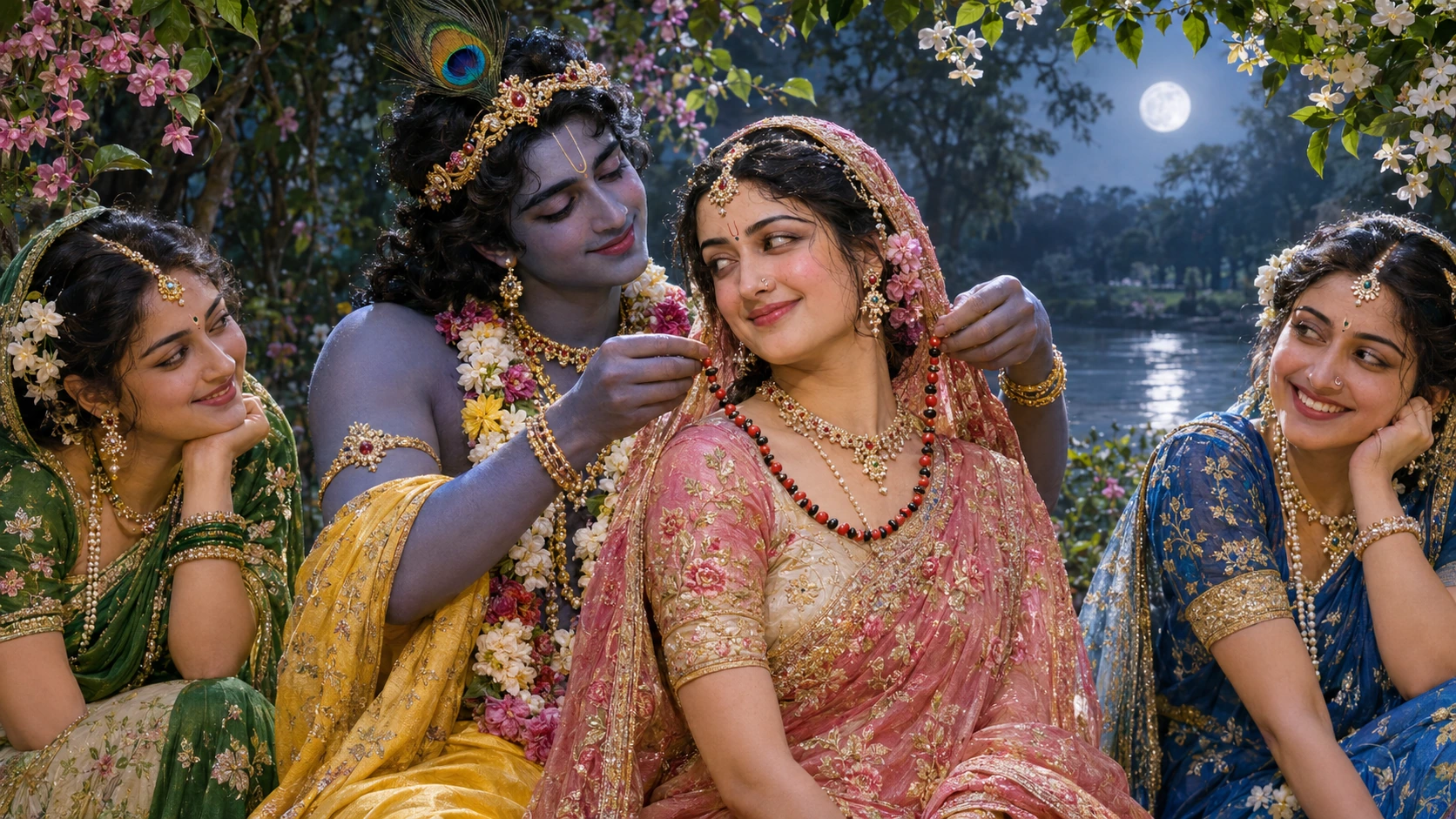
Krishna admired the flowers fortunate enough to be so close to Radha. She asked Visakha to return her gunja necklace. The sakhi had earlier taken it from her neck, and Radha now wanted it back instead of the faded garland. Krishna invited her closer and offered to place it around her neck Himself. Lalita noticed His skill at turning even that small service into an occasion for nearness. Radha turned with an embarrassed glance, and Visakha asked whether she had finally received what she wanted.
Radha teased her with her lotus. Visakha laughed and explained that she was asking only about the necklace. Krishna wished that He too might receive the lotus's favor, or at least the touch of Radha's glance. Lalita compared Radha's reserve with keeping the box after the precious jewel had already been given away. Radha asked that these jokes should not reach the elders. Visakha assured her that Paurnamasi would know how to settle the difficulties.
Lalita joyfully saw the smiling glance Radha sent toward Krishna. Visakha described the sight through a succession of adornments. The moon adorned the sky, its radiance surrounded the moon, and Vrindavan received the light. Krishna adorned the forest, Radha adorned Him, and the powerful flow of love beautified her. Then the sakhis noticed the wet traces beside the place of Surya worship. In the poetic picture, moonstones released water that washed away the coating of the platform.
Lalita suggested moving toward the flower garden. Krishna held the edge of Radha's garment, and she told Him that her friends were calling. Their exchange continued with a little wordplay about tenderness and resistance. He again compared Himself with a bee drawn by the fragrance of her lotus beauty. Even the language of liberation and union became a poetic plea for nearness. Then He showed her the moon over the landscape of the Yamuna.
Its light refreshed the night lilies and beautified the river. According to the poet's images, the same moon brings joy to some and longing to others. Krishna invited Radha to explore the bower bathed in those rays. After Paurnamasi's arrangements, the long waiting and the many jests, the meeting reached a peaceful conclusion. Radha and Krishna departed toward the moonlit grove. Their departure closes the third act of the play.
Verse notes
- Dark and red gemstones adorn both ends of the flute, while gold set with diamonds shines in the middle. From a distance, Paurnamasi sees Krishna’s pupils turn slightly and His sighs wilt His jasmine garland.
- Paurnamasi uses a word that means both clothing and a dwelling. At the flute’s call, the gopis’ garments loosen and their homes empty.
- The river Radha leaves the bridge of duty behind and crosses the mountain of family elders to reach the ocean Krishna. Madhumangala points to a bow of flowers he has already made, and cuckoos call around them. Paurnamasi describes how water dripping from the moonstones on the veranda makes Radha think the moon has risen. Radha faints in distress.
- Radha compares Hari’s words to coconut water and His smile to camphor. Without His nearness the sweet drink tastes like poison to her. Vishakha reminds her how deeply her love has moved even dark Shyamasundara. Radha then likens herself to a night lotus crushed by a wild elephant and asks what joy its sunrise can bring.
- Paurnamasi says that even Shiva and the other teachers of the worlds practice austerities for a moment of Krishna’s glance. Now Krishna Himself grows thin with longing for one glance from Radha.
- Krishna sees the sun’s disk like a ball of heated gold touching the ocean. Darkness surrounds Vrindavan like a herd of elephants and is like dark kohl to the owls. Moonbeams wake the night lilies, while girls on their way to secret meetings resent the moon for lighting their path.
- While He believes Radha has been taken to Mathura, Krishna feels the sandalwood wind as torment, the moon as if scattering dust from smoldering embers, and the bees’ hum as a threat from the god of love. Vishakha ends the joke and says that even the distant sound of His name makes Radha tremble. On seeing a dark rain cloud, Radha wishes for wings to embrace it.
- Waiting in the bower, Radha wonders whether Krishna’s other beloveds have held Him with their glances or whether He is deliberately leaving her to wait. Moonlight already fills the landscape.
- In the poetic ordeal, the snake is the dark line between two golden vessels and the jewel is the central ornament of the necklace. Lalita says the likeness of the snake could bewilder even the jewel on Garuda’s crown. She sees Krishna’s hand tremble and compares His raised hairs to the peacock feather in His crest.
- Krishna notices that Radha’s sidelong glance seems to give her diamond earring the dark sheen of emerald. He hears the smile in her words. In another play on words, He sees Kaliya, Dhenuka and Pralamba in her eyebrows, sharp glance and hanging hair. He marvels at her strength, since His defeated foes now serve her.
- When Radha threatens to leave after Krishna’s offer of service, Lalita holds the corner of her garment again. She asks her to stay while the swan of her heart is in another’s hands and asks why she ties a knot in her garment when the gold is already given away. When Mukhara arrives, Lalita describes the dark figure as a tamala with gold at its roots and the wind-swayed branch as the arm that pulled Radha’s garment.
- In the closing wordplay, “mukta” means both a pearl and a liberated soul. Krishna speaks of pearls sharing one abode, His own solitude and His longing for union. He then points out the moon that nourishes the ocean and cools the night lilies. To the chakravaka birds, parted at night, it is like a priest presiding over a rite against them.