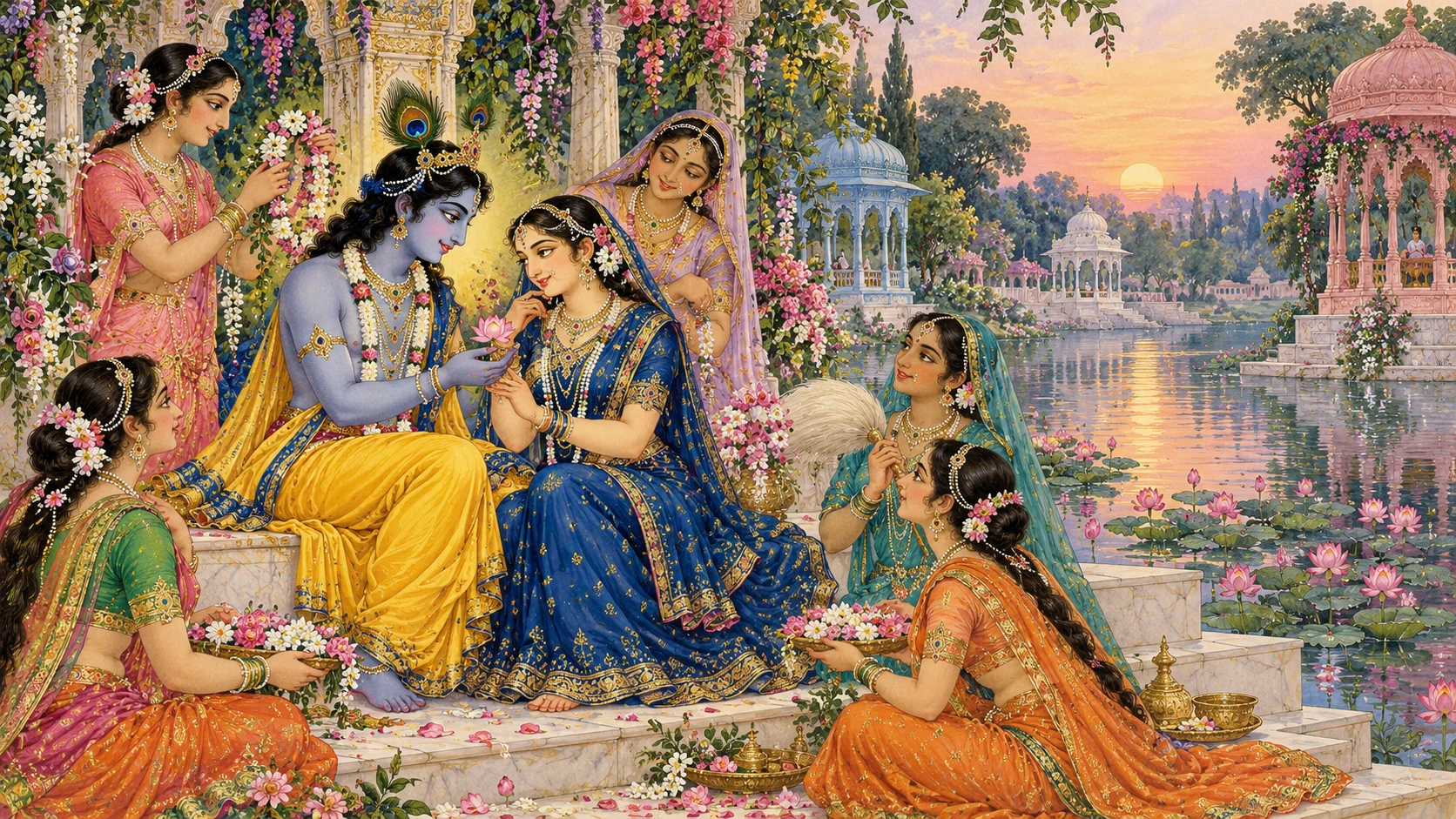
Near Govardhan lies Radha-kunda. Not far from it is Shyama-kunda. The poet describes both sacred lakes with love. He connects their names with Radha and Krishna. In his poetic image the water speaks of Their prema. The lakes are places of remembrance and devotion. Many beautiful gardens surround Radha-kunda. They belong to Radha's close friends. Flowers and vines adorn the banks. Each garden has its own special appearance.
Imagine Radha beside the quiet water. Krishna and Her sakhis are with Her. The water reflects light and greenery. Flower fragrance arrives from different directions. Birds and bees can be heard in the branches. The friends know the surrounding paths. For them each garden is a place of service. They connect its different corners through care. Radha and Krishna are the center of their devotion. And the lake gathers the beauty around it.
To the north the poem mentions Lalita's garden. It is associated with lotuses and shining ornaments. Vishakha's garden is described nearby as well. Flowers give it a beauty of its own. Each sakhi has a special service. But their gardens are not places of separation. They are arranged around the same beloved lake. The friends can share their different gifts. One prepares flowers, another cares for a path. These images of care are imagined in the retelling.
To the east lies Chitra's garden. Her name recalls a variety of colors. The poet describes it with many-colored flowers. Near it are other beautiful shelters too. Indulekha's garden is associated with gentle light. Each direction reveals a new shade of beauty. The different flowers do not compete with one another. In the poem they enrich the same landscape. Radha and Krishna are surrounded by the sakhis' attention. And Their friends rejoice in shared service.
Champakalata's garden has its own golden beauty. Its name recalls the champaka blossoms. On another side is Rangadevi's blue grove. It shines with the deep color of sapphire. Each image has its place around the lake. Golden and blue are different colors. Yet together they adorn Radha and Krishna's world. The friends need not all serve in the same way. Different gifts can serve one love. The poet shows this through the gardens themselves.
The gardens of Tungavidya and Sudevi are described too. Their colors and ornaments continue the circle. Many paths wind around the water. Some pass trees and flowering vines. Others open a view toward the bank. Each sakhi adds something of her own to the landscape. In the poem there is room for Ananga Manjari too. Her bower is connected with the water itself. Thus the whole lake becomes surrounded by service. The different gardens celebrate the same friendship.
The poet connects the lakes with Radha and Krishna's love. He speaks through comparisons and poetic images. He does not ask the reader to measure that love. He directs the heart toward its depth. Radha-kunda and Shyama-kunda are dear to devotees. Their names remind them of the divine couple. The flower bowers reveal the world of the sakhis. Bees and birds fill the poetic scene. Water and gardens are joined into one whole. Within it lives the remembrance of Radha and Krishna.
In this story an imagined walk connects the descriptions. The poem does not say all gathered at the same moment. Nor does it list every conversation between the friends. It describes the places and their spiritual meaning. Therefore the scene by the water is a literary elaboration. Its main places come from the source. Images of care help us understand the sakhis' contribution. They should not be read as literal verses. Thus the description becomes a story of shared devotion. And the link to the poem remains available to the reader.
We can imagine the gathering pausing beside the lake. Radha looks at Her friends with love. Krishna shares the beauty of the place with them. No single garden has to represent the whole landscape. Each adds its own fragrance, color, and form. The paths allow those gifts to meet. The water reflects them all without dividing them. The sakhis have different roles and one shared joy. The poetic image remains calm and bright. It invites us to remember it with attention.
This story is inspired by the third chapter. It presents Radha-kunda and Shyama-kunda. The poem connects them with Radha and Krishna's love. The gardens of the sakhis are described around Radha-kunda. Lalita, Vishakha, and the others have their own bowers. Their different colors form one beautiful circle. The imagined walk is not a literal translation. It joins the source descriptions into a literary scene. The lakes and gardens remain at the center. Friendship and service unite their beauties.