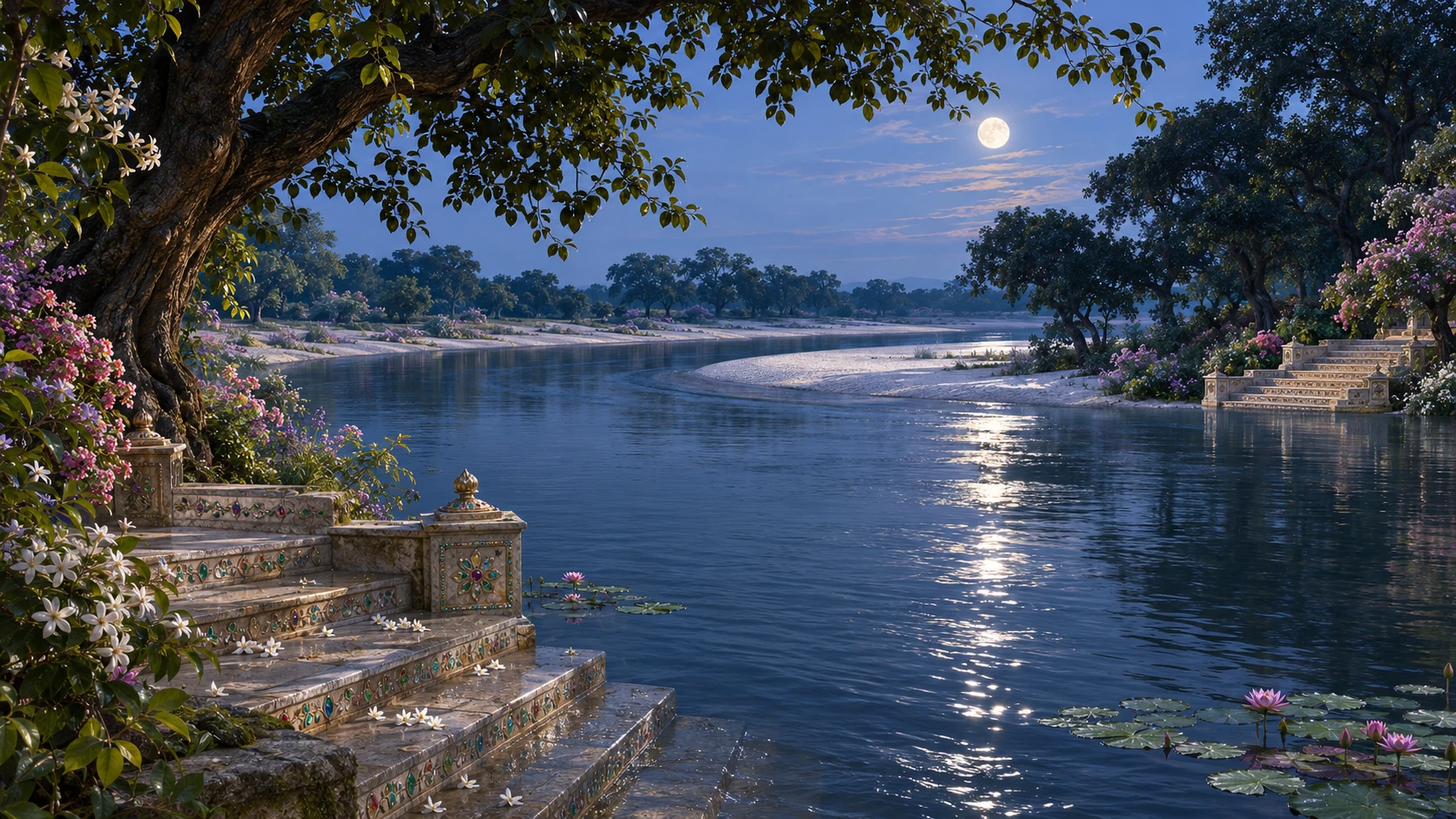
The Yamuna circles Vrindavan like a moat the color of black kohl. She purifies those who bow to her or bathe in her waters, and they carry Krishna in their hearts. In her flowing waters the poet sees a long garland of blue lotuses, a moving necklace of gems, and the dark blue garment of Vrindavan’s goddess. In the poem the Yamuna traverses the seven seas and seven worlds, pierces the seven coverings, and reaches Vaikuntha and Goloka. There she carries her waters through the forest in service to Vrindavan. Her water travels a great distance, yet it curves back around Vrindavan. The countless eddies show the river’s wish to linger, like a person hungry for wealth who waits at a rich man’s door.
The poet plays on the word for darkness. The Yamuna’s dark current kindles the sweetness of love for dark Shyama, immersing Him and the sakhis both in her own water and in that sweetness. The creatures of the river raise their heads again and again. Immersed in love for Shyama, they seem to await His arrival, hoping to see Him. Rows of precious stone steps descend from both beautiful banks. They are like the teeth of the goddess of beauty, with the power to bring Krishna to mind. As soon as they drink in the sound of His flute, river and steps seem to exchange their natures. The solid steps melt and the water flowing between them grows still and firm.
In the moonlight the sandbanks look dusted with camphor. Their names preserve memories of particular moments of the rasa dance. Groves gleam among the river’s sandbanks. Birds dart through their clearings, longing to catch sight of Govinda. The poet compares the manifestations around Vrindavan and the Yamuna to divine descents. The thought of them awakens love, and Krishna, the moon of Vraja, rises at once in the heart.