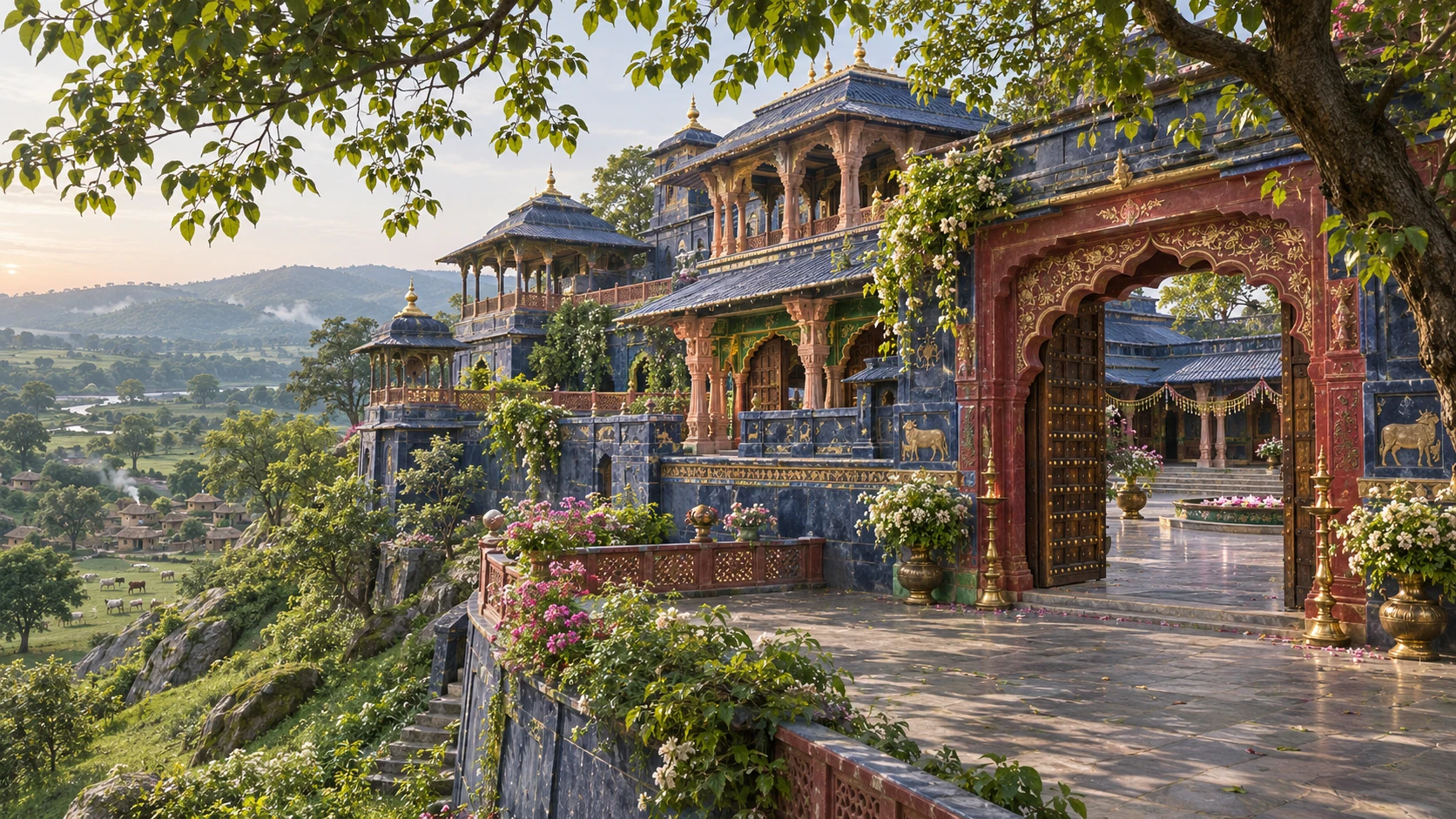
The devotees see Nandishvara as a luminous crown upon Vrindavan. The hill is a form of Shiva, resplendent as Nanda’s capital. People free from sorrow live on the eastern, northern and southern slopes. On the summit stands Nanda’s ancient city, remembered in the Puranas. A sapphire wall surrounds the dwellings. Houses shine emerald green, with coral pillars, roofs of gold and crystal windows. Within the palace shine deep-blue gems, roofs of vaidurya stone and great ruby gates. The courtyard lies at the center. The treasury is to the west, Balarama’s residence to the north and Krishna’s quarters to the south. On the eastern side stands the shrine where Nanda serves Narayana, praying for his son’s welfare. South of the treasury and west of Krishna’s home lies the kitchen where Radha cooks and rests. Farther south, beyond the house and kitchen, lies a secluded garden with a lovely lake, hidden cottages and courtyards.
Beautiful cowherd dwellings line both sides of the hill. Nandishvara rises behind them, and Shiva bows before it again and again. Each dwelling is protected by a jeweled wall, with gleaming thresholds and gateways festooned with strings of pearls. To mortals the homes resemble celestial palaces. To the celestials they suggest Vaikuntha, and to those who dwell there they embody the essence of bliss. At the gateways and around the residences stand the homes of doorkeepers, priests and the other attendants. Beyond them run rows of houses, market lanes and roads branching in several directions. At the city’s edges the streets cross and open into long, orderly lines of shops. The merchants display gemstone ornaments, banners, strings of pearls and flower garlands as full as blossoming trees. Some markets carry the rich scent of spring blossoms. Others seem like hills heaped with aromatic substances. Some stalls shine like mines full of gemstones. From others drift the scents of musk and kumkuma.
Vishvanatha introduces the next picture humbly. Beside the poets who have sung of Vrindavan’s joy, he pictures himself as an untutored player touching a few strings of a vina. In the residents’ speech, matsara can suggest ‘my lake,’ khala a woman’s girdle, and mala is heard in komala, a word for tenderness. The same play with words summons twilight, the moon, affectionate indignation, playful theft and night. Danda is the handle of a parasol or a chamara fan. Binding suggests a ribbon in the hair, and the word adhi leads the mind toward deep contemplation.