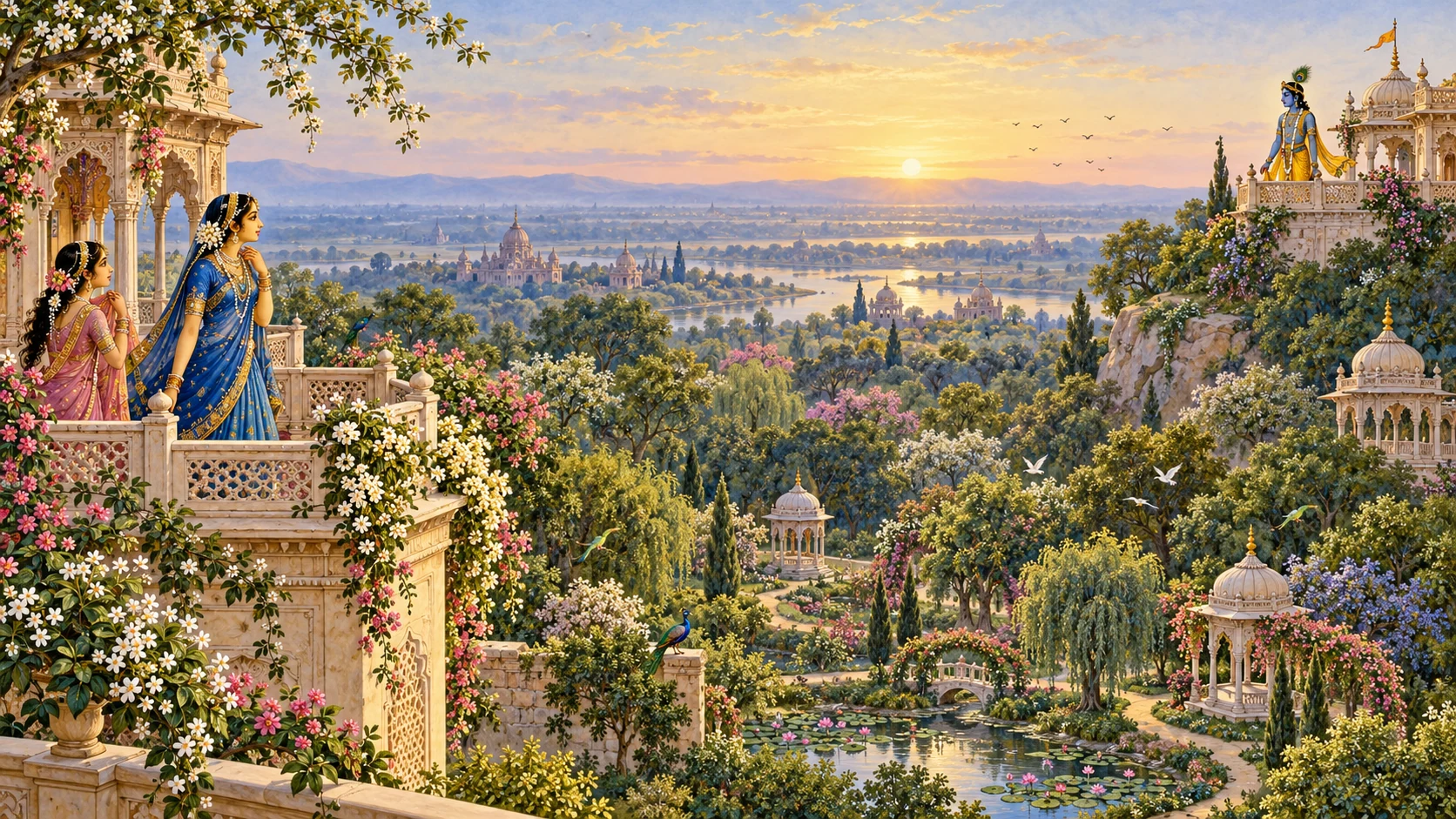
The poem describes the beauty of Vraja. Nandishvara Hill rises within it. There stands Nanda's home. It is also the home of His son Krishna. Another majestic hill belongs to Vrishabhanu. His home is connected with Radha. Between the two hills lies Sanketa. It is a place for Radha and Krishna's meetings. The poet reflects on it with devotion. He sees it as an image of Their love.
From one hill we can imagine the way to the other. The land of Vraja stretches between the homes. Branches and forest paths change the landscape. Sanketa lies among those beloved places. It is more than a point on an imagined map. For the poet it holds memories of Their meetings. The hills shelter the families' homes. The grove between them offers a quiet refuge. Radha and Krishna know these surroundings. Their friends know the paths as well.
The poem also mentions Yavata. It is the town of Radha's husband's family. The poet describes it as a beautiful place. There Radha sometimes climbed to the roof. From that height She looked in one special direction. She sought Krishna's home with Her eyes. Distance did not interrupt Her remembrance. She could see only part of the landscape. But She knew which home Her thoughts turned toward. Her glance became a quiet way to remain close.
Krishna also looked toward Yavata. He too climbed to the roof. From His home He sought the direction of Radha. Each of Them had family and responsibilities. The elders were part of Their daily life. So not every glance was meant for everyone. The poem describes Their carefulness. They looked separately, each from a different place. But Their thoughts moved toward one another. The two rooftops became places of anticipation.
Imagine morning over the two hills. Light slowly reveals rooftops and paths. Radha stands beside a trusted friend. Krishna gazes across the forest landscape. No one has to call aloud for remembrance to exist. A glance can be quiet and full of feeling. Between Them lies the place called Sanketa. There the friends know the forest shelters. The hills make the distance visible. And love gives that distance meaning.
The poet compares Sanketa to Their love itself. This is not an account of a meeting at an exact hour. It is a place associated with Their meetings. In the literary image paths run through greenery. Flowers and birds make the landscape alive. The friends' movement belongs to that world. But the poem does not describe every step they take. Its words leave room for reflection. Sanketa rests between the two dear homes. Thus the landscape becomes part of the story.
In Yavata Radha could remember Krishna. At Nandishvara He could remember Her. Each glance had its own quiet. There was no need to see every tiny detail. It was enough to know the beloved home's direction. The friends understood Radha's longing. Krishna's companions knew His affection. In the account of Vraja, homes are not lifeless buildings. They carry the lives of families and friends. And paths connect their stories.
Radha did not forget Her companions. Krishna too was surrounded by close people. Among all those relationships was room for a quiet thought. The poet need not tell us every word. A glance toward a distant home says enough. Nanda's hill and Vrishabhanu's hill are distinct. Yet Sanketa joins them in one poetic image. Home and forest have their own roles. Both separation and hope of meeting are present. That is why the place is dear to the poet.
Some visual details in this retelling are imagined. The source names the hills and the place Sanketa. It describes Yavata and the glances from rooftops. It does not prescribe an exact path for this imagined scene. So we read it as literary contemplation. The two directions of the glances remain faithful to the source. The friends belong to the world the work describes. Sanketa remains a symbol of meeting. The poem connects the land with Radha and Krishna's love. The story invites us to imagine that connection.
This story is inspired by the first chapter. Nandishvara is connected with Nanda and Krishna's home. The other hill is connected with Vrishabhanu and Radha. Sanketa lies between the two hills. The poem also mentions Yavata. Radha looks toward Krishna's home from the roof. Krishna looks in the direction of Yavata. This is a literary retelling, not a literal translation. Some details help bring the landscape to life. The source places are connected with remembrance and love.