Love for their beloved once gave the gopis the courage to set aside their embarrassment before others. As that love deepened, the poet marvels that modesty came to matter to them anew. The brahmanas of Vraja embody the pure way of devotion. Some teach the Vedas, and others devote themselves to the Pancharatra. They accept the gifts of the king of Vraja. Some are drawn to the majesty of his son, and others to His sweetness. Betel and oil sellers, makers of garlands and the other residents perform their daily services. They bear a love for the moon of Vraja that even celestial beings rarely attain.
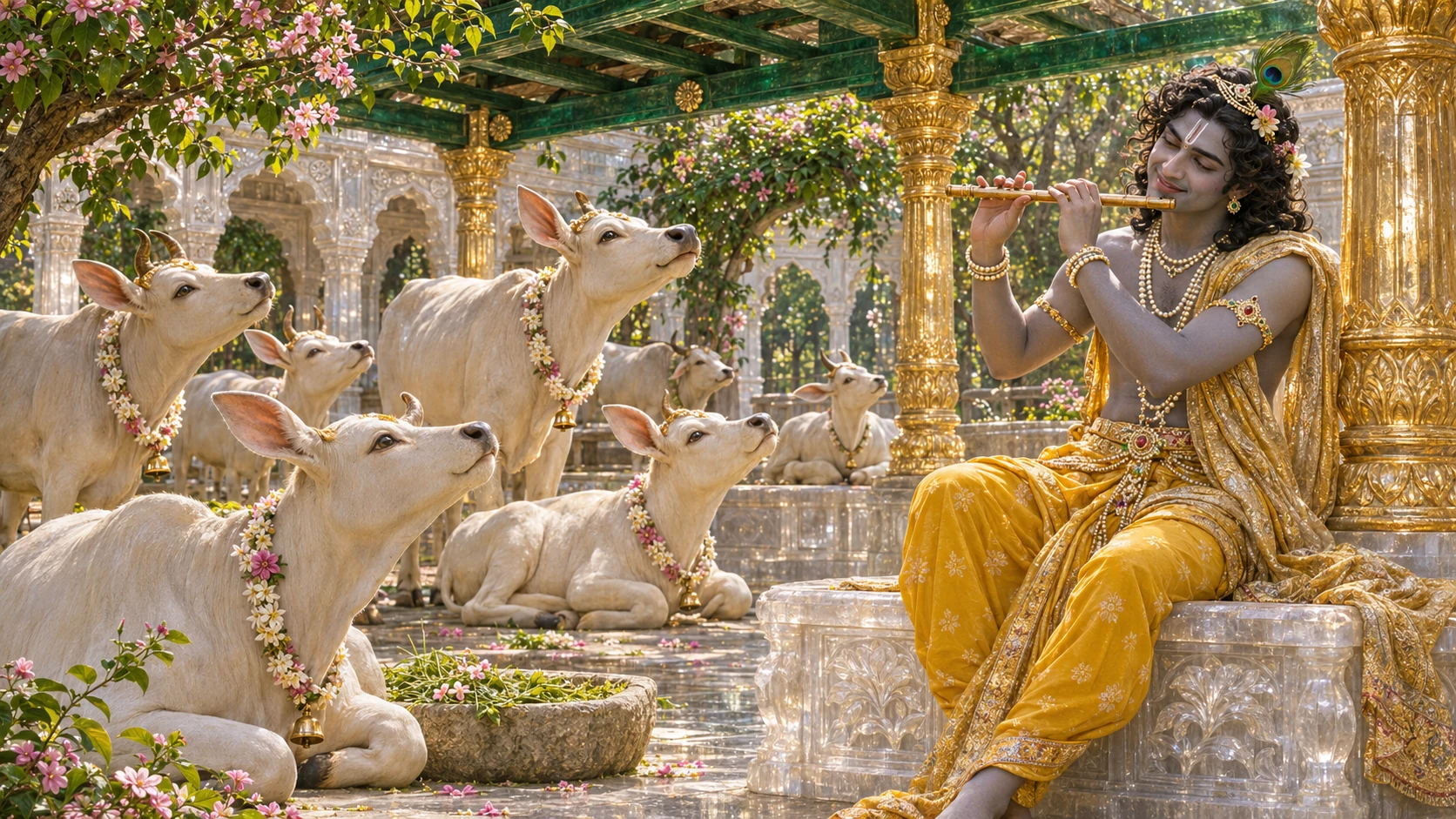
Even the cowsheds have crystal walls. Emerald beams glisten beneath their roofs, and great golden columns stand at their corners. Rubies glow red at the joins. Gemstones of many hues cover the roofs. Surabhi cows roam those courtyards, white as the form of Sarasvati. Grave and composed, they remind the poet of contemplative ascetics. They are like wish-fulfilling cintamani jewels, and their lively calves carry the joy of summer. Their lowing sounds like poetry, and their ears are always raised toward the flute.
Among them the calves gleam like living fragments of Kailasa’s summit, as though they were children of moonlight. As they wander, the poet likens them to foam upon the ocean of milk, to smiles of Shiva and to living shapes of pure goodness. The bulls resemble boulders from a crystal hill or great waves of the sea. They move at will by day like liberated souls, then rest at home in the evening like sages in contemplation. When they low proudly, the folds beneath their throats suit the gravity of old renunciants. Their reddish gaze is steady and absorbed.
In the chapter’s closing verse, after the description of Sanketa and Yavata, Vishvanatha ascribes the poem to the grace of Krishna, Chaitanya, Rupa and the spiritual teacher. He rounds off the first chapter with the vision of Nandishvara.