The poet admires the fresh line of sindur in Radha’s parting. As it divides her dark, curling hair, it looks like a stream of love’s nectar. In the verse, Shyama brings the dark hair and the beloved Krishna together in a single word. Madhupati’s gaze drinks in the light of her moonlike face as a chakora bird does. It lingers at her lotus feet like a bee, dances like a wagtail along the bank of her hips, swims like a fish in her lake of rasa and roams like a deer in her forest of joy. Madhava feels the coolness of her limbs under his soft palms again and again and sinks into a lake of nectarean joy. Lotus-eyed Radha, love itself given form, shines in his lap. He holds her close, lifts her chin and kisses her. The poet asks this Radha to watch over him.
The poet keeps singing Radha’s praises and returning to accounts of her love, which bring him fresh delight every time. He stays in her secluded forest and, his heart carried away in devotion, meditates on the nectar of her feet. Radha murmurs ‘Shyama, Shyama,’ syllables that pour nectar for her. At times her longing raises her voice and sends a thrill through her. Nowhere can she settle. She struggles to get through the day and in her distress grows impatient even with the sun. At one moment she sings of her beloved’s skill in love’s play. At another, she thinks of the meetings still to come. The day passes with him in her thoughts, even in her bewildered words, ‘Enough, let me go, let me go!’ The poet longs for that Radha to bring him joy.
He turns again to Govinda. Radha is the crown jewel of Vraja’s young women, and her lotus feet are dearer to him than millions of lives. Moment by moment, the poet asks Govinda to let Radha accept him into a service that offers an ever-fresh taste of love. He holds young Krishna in his heart, bright as a blue lotus, with a crown of peacock feathers and yellow cloth shining like molten gold. By holding that image in meditation, he hopes to please Radha and be admitted to the service of her that is so rarely attained. He continually meditates on the one crowned with a peacock feather, sings his name, serves his lotus feet and repeats his mantra. He carries in his heart a wish dearest of all, to serve Radha’s feet. When, by Krishna’s grace, will that love blossom into a celebration? In that service he would sing for Radha and Krishna about their forms and virtues. He would bring necklaces of gunja seeds and peacock-feather crowns, together with the betel nuts, garlands and fresh perfumes sent by the sakhi Shyama. He longs to plunge into the lake of rasa lit by the nails of their lotus feet. Where is Radha, beyond the reach of the Vedas, and where is Krishna, whose secret home is between the buds of her breasts? The poet feels small and unworthy on account of his deeds. When Radha’s name nonetheless comes alive on his lips, he recognizes the greatness of Vrindavan. He meditates on Radha in the forest of Vrindavan, playing with the most skilled lover. She is tender love given form, and the fragrance of her lotus feet is the height of sweetness. He wonders how, after this embodied life, he might receive a form in which he could become her attendant.
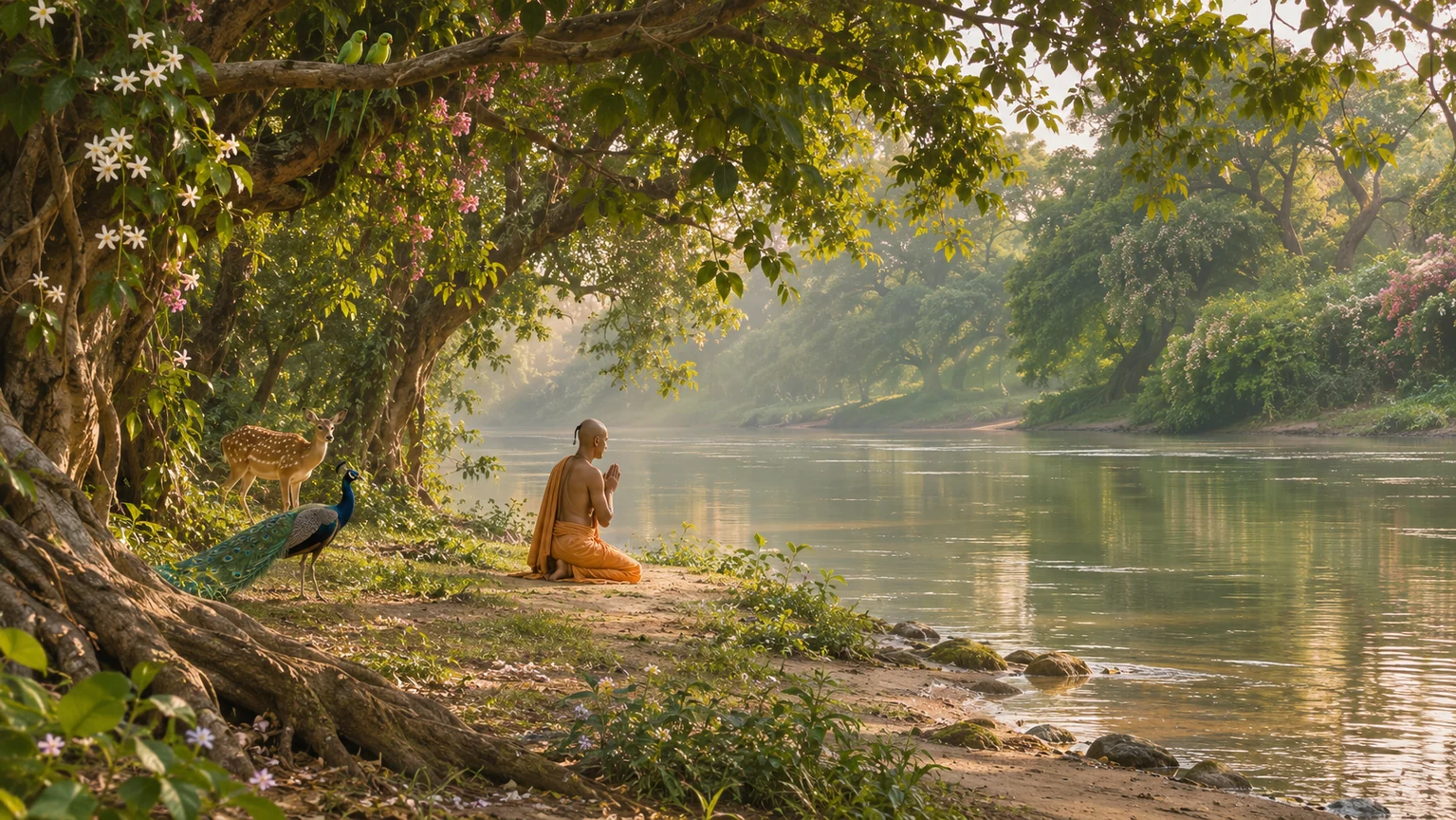
Now he speaks to the Kalindi, in whose waters his treasure, Radha, played with her beloved. He calls to the trees and creepers that received her touch, to the parrots that know her play, and to the deer and peacocks. He bows again and again and asks for their kindness. The river, bright as a blue lotus newly in bloom, carries the saffron pigment washed from Radha’s breasts during her play in the water. It carries the taste of an incomparable love. The poet asks the Kalindi to rekindle the light in his dulled heart. Among those who gather in Vrindavan are cruel and sinful people whose company holy people would ordinarily avoid. When the poet sees them here, even they appear to him as forms of deep joy. He holds them in honor as he would the greatest yogis. Vrindavan’s true splendor becomes visible to those who carry Radha’s service in their hearts. It is hard to enter, and only a touch of her grace reveals it in meditation. The poet prays for this precious essence of the ocean of love’s nectar to shine even in a heart like his.
When will he live in sacred Vrindavan, which witnesses Radha’s pastimes? The poet longs to be wholly overtaken by love. In the luminous grove he hopes to see clearly his own tender spiritual form, with eyes and senses suited to that service. Wherever his deeds lead him in another birth, whether to hell or the highest abode, he has one request. May the whole circle of groves where Radhika plays in love keep shining in his heart. The poet wonders how someone with his clouded understanding can utter the sacred name and give voice to the taste of highest joy. Yet words flow from his experience of Radha’s feet. He joins them to the tender groves of Vrindavan and to the rays from the nails of Vrishabhanu’s daughter as she plays there. The Vedas, the wise and the Lord himself seek Radha’s glory. The poet says he composed the hymn only through her kindness, though he feels unworthy and faults himself for straying from the right path. He turns to her as his only hope and prays that she will look on him kindly with eyes brimming with loving tears.
At the close, he invites the wise who long for wondrous joy to receive the hymn Radha-rasa-sudhanidhi. Let them fill the vessels of their ears with it and drink its nectar. The final verse gives glory to Gaura as an ocean. With the nectar of Radha’s rasa, he cooled the sky of the poet’s heart, which had been scorched by the sun of Mayavada.