The poet longs to live in Vrindavan and return in memory to Radha’s pastimes. ‘It was in this very grove that she showed a new art of love. Here Radha, the treasury of rasa, danced with her beloved.’ He wishes such a tide of remembrance would sweep him into wonder. Radha’s lips, red as bimba fruit, hold countless oceans of fresh sweetness. From the corners of her eyes fly keen arrows from love’s flower bow. The poet sees all the delight of rasa in her bosom, while from her lotus feet the nectar of love pours in streams without end. When Radha and Madhupati fall asleep on the bed in the bower, the attendant longs to massage their lotus feet with the gentlest touch. Might drowsiness overtake her too, there at the edge of the bed where the blissful pair lies? In a bower by the Kalindi, where fresh nectar of love wells up from Radha’s feet, the poet longs to forget all else. He would hold tender devotion in his heart and serve in his thoughts the Radha whose deep affection and artistry in love are revealed along Vrindavan’s lovely paths. The attendant imagines the anguish of even a blink in which Radha is left without her beloved in her lap or by her side in their play. She would sink into a sea of grief and faint. What would grieve her most is that she could not give Radha comfort.
The attendant addresses lotus-eyed Radha. Why keep turning Krishna away with words when the trickster keeps following her? Let him glimpse just the curve of her bosom, the attendant jokes, and his tender mind would rush out through his eyes and come undone at the sight. The poet asks what holy books and paths trodden by the wise can offer him if they hold none of the nectar of Radha’s glory or feelings. Even the splendor of Vaikuntha would be empty for him without her, love in living form. He prays that his sweet hope for Vrindavan stay with him through millions of births. Radha pauses to murmur ‘Shyama, Shyama,’ then speaks his name again in a still sweeter voice. Tears as large as pearls roll from her eyes and a thrill of joy raises the fine hairs on her skin. The poet asks the protection of this Radha, wondrous at every step. The son of Vraja’s ruler falls at the attendant’s feet with a blade of grass between his teeth. He begs her to help him meet Radha, then keeps following her with the same appeal. She wonders when she will be able to bring his distress before Radha.
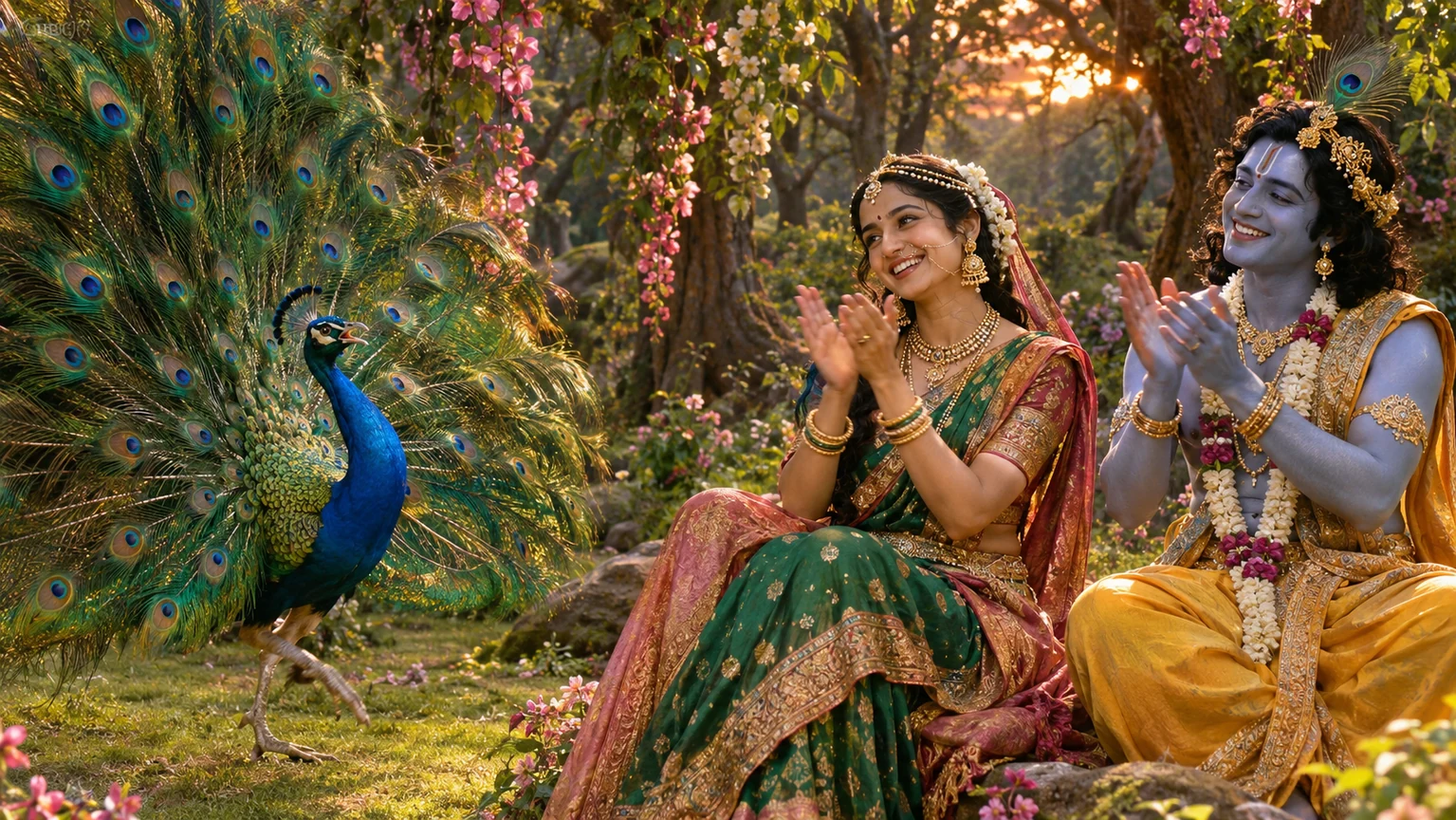
In Vrindavan the two copy the lively gait of a pair of swans, then imitate a peacock dancing before a peahen. Elsewhere they embrace like a vine around a splendid tree. That is how the artful pair turns a walk through the forest into play. A cool, fragrant wind comes from the Kalindi to refresh them. Their brilliance outshines blue and golden lotuses in full bloom. The poet sees them as two lights from which love springs. In their play the joy is deep and the sweetness ever fresh. Radha and Krishna teach the sweet-voiced parrots verses dear to them. Elsewhere they clap to set a peacock dancing. Farther through Vrindavan, their embrace is like a golden vine twined around a tamala tree.
Before a new meeting, Radha is restless. Her attendant longs to draw leaf patterns on her cheeks, trace her eyes with kajal, tint her lips and anoint her bosom with saffron. As she paints Radha’s toes with red lac, she would feel the fulfillment for which she has been waiting. The attendant wonders when she might tease Radha’s beloved. ‘Son of the cowherd king, it took effort to hold a single hill, Govardhana, in your hand. Yet the sight of Radha’s two golden hills would frighten you. Why boast so much?’ The bower’s courtyard fills with the ringing of their waist bells, like drums announcing love’s victory. Their play grows into what the poet calls a battle of love, with touches, scratches and bites. In Vrishabhanu’s home, Radha plays among the sakhis like the crown of their circle. When the young pair catch sight of each other, her eyes seem to learn the art of a bashful dance. Startled, she covers the bosom the poet likens to jewels. Her radiance comes to match that of her beloved, who enchants the world. Krishna marvels at the two orbs of light at her bosom, already enough to unsettle his heart. He wonders what will happen when she sets the arrows of her glances to the bow of her brows. He cannot tell what those arrows will do if they strike him.
‘Shridama, Subala, Vrishabha, Stoka-Krishna, Arjuna, did you see what I saw?’ Krishna tells his friends how even outside the bower a radiant goddess looked at him with startled eyes. Her beauty, a flood that could cover every world, had stolen everything from their friend without even coming near him. The cows are far away, the day has reached its last quarter and Krishna’s mother keeps watch over the road. His friends cannot go on. Suddenly they see him roll silently on the ground, his face downcast and his eyes full of tears. They wonder how they themselves can bear to live seeing him like this. The attendant calls on Radha to draw the jewel of Vraja toward her. A new pearl glints with gold on her nose, and her movements come in waves of loving play. Let the beauty beneath her patterned bodice, lit by its gleaming gems, draw him too.