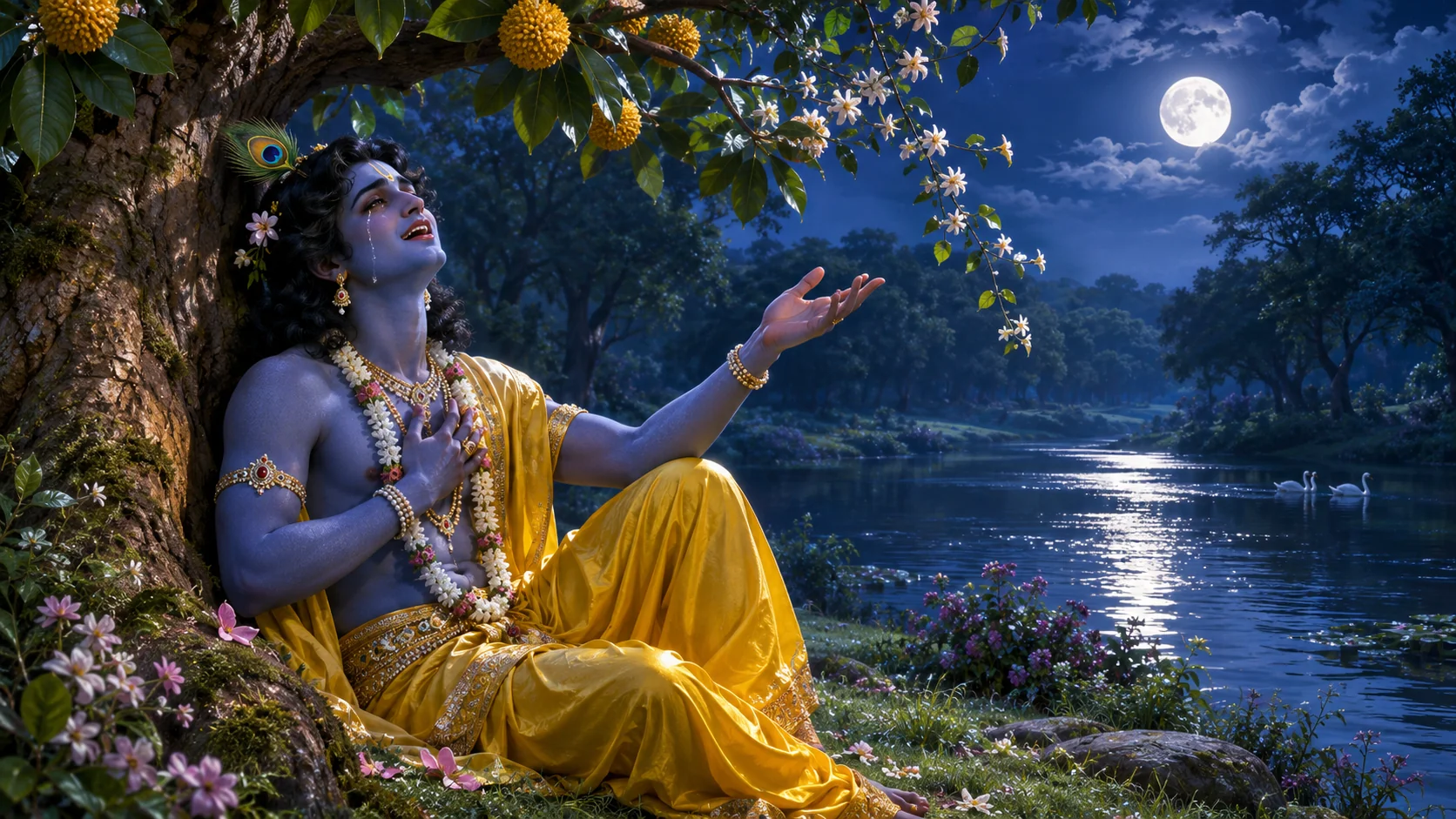
Radha went quickly home. After her departure, Govinda entered the forest of Vrindavana, which the poet calls the dwelling place of joy. Even the rising moon could bring Him no joy. Neither its coolness nor the fragrant wind from Malaya eased His pain. The breeze from the Kalindi and the lotuses by the river brought Him no relief either. Even when He moistened His yellow garment and laid it against His body, longing for Radha still burned within Him.
In the distance He saw a vine swaying in the breeze, surrounded by the humming of bees. Thinking that Radha was calling Him, He ran toward it in such delight that His yellow garment slipped loose. The soft call of the swans on the Kalindi drew His eyes again, as though it announced Radha. As He went through Vrindavana, He was deceived again and again into thinking she was near.
In the clusters of blossoms He imagined the contours of Radha, and in the moon He recognized her face. In the eyes of the does He saw her eyes, and in the spread feathers of the peacocks He saw her hair. The lotus stalks reminded Him of her arms. As He wandered through the forest, every small likeness brought some feature of her beauty to mind. Amid the cuckoos’ songs and the humming of bees, His thoughts sank into the memory of her embrace and the sweetness of her lips. He stopped beneath a kadamba tree. With tears in His eyes and His voice breaking, He began to sing.
The song in Shri raga opens with His wish to see Radha’s face, bright as the moon. As soon as she notices Him, she covers her face with the edge of her garment and turns her gaze aside. She talks freely with others and gives Him scarcely a word. When He approaches, she draws away and His appeals go unheard. If she has come to the forest for flowers, He wonders, why does she refuse even to touch the blossom He offers? And in that very reserve He finds a sweetness He cannot explain. Her shyness keeps her from lifting even her smiling face. How, then, can He find the closeness for which He longs?
He likened Cupid to a merciless hunter whose arrow had wounded His heart. With Vrishabhanu’s daughter still unmoved, He wondered what to do and where to go. He had tried to win her over with a jeweled ring and His gleaming flute. She took no interest in either. At last He addressed His very life, wondering how it could take a moment’s pleasure while deprived of Radha’s company. The poet asks his listeners to sing this song of Hari in separation.
For Krishna, Radha was before Him and behind Him, here and there. He felt her within His heart and saw her above, below, and among the trees. The whole world appeared to Him filled with Radha. He wondered when she would arrive unexpectedly and see His distress. He hoped she would comfort Him with gentle words and take Him by the hand. He longed to lift the doe-eyed daughter of Vrishabhanu onto His lap.
Can a body live without breath, He asked, or a fish without water? How could the moon shine without night, and who could live without food? In this way Krishna expressed the feeling that He could not live without Radha. In closing, the poet recalls that great yogis seek the dust of Krishna’s feet, while Krishna Himself seeks Radha. Her restless glance captivates the One who captivates the whole world. Though filled with bliss, He counts Himself fortunate to taste even a drop of her love. The chapter closes by asking the blessing of Radha, whose radiance the poet compares to a blooming champaka.