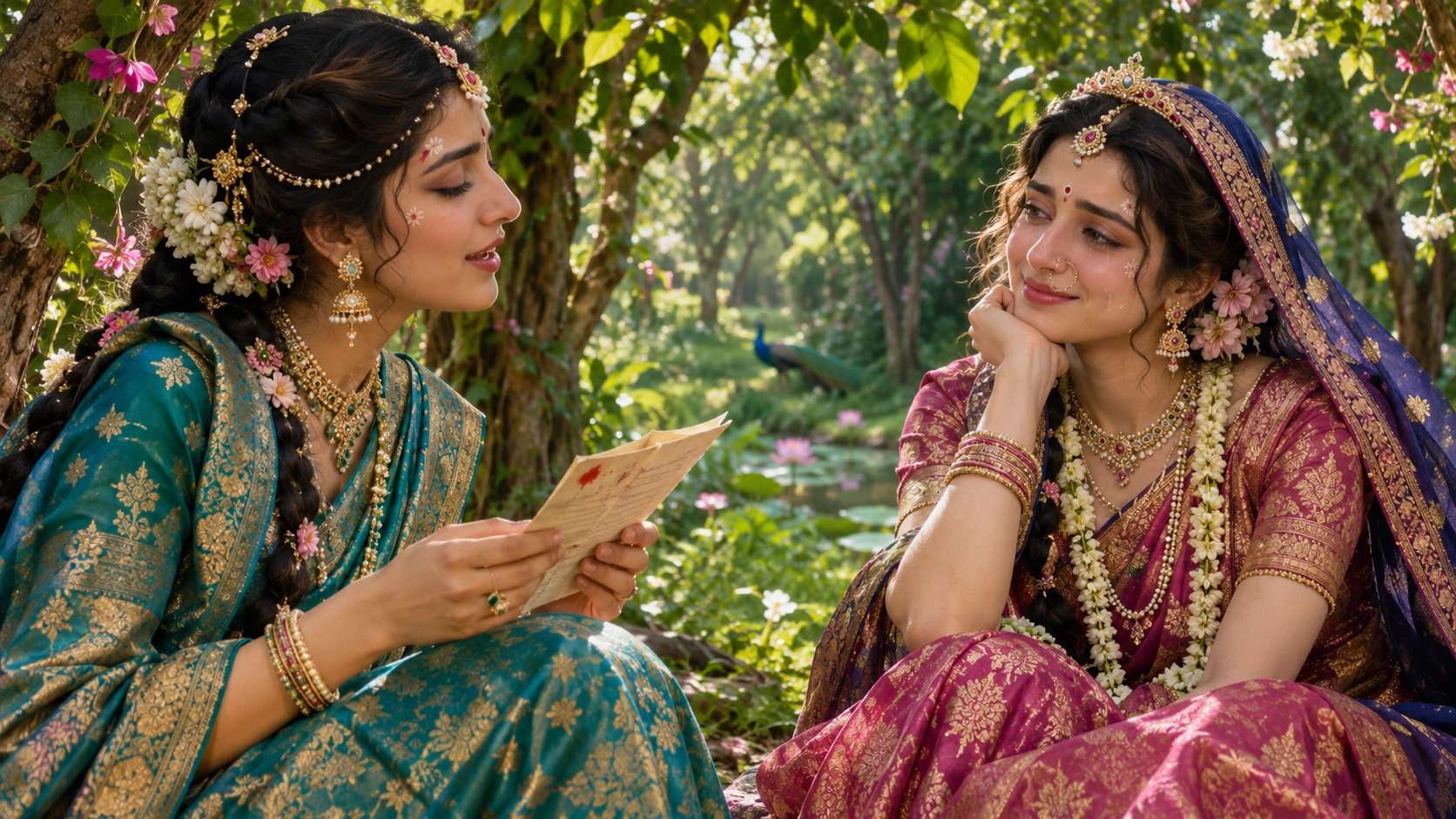
Tungavidya understood how deeply longing troubled Radha. She asked her friend to set aside her wounded pride and listen closely. The names she was about to share, she explained, had long ago been taught to Kandarpa-sundari. She too had been restless with longing, wishing for Radha’s friendship. Vrinda, who could read the smallest signs of the heart, wrote those names in red vermilion. She gave the writing to Krishna, Radha’s dearest friend. When separation from Radha caused Him pain, Krishna would recite her names. That, Tungavidya told her, was how He found peace.
Tungavidya called Radha the sovereign of Krishna’s forest and the blossom of the madhavi vine in Mukunda’s spring. She is foremost among Govinda’s beloveds and the queen of Vrindavan. Radhika’s fame crowns the worlds. She presides over the month of Karttika, is dear to Damodara, and is the daughter of Vrishabhanu. She knows how to worship the Sun with devotion. She is as dear as life to her grandmother Mukhara and brings renown to her mother Kirtida. An ocean of love for Krishna springs from Radha. She shows tenderness to His mother. She is the life of the sakhis, dearer to Lalita than her own life. She is everything to Vishakha and is brimming with the nectar of compassion. She receives Purnamasi’s deep affection and brings joy to Subala. As Krishna’s queen, Radha enjoys His pastimes in the forests of Vrindavan. Her friendship with Vishakha is renowned, and Lalita showers her with affection.
Radha is ever youthful and plays with the prince of Vraja. To teach love for Govinda, she appears in the form of a dancer. The poem recalls Chandrakanti and the beauty of the dance on Prabodhini night. In that form Radha purifies the line of the gandharvas. Her birth adorned the lineage of Vrishabhanu. She has mastered the art of graceful dance, and the rasa pastime springs from her. She is foremost at the rasa dance. Krishna leads her to a secluded place, ties up her hair, and adorns it with flowers. Radha delights in the excellence of the lotus-eyed girls of Vraja. She satisfied the sage Durvasa with food. The Vedas celebrate her by the name Gandharva. As Gandharvika, she astonishes Balarama and Achyuta with her artistry. She is dear to the vanquisher of Shankhachuda and is like a garland crowning the gopis.
Her complexion has the glow of gorochana, and her garment gleams like a blue jewel. The poem also celebrates the adornments of her braided hair. Her face outshines the lotus and the moon and captivates Krishna. Her eyes astonish the chakora birds and captivate Hari. Her curving brows are likened to a serpent that makes even the subduer of Kaliya tremble. A pearl hangs from the tip of her nose. Her lips draw Madhusudana as a bandhuka blossom draws a bee. Her teeth outshine white mountain peaks. She is dear to the lifter of Govardhan. Jeweled earrings sway beside her cheeks. The poem likens Krishna in yellow silk to a parrot drawn to round pomegranates. Jeweled bells ring at her waist. The radiance of her feet surpasses that of lotuses that grow on land.
One name preserves the pastime in which Radha made her pond after the teasing that followed the defeat of Arishta. Her fragrance intoxicates Govinda, and she is paired with Madhava. She is the beauty of the bowers along the Yamuna and the adornment of the bank at Bhandira. The poem associates her with Nandishvara and the caves of Govardhan, which are dear to her. Krishna’s flute is like a hook that catches the fish of her mind. At its sound her girdle loosens, and Radha starts and reaches to hold it in place. To Mukunda’s gaze Radha is like a pool of nectar to a playful fish. In the secluded bower by her own pond she is carried away by the joy of love. When Krishna raises the bow of His brow, the bird of her composure flies away. She in turn rocks Achyuta in the nectar ocean of her affection. The moon of Krishna’s face lifts the tide of her longing. The names also recall the playful encounter in which He pulled at her garment. When Keshava’s teasing grew bold, Radha struck Him with the lotus in her hand. The poet likens her to a golden-yellow streak against the dark radiance of Hari’s chest. Madhava’s chest is her couch and Krishna’s arm her pillow. Radha grows shy when her friends smile at having guessed what happened in their private pastime.
When Radha speaks before the sakhis of their private pastimes, she praises Hari. She expertly weaves vaijayanti garlands and garlands of woodland flowers. She paints with mineral colors so skillfully that the poem compares her to Brahma. She is a teacher in the art of wit and shows her skill with graceful touches. Her good fortune rises like waves of nectar. Radha is charming in shyness and in boldness, in composure and when feeling carries her away. For the secret meeting she wraps herself in dark cloth and silences her anklets. She prepares the bower and watches the path by which Madhava is to arrive. Her longing deepens and separation leaves her sorrowful. At daybreak she addresses Krishna with sharp wit and glances sideways at Chandravali. Proud in her hurt, Radha turns a deaf ear to Hari’s pleas. After sending Him away, she is overcome with regret. She longs to see Him again. Out of apprehension of Lalita she holds on to her wounded pride, and when a message arrives from Hari, the pain of separation eases.
A few words from Radha win over lotus-eyed Krishna, who adorns her. A movement of her brows distracts Him, and she takes the flute from His hand. The poem celebrates her unique fortune in tasting the sweetness of Achyuta. When Hari falls asleep after their playful wrestling, she takes His necklace. Having beaten Krishna at dice, Radha claims the flute and teases Him. Even the tips of the nails on Krishna’s feet are dearer to her than countless lives. At Tungavidya’s words Radha trembled with feeling. Then she went secretly toward Krishna’s bower among the creepers. Rupa Gosvami closes the poem with the wish that whoever honors her one hundred and eight names with devotion may taste the nectar of love.