After the director told of his dream, his assistant came in and reported that the performers had taken their parts in his new play, “Vidagdha-madhava.” They asked his permission to enter the stage. The director asked whether the appearances and costumes called for by their parts were ready. He thought for a moment and agreed to begin. “My verses may have little grace, yet discerning people will rejoice when they catch the fragrance of Hari in them.” “Even ordinary well water gains dignity after it has bathed the sacred shalagrama stone. What wise person would fail to drink it with bowed head?”
The assistant suggested addressing the assembly in praise of skill on the stage. “These people are so learned they could call even the gods to account. Surely they would find fault with us performers.” The director wanted no empty formalities. “These good people gladly do what pleases others without reckoning how tired it makes them.” “When praised, they grow as bashful as if they had done something wrong. The more their learning, wealth or standing in their families, the humbler they become. How lovely this natural virtue of theirs is.”
The director looked around him with joy and called out to those who held the lion of the cowherds dear. He called them teachers among those versed in devotion to the Lord. He begged them to forgive a dancer for venturing to speak before them and bowed. “From me, a person of little standing, has come this work full of Hari’s qualities. It can help you attain your purpose.” “When a man of the Pulinda people makes fire by rubbing wood, that very fire takes the impurities from gold.” In the director’s words about his own small standing, the edition’s commentary also hears the playwright’s name, Rupa.
“Let me call to mind the Lord I worship. Now let the sweetness of the dance come forth.” The director folded his hands. He prayed that the Lord whose form is eternal might give him joy. The Lord reveals His sweetness to those who take refuge in Him. He dwells in the pavilions of Vrindavan’s wooded bowers, His mercy knows no bounds, and His heart delights in Vraja’s pastimes. The expression for the eternal form can also be heard as a reference to Sanatana Gosvami, as the commentary observes.
“Look, teacher,” said the assistant. “Devotees with open understanding and a natural radiance have gathered. The work about the beloved of the gopis has flowered in the descriptions of His ways.” “The depths of Vrindavan forest have become a place for dancing. It seems that the good deeds of people such as myself are ripening now.” He urged them to hurry and serve the sweetness of the pastimes. The director admitted that he hesitated for fear that people with no taste for them would turn away. “Let those unfamiliar with rasa remain indifferent,” the assistant encouraged him. “People who will rejoice in your work are here. Camels pass the mango tree by, but cuckoos find delight in it.” “Let the sacred art of the Gandharvas begin, to fill the spectators’ hearts with wonder.”
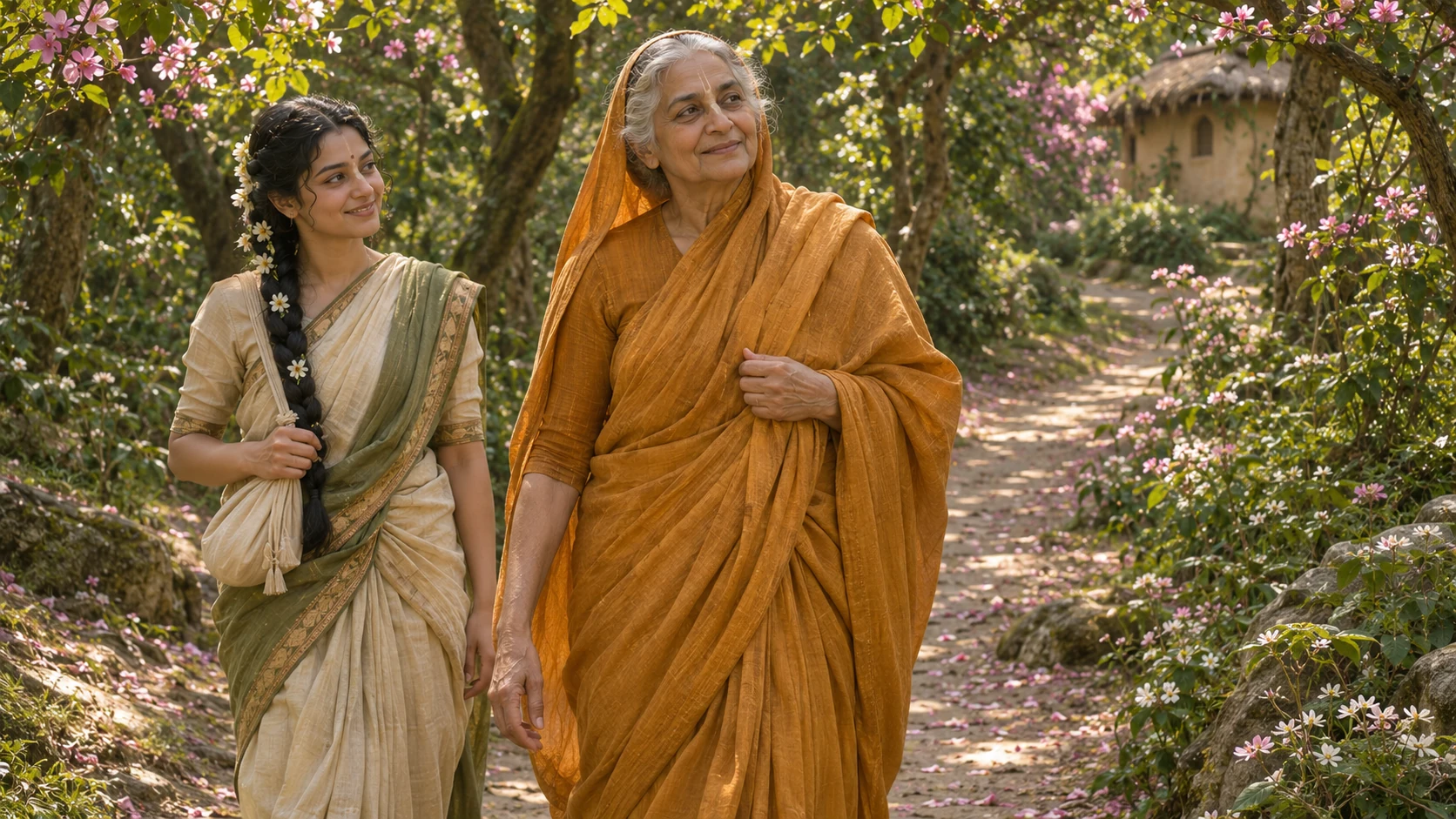
“Look, spring has arrived,” the director said. He foretold that at night Paurnamasi, keeping her purpose a secret, would bring radiant Radha to Krishna, in whom fresh love had awakened. The verse opens a second picture in the sky. Paurnamasi’s name means the full moon, and in the play on words Radha can also name the constellation Vishakha. The word for newly awakened love also suggests the full moon taking on color. Then Paurnamasi spoke from behind the stage. “Master of the dancers, how did this carefully hidden flower of the plot become an ornament for your ear? I will bring Radha and Krishna together.” The director looked that way in surprise. “Is the revered Paurnamasi coming from here? Look!” She was dressed in saffron, her hair was white and she shone like Savitri. She was the sage Sandipani’s mother and Narada’s pupil. With her attendants she came slowly from Nanda’s home along the path to the forest hermitage. “Let us see to the parts and costumes for what follows,” the director said. The two exited, and the prologue ended.